 Bellingham Exterior
 A Standard We Don't Bend On
Homeowners sometimes ask why we don't offer a menu of siding brands the way some contractors do. The honest answer is that we looked at what actually holds up on homes in Whatcom County — through the wet winters, the salt-laden air off Bellingham Bay, and the long stretch of gray months where moss and mildew have every advantage — and one product kept outperforming the rest by a wide margin. That product is James Hardie fiber cement siding. We don't install LP SmartSide, vinyl, Cemplank, Allura, primed spruce, or cedar, and this page explains the reasoning rather than just asserting it.
This isn't a brand loyalty pitch. It's a decision built around what a house in this specific climate needs to survive decades of exposure without becoming a maintenance project every few years.
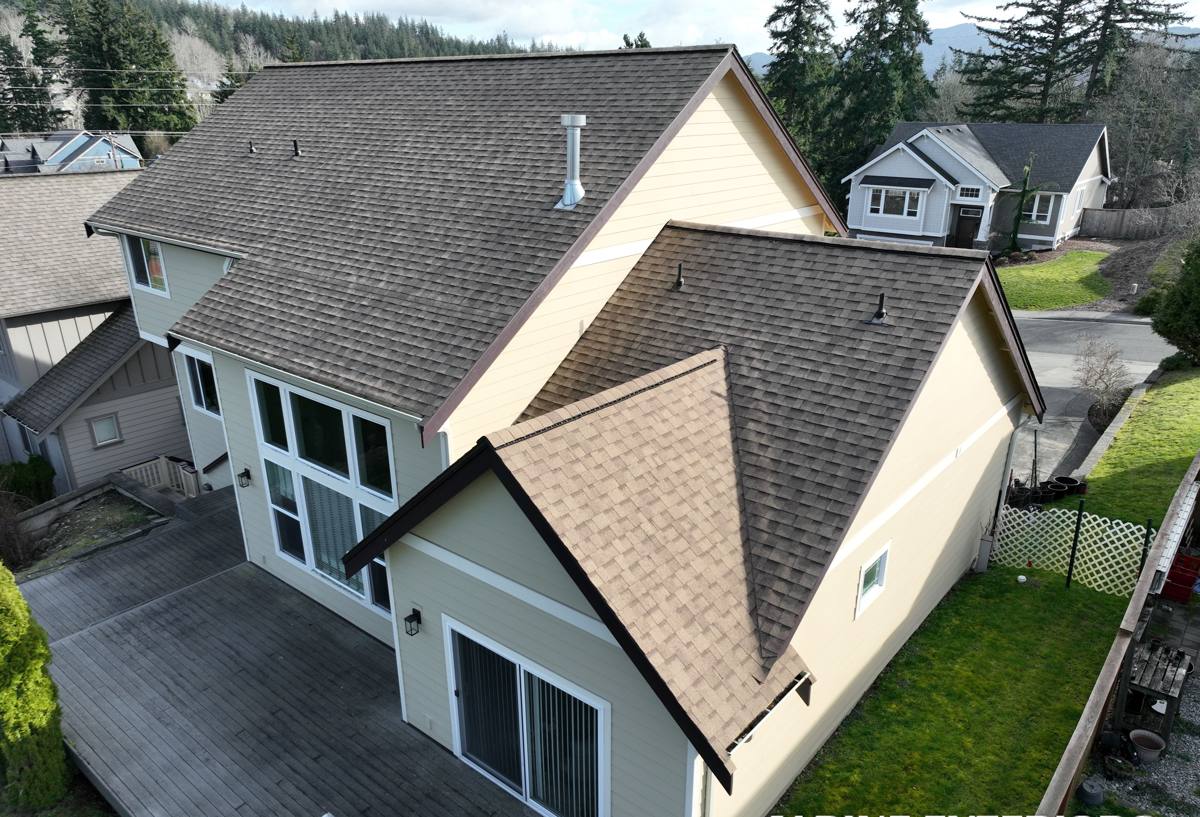
What Bellingham's Climate Actually Does to Siding
Whatcom County sits in a spot where several tough conditions overlap instead of taking turns. Understanding these is the whole reason our product standard exists.
Salt Air
Homes near Bellingham Bay, Chuckanut Drive, and the waterfront neighborhoods deal with airborne salt that accelerates corrosion on fasteners, staples paint faster than it should, and works its way into any seam or crack in a siding system. Materials that aren't dimensionally stable or that rely on surface coatings alone tend to show wear here sooner than in inland climates.
Driving Rain
Bellingham doesn't just get rain — it gets wind-driven rain that hits siding at an angle, forcing water into laps, seams, and fastener penetrations that would stay dry in a calmer climate. Any siding product with a weak point in its water-shedding design gets tested constantly here, not occasionally.
Moss and Mildew Season
Long, mild, damp winters mean months where siding rarely gets a chance to fully dry out. Moss, algae, and mildew take hold on shaded north- and west-facing walls, under eaves, and anywhere airflow is limited. Products that absorb moisture or that have organic components in their makeup are far more vulnerable to this than inorganic materials.
Put those three together and you get a climate that punishes shortcuts. That's the lens we use for every product decision, not just siding.
Why We Standardized on One Manufacturer
Running a crew that installs a single product line, to one manufacturer's spec, produces better outcomes than running a crew that has to switch installation methods, flashing details, and warranty paperwork from job to job. Our installers know Hardie's fastening patterns, clearances, and joint treatments cold because it's all they do. That familiarity matters more than people expect — most siding failures we get called to inspect trace back to installation error, not the product itself.
James Hardie fiber cement is engineered specifically for regional climate demands, which is directly relevant here:
- HZ5 and HZ10 product lines are formulated for climates with significant moisture exposure and freeze-thaw cycling, which describes Whatcom County for a good part of the year.
- Non-combustible core — fiber cement doesn't burn, which matters as wildfire smoke and dry-season risk has become a bigger regional concern even in the traditionally wet Pacific Northwest.
- ColorPlus factory finish is baked on in a controlled environment rather than field-applied, which produces more even coverage and better long-term color retention than paint applied on-site in Bellingham's damp, hard-to-schedule weather windows.
- Dimensional stability — fiber cement doesn't expand and contract with moisture and temperature the way some other materials do, which keeps seams tighter over time.
How Hardie Compares to What We Don't Install
We're not going to tell you those other products are junk — they're not, and each has a legitimate place in the market. But when we weighed them against what a Bellingham home needs to survive without heavy maintenance, they came up short in specific, explainable ways.
| Material | What It Gets Right | Why We Don't Install It Here |
|---|---|---|
| Vinyl | Low upfront cost, no painting | Can warp or crack in temperature swings; seams are a common water entry point; doesn't hold up well against Bellingham's wind-driven rain over decades |
| LP SmartSide | Engineered wood strength, easier to work with than solid wood | Wood-based core is more vulnerable to moisture intrusion at cut edges and fastener points than fiber cement — a real risk in a climate this wet |
| Cemplank / Allura | Also fiber cement, similar core material | We standardized on one manufacturer for installation consistency and warranty simplicity; not a knock on the product itself |
| Primed Spruce / Cedar | Natural look, traditional appeal | Organic material in a climate with a long moss season means ongoing repainting, sealing, and rot vulnerability at joints and end cuts |
Every one of those trade-offs gets magnified by the specific conditions here — the salt, the driving rain, the months of damp shade. In a drier or less coastal climate, the calculus might land differently.
What Correct Installation Actually Involves
Buying the right product doesn't guarantee the right result. Fiber cement siding is installation-sensitive, and most of the failures homeowners associate with "bad siding" are really installation failures. A few things we hold to on every job:
- Proper clearance between siding and grade, decks, roof lines, and other horizontal surfaces to prevent wicking
- Correct fastener type, spacing, and depth per Hardie's published installation guide — over-driven or under-driven fasteners are a common source of cracking
- Weather-resistant barrier and flashing details installed before siding goes up, not patched around it afterward
- Properly caulked and sealed butt joints, or joints treated per manufacturer spec to avoid water entry
- Field-cut edges primed or sealed before installation, since factory finish doesn't extend to a cut made on-site
Skipping any of these doesn't usually show up as a problem in year one. It shows up in year five or ten, as staining, soft spots, or paint failure at specific joints — which is exactly why we treat installation discipline as part of the product decision, not a separate topic.
Where Homeowners Get Burned
The most common issue we see on inspections isn't a bad product choice — it's a rushed installation of a good product. Fiber cement installed without correct clearances or with the wrong fasteners can develop problems that look like a material defect but are actually a workmanship issue. That's part of why the manufacturer's transferable warranty structure matters: it protects you against material defects, but proper installation is what protects you against everything else.
The Warranty Picture
James Hardie backs its siding products with a non-prorated limited warranty, and ColorPlus finishes carry their own finish warranty separate from the product warranty. Warranties are transferable to a new owner if the home sells within the coverage window, which is worth mentioning to anyone thinking about resale value. We always recommend reading the actual warranty document rather than relying on marketing summaries, since coverage terms and what voids them (like improper installation) are spelled out in detail there.
Color and Style Options
One misconception is that standardizing on one manufacturer limits design choice. In practice, Hardie's lineup covers most of what homeowners in this area ask for:
- Lap siding in various exposures for a traditional Pacific Northwest look
- Board and batten for a more modern or farmhouse aesthetic
- Shingle-style panels for accent areas or full coastal-cottage exteriors
- Trim boards that match or contrast the field siding
- A factory color palette wide enough to match most neighborhood and HOA expectations without a field-applied paint job
We can walk through samples and talk through what tends to look right on Bellingham's older craftsman-style homes versus newer builds — the material doesn't limit the design nearly as much as people assume going in.
Is This the Right Call for Every Home?
We'll be straightforward: fiber cement costs more upfront than vinyl, and it's heavier and more labor-intensive to install correctly than most alternatives. If your only priority is the lowest possible material cost and you're not planning to stay in the home long-term, that's a real trade-off worth discussing honestly. What we won't do is install a product on your home that we don't believe will hold up to a Bellingham winter over the long run, even if it's cheaper today. That standard is why we turned down offering multiple product lines in the first place.
Let's Talk About Your Home
If you're weighing a siding replacement or a repair and want a straight answer about what your home actually needs, we're happy to walk the exterior with you, point out specific problem areas, and explain exactly why we'd recommend what we recommend. Reach out for a free, no-pressure estimate — there's a form right below this page.