 Bellingham Exterior
 Why Ferndale Homes Wear Differently Than Homes Inland
Ferndale sits close enough to the Strait of Georgia and the Nooksack River delta that homes here deal with a specific combination of exterior stressors: salt-tinged air blowing in off the water, long stretches of driving rain pushed sideways by wind, and a moss season that can run most of the year in shaded, north-facing spots. None of these things alone is unusual for Whatcom County. Together, on a home that's exposed to wind off the water or tucked under conifers, they add up faster than most homeowners expect.
Salt air is corrosive to metal fasteners, flashing, and gutter systems, and it accelerates the breakdown of lower-grade paints and coatings. Driving rain doesn't just wet a wall surface — it gets forced up under laps, around trim, and into any gap in the water-resistive barrier if the siding wasn't installed with the right clearances and flashing details. And moss doesn't just look bad on a roof or a north-facing wall; it holds moisture against the surface underneath it, which is exactly the condition that rots wood trim, delaminates weak siding products, and shortens the life of asphalt shingles.
We work throughout Bellingham and Whatcom County, and Ferndale's exterior problems generally track with how exposed the lot is and how much shade and moisture the north and west sides of the house hold onto through the year. A home a half-mile off the water with open western exposure ages differently than one tucked into a stand of trees a few miles inland — but both need an exterior system built for damp, not just for rain.
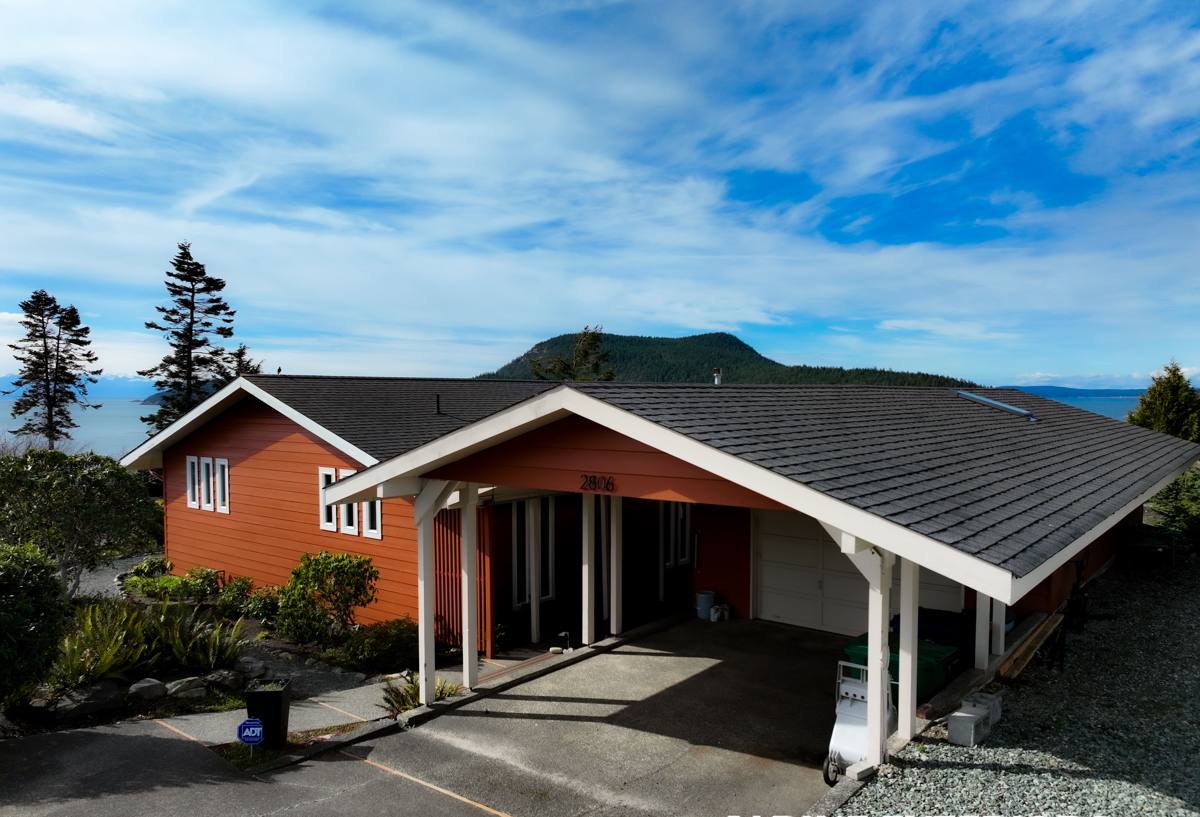
Siding: Why We Only Install James Hardie Fiber Cement
We made a decision a while back to stop installing several common siding products, not because they're bad on paper, but because of how they actually perform after years of Whatcom County weather. We only install James Hardie fiber cement siding now, and it's worth explaining why, honestly, rather than just asserting it.
What We Stopped Installing, and Why
- Vinyl siding is affordable and low-maintenance in mild climates, but it expands and contracts with temperature swings, can crack in cold snaps, and doesn't hold up well against sustained wind-driven rain at seams and corners. It also can't be painted a dark color without risking warping from heat absorption — a real limitation if a homeowner wants to update the look later.
- LP SmartSide is an engineered wood product with a resin-treated strand substrate. It performs reasonably well when installation details are followed exactly, but it's still wood-based, and any breach in the factory coating — a poorly caulked joint, a missed touch-up, a woodpecker hole — gives moisture a path into a substrate that swells and can degrade over time. In a climate with Ferndale's rain totals and humidity, that margin for installation error is thinner than we're comfortable with.
- Cemplank and Allura are both fiber cement products and chemically similar to Hardie's. Our concerns with them are less about the base material and more about product consistency, factory finish quality control, and the strength and clarity of the warranty backing them in our market. We'd rather stand behind one system we know inside and out than juggle several with different tolerances and paper trails.
- Primed spruce and cedar look great new and age beautifully when maintained religiously, but "religiously" is the operative word. Real wood siding needs recoating on a schedule, and in a moss-prone, high-rain area, skipped maintenance shows up as cupping, checking, and rot years sooner than the homeowner expects. We still respect cedar as a material — we just don't think it's a fair trade for most homeowners' actual maintenance habits.
Why James Hardie
Fiber cement from James Hardie is non-combustible, dimensionally stable across temperature and moisture swings, and comes with a factory-applied ColorPlus finish that's baked on and warranted against fading and peeling — which matters when salt air is working against every painted surface on the house. Hardie also engineers specific product lines (their HZ5 designation, for example) for wetter, colder climate zones, which the Pacific Northwest falls into. That's not marketing — it affects the actual formulation and moisture performance of the board. Combined with a strong transferable warranty, it's the system we're willing to put our name behind on every job.
| Siding Option | Where It Struggles Locally | Maintenance Burden |
|---|---|---|
| Vinyl | Seams under wind-driven rain, cold-weather cracking | Low, but limited repair/color options |
| LP SmartSide | Any coating breach lets moisture into wood substrate | Moderate — coating upkeep matters |
| Cedar / Primed Spruce | Cupping and rot if recoating is skipped in moss-prone areas | High — recoat on a strict schedule |
| James Hardie Fiber Cement | Requires correct installation clearances (like any siding) | Low — factory finish, no recoating cycle |
Roofing: Handling Moss, Debris, and Sustained Wet Season
Roofs in and around Ferndale earn their keep. Between conifer debris, extended damp periods, and moss that establishes itself on any shaded or north-facing slope, a roof here is doing more work than the same roof would in a drier climate. Good roofing work in this area comes down to a few fundamentals done right every time: correct underlayment for wet-climate performance, ice-and-water shield at valleys and eaves where it's needed, proper ventilation so the attic isn't trapping moisture from underneath, and flashing details at every penetration and wall intersection that actually shed water instead of relying on caulk to do the job long-term.
Moss removal and prevention matter here more than in most parts of the state. Left alone, moss lifts shingle edges, holds water against the roof deck, and shortens the effective life of an asphalt roof by years. We look at tree overhang, slope orientation, and existing moss growth as part of any roofing conversation, not as an afterthought.
Windows: Sealing Out Wind-Driven Rain
Window failures in this climate are rarely about the glass — they're about the seal and the flashing around the opening. Wind-driven rain off open exposure will find any gap in the flashing tape, sill pan, or perimeter sealant, and once water gets behind a window frame it can sit there for a long time before it shows up as a stain on an interior wall or soft trim outside. Replacing windows the right way means integrating the new unit's flashing with the existing water-resistive barrier correctly, not just caulking around the trim and calling it done. We also talk with homeowners about glass packages suited to the Pacific Northwest — modern double-pane, low-E units cut down on both heat loss and condensation on cold, damp mornings, which is a common complaint in older single-pane or early dual-pane homes in this area.
Decks: Built for Standing Water and Moss, Not Just Sun
A lot of deck damage around here isn't from sun exposure — it's from standing water and organic buildup. Leaves and needles collect between boards, moss establishes in shaded corners, and any spot where water can't drain freely becomes a rot starting point, especially at ledger boards, post bases, and stair stringers where wood meets masonry or grade. Composite decking sheds water more predictably than untreated wood and doesn't need annual staining, which is worth factoring in if the deck sits under tree cover or gets little direct sun to dry it out between rain events. Whatever material a homeowner chooses, proper flashing at the ledger board and adequate airflow underneath the deck are what actually prevent the rot problems we see most often on older decks in wetter, shadier yards.
Why a Local Crew Matters Here
Exterior work in Whatcom County isn't generic exterior work. A crew that mostly builds in drier climates will default to installation details that are fine there and inadequate here — thinner flashing margins, less attention to ventilation, siding clearances that don't account for how long surfaces stay wet after a storm rolls through. We work this specific climate, on homes with this specific mix of coastal exposure, rainfall, and moss pressure, and that shapes every material and installation decision we make, not just the sales pitch.
What a Ferndale Exterior Project Usually Involves
- An on-site assessment of exposure — how much wind-driven rain, sun, and moss pressure the specific walls and roof slopes actually face
- A look at existing moisture damage before any new material goes up, so problems aren't sealed in behind new siding or roofing
- Correct water-resistive barrier and flashing integration at every window, door, and penetration
- Material selection suited to sustained damp conditions, not just upfront cost
- Attention to drainage and airflow on decks and at grade-level siding clearances
- A realistic maintenance conversation, so the homeowner knows what upkeep (if any) the chosen materials actually require
Getting Started
If you're dealing with moss buildup, a failing roof, siding that's showing its age, drafty windows, or a deck that never quite dries out, we're happy to take a look and walk through what we're actually seeing — no pressure, no inflated quote to scare you into a bigger project than you need. Reach out for a free estimate and we'll give you a straight read on your home's exterior and what it would take to get it standing up to Ferndale's weather for the long haul.