 Bellingham Exterior
 Allura Is a Real Fiber Cement Product — Here's Why We Still Don't Install It
Homeowners in Bellingham sometimes ask us to bid a job using Allura fiber cement siding, usually because a builder spec'd it or another contractor quoted it at a lower price. We want to be upfront: Allura is a legitimate fiber cement product, not a knockoff. It's cement, sand, and cellulose fiber pressed and cured the same basic way Hardie's material is made, and it will outperform vinyl or untreated wood in most respects. Our reason for not installing it isn't that it's a bad product on paper — it's that after years of working on homes in Whatcom County's specific weather, we've standardized on one manufacturer we can vouch for from the factory finish to the fastener schedule, and Allura isn't it.
This page explains the actual differences that matter here — not marketing claims, but the practical trade-offs a homeowner on a Bellingham lot near the water, in a fog pocket, or under a stand of Douglas fir should understand before signing a siding contract.
What Bellingham's Climate Actually Demands From a Siding Product
Whatcom County siding takes a specific kind of beating. We're not dealing with the hail-and-freeze-thaw cycle of the Midwest or the UV load of the desert Southwest. Our problems are moisture-driven and slow-acting:
- Salt air along Bellingham Bay and the county's shoreline neighborhoods accelerates finish breakdown and fastener corrosion.
- Driving rain off the Sound pushes water sideways into laps, seams, and butt joints, not just straight down the wall.
- A long moss and algae season — shaded, damp siding here can stay wet for days at a time, which is exactly the environment moss and mildew want.
- Limited direct sun on north-facing and tree-shaded elevations means finishes have less chance to fully dry out and self-clean between rain events.
None of this is exotic weather. But it's relentless, and it's the reason we care less about how a siding product performs in a lab and more about how it performs on a wall that stays damp from October through May.
Where Allura and James Hardie Genuinely Overlap
To be fair to Allura: it's non-combustible, it doesn't rot or attract insects the way wood does, and it holds paint better than most alternative claddings. If a customer already has Allura on their home and just needs a repair or an addition matched, we'll talk through the situation honestly rather than pretend the product is a hazard. The differences we're about to walk through are about long-term performance margins and support, not a defect in the base material.
Factory Finish: The Difference We See Most Often
Baked-on color vs. field-applied and primed options
The biggest practical difference on a jobsite is the finish. James Hardie's ColorPlus finish is a multi-coat, baked-on factory finish applied and cured under controlled conditions before the board ever reaches the truck. Allura's lineup includes both prefinished and primed products, and the primed boards depend on whoever installs them to prime the cut edges and field-paint the siding correctly and promptly.
That distinction matters more in a climate like ours than it would somewhere dry. A primed board that sits unpainted through a wet Bellingham stretch, or gets caulked and painted by a crew in a hurry to close out a job before the rain starts again, is where we see early finish failure — chalking, uneven sheen, and moisture wicking into cut edges. A factory finish removes that variable entirely. We'd rather not offer a product where the long-term look of the siding depends on field conditions on installation day.
Cut-edge treatment
Every fiber cement board gets cut on site — around windows, at corners, at gable ends. How the manufacturer expects installers to treat those raw edges matters a lot in a wet climate, since an untreated cut edge is the fastest path for moisture into the board. We standardize our edge-sealing process around Hardie's published detailing because we know exactly what the product expects; mixing installation habits across different manufacturers' specs is how mistakes creep in.
Product Lines Engineered for Specific Climates
James Hardie sells regionally engineered product formulations — including an HZ5 line built specifically for climates with more moisture exposure and freeze-thaw cycling, which is closer to what Western Washington sees than a one-size-fits-all national formulation. Having a manufacturer that explicitly engineers around wet, coastal-adjacent climate zones gives us more confidence in long-term performance than a general-purpose board rated the same everywhere in the country.
Warranty Structure
Warranty terms change over time and by product line, so we always confirm current published terms with the customer before a job — but the structure itself is worth understanding, because it's a real point of difference:
| Factor | James Hardie | Allura |
|---|---|---|
| Base material warranty | Long-term limited warranty on the fiber cement substrate, transferable to a subsequent owner | Manufacturer-backed warranty on the substrate; terms and transferability vary by product line |
| Finish warranty | Separate, dedicated ColorPlus finish warranty covering fade and peel on factory-finished color | Coverage depends on whether the board is prefinished or field-painted; field-applied paint is typically covered by the paint manufacturer, not the siding maker |
| Regional installer network | Established, well-documented network of contractors trained specifically on Hardie installation and detailing | Smaller, less consistent contractor familiarity in this region |
| Product matching for future repairs | Wide distribution and stable, long-running color and profile lines | Distribution and continuity vary by market and over time |
The practical upshot: if something goes wrong ten or fifteen years from now, we want a warranty structure we understand cold and a manufacturer whose claims process we've actually used, not one we'd be researching for the first time on the customer's behalf.
Installation Sensitivity
Fiber cement, generally, is not a forgiving product to install badly — wrong fastener placement, missing flashing, or tight-butted joints without expansion gaps will cause problems with any brand. But manufacturers differ in how much documentation, local training, and installer support exists to keep crews from making those mistakes. Hardie's installation specs are extensively documented and widely taught in this region, which means every crew member on our jobs is working from the same detailed playbook. We don't have the same depth of local training and support behind Allura, and we're not willing to install a product where our crew's only reference is a PDF instead of years of hands-on regional experience.
Availability and Long-Term Support in Whatcom County
When a homeowner needs a siding repair five, ten, or twenty years after the original install — storm damage, a remodel that opens up a wall, a new addition that needs to match — the ease of sourcing matching material matters. Hardie products are broadly stocked and distributed throughout Western Washington, which keeps repair and matching jobs straightforward. Availability for other fiber cement brands can be spottier locally, which either means a longer wait for materials or a mismatch when older stock isn't available anymore. We don't want to hand a customer a siding job that becomes hard to service a decade from now.
What We Install Instead — And Why
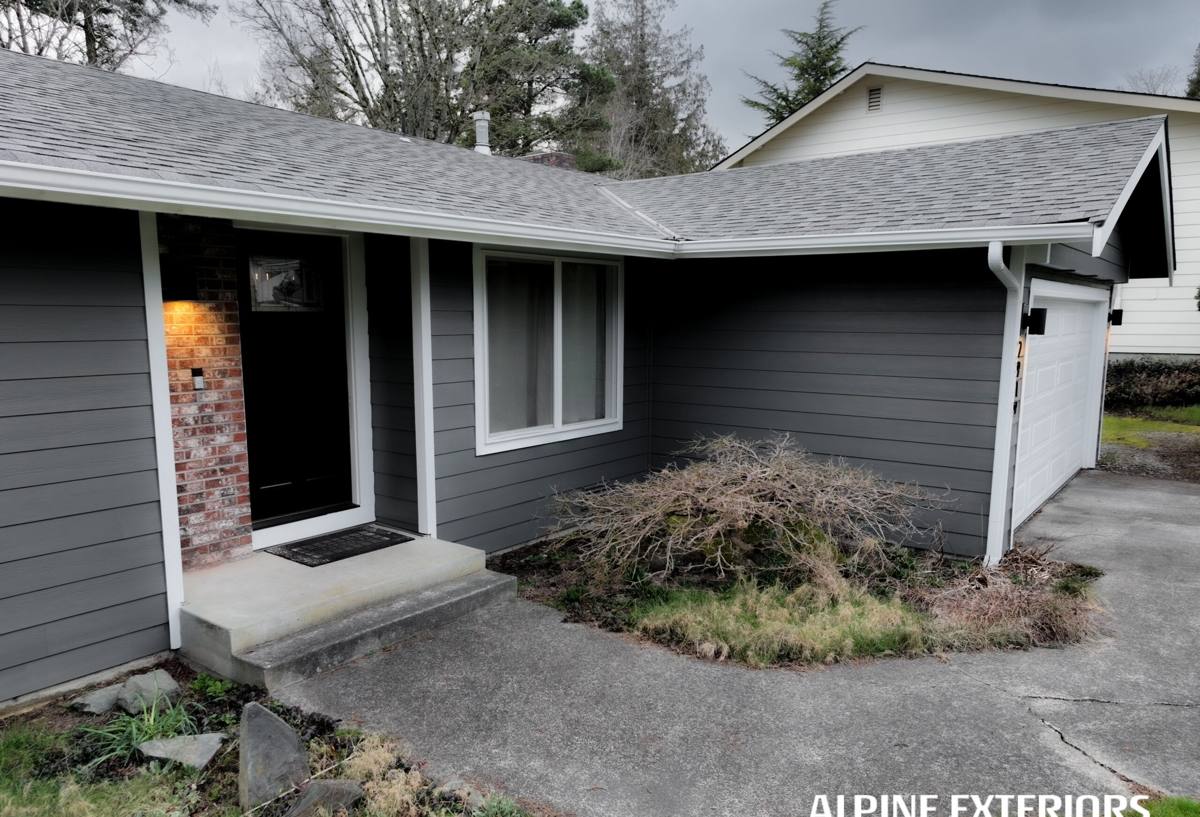
We install James Hardie fiber cement exclusively: HardiePlank lap siding, HardiePanel, and matching trim, in ColorPlus factory finishes. It's non-combustible, it's engineered in a line built for wetter climates, it carries a factory finish that doesn't depend on field paint timing, and it's backed by a warranty and installer network we've worked with directly. For a house on a Whatcom County lot dealing with salt air off the bay, sideways rain, and long damp stretches under tree cover, that combination of engineering and factory finish is what gives us confidence the siding will still look right in fifteen years — not just perform on a spec sheet today.
Questions worth asking any contractor before you commit to a siding product
- Is the siding factory-finished, or will it need field priming and painting after install?
- Is this specific product line rated or engineered for a wet, coastal-adjacent climate — or is it a generic national formulation?
- What does the manufacturer's warranty actually cover, and is it transferable if you sell the home?
- How readily available is matching material locally if you need a repair or addition in ten years?
- How much local installer experience and training exists specifically for this product?
- Who backs the finish — the siding manufacturer or a separate paint company?
Get an Honest Look at Your Project
If you're weighing siding options for a home in Bellingham or elsewhere in Whatcom County, we're happy to walk your specific house, explain what we'd recommend and why, and give you a straightforward, no-pressure estimate — including an honest answer if James Hardie isn't the right fit for your budget or goals.