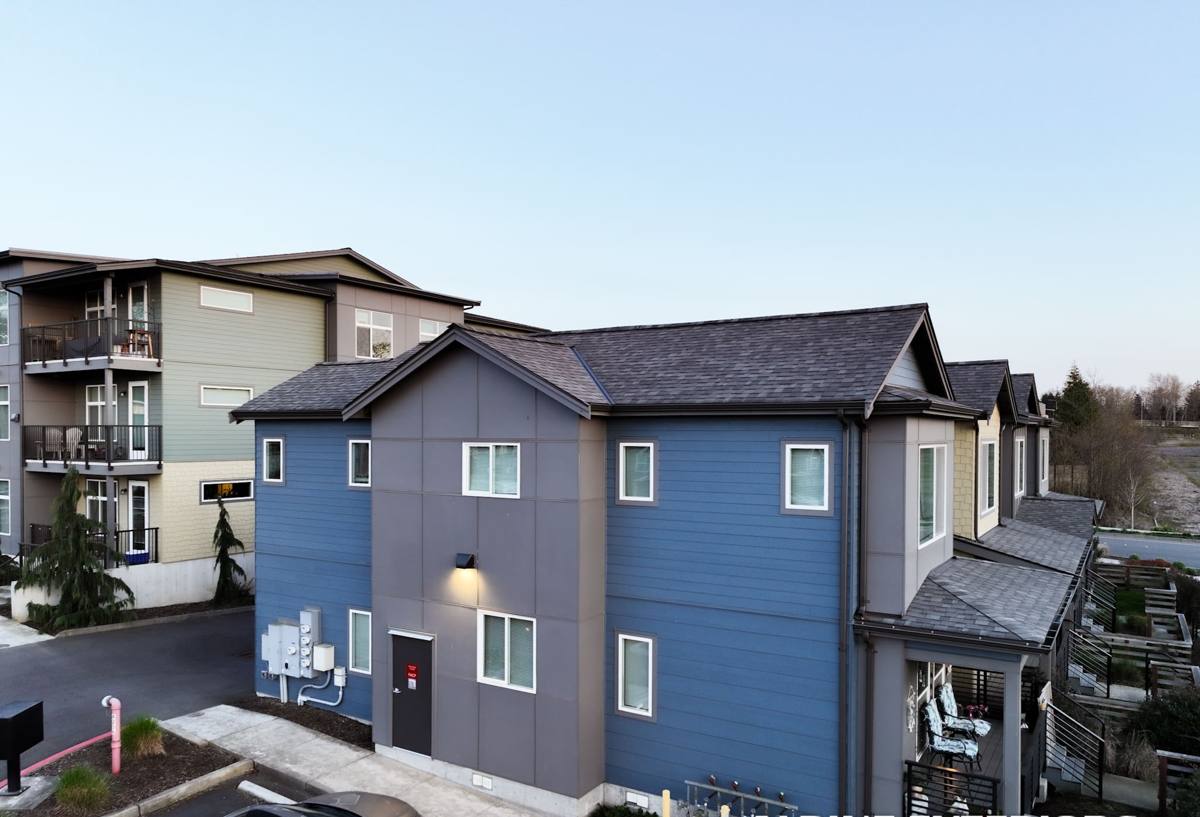
 Bellingham Exterior
 What Primed Spruce Siding Actually Is
Primed spruce siding is solid-sawn wood lap siding, milled from spruce or a similar softwood, that arrives from the mill with a factory-applied primer coat instead of bare wood. Builders like it because it looks and feels like traditional wood clapboard, it's easy for a carpentry crew to cut and nail with standard tools, and the primer gives painters a head start compared to bare cedar. It's been a staple in Pacific Northwest home construction for decades, and a lot of Bellingham homes still wear it.
We get asked about it often, usually by homeowners who grew up around wood siding and want that same look on a replacement project. This page explains what primed spruce does well, where it runs into trouble in our specific climate, and why we made the decision years ago to stop installing it in favor of fiber cement.
What Primed Spruce Gets Right
We're not going to pretend this product has no merit — that wouldn't be honest, and it's not how we talk to customers in person either.
- Authentic wood grain and profile. No composite or engineered product replicates the look of real sawn wood quite as convincingly, especially on older or historic-style homes where a genuine wood look matters to the owner.
- Workability. It cuts, copes, and nails easily on-site, which historically made it a fast, familiar material for carpentry crews.
- Repairable in small sections. A damaged board can be cut out and spliced by a competent carpenter without specialty tools.
- Lower upfront material cost than most premium siding systems, which is part of why it stayed popular for so long.
If a homeowner's only priority were matching a historic wood look at the lowest possible material cost, primed spruce would still be in the conversation. But siding decisions aren't made in a vacuum — they're made against Bellingham's weather, and that's where the calculation changes.
The Core Problem: Primer Is a Coating, Not a Cure
Priming spruce doesn't change what the board is underneath — it's still a cellulose-based wood product that absorbs and releases moisture with the seasons. The factory primer coat is a thin barrier meant to help paint adhere and slow initial moisture uptake before the siding goes up and gets a field coat of paint. It was never engineered to be a long-term moisture management system on its own, and it isn't marketed as one.
Wood siding fails in fairly predictable ways once moisture gets past that coating: swelling and cupping at the board faces, checking and splitting along the grain, and softening at butt joints, corners, and anywhere end grain is exposed. Once water gets into end grain — cut edges at joints, around windows, at corner boards — it wicks along the fibers far faster than it does through the face of the board, and no amount of surface primer stops that.
Why This Matters More in Whatcom County
Every siding material has to survive its local climate, not a national average. In Bellingham and the rest of Whatcom County, we're dealing with a specific combination of stressors that's tougher on wood than a drier or milder region would be:
- Salt air off the Puget Sound and Bellingham Bay accelerates coating breakdown and can contribute to premature paint failure on exposed elevations.
- Driving rain off winter storms pushes moisture horizontally into laps, joints, and fastener penetrations that a vertical-rain assumption in the coating spec doesn't account for.
- A long moss and algae season — our wet, mild, low-sun-angle stretch from fall through spring keeps north-facing and shaded wood siding damp for extended periods, which is exactly the condition that lets moisture work past a coating over time.
None of that means primed spruce is doomed to fail immediately. It means the margin for error — in caulking, flashing, paint maintenance, and gutter upkeep — is much thinner here than it would be in a drier climate, and that margin keeps shrinking every year the homeowner falls behind on upkeep.
The Maintenance Reality Most Homeowners Underestimate
This is the part of the primed spruce conversation that doesn't show up in a showroom sample or a builder's spec sheet, but it's the part that determines whether the siding lasts 10 years or 40.
Primed spruce siding is a painted wood product for the life of the house. That means:
- A repaint cycle every 5-8 years in our climate, sooner on sun- and rain-exposed elevations, to keep the moisture barrier intact.
- Annual (or more frequent) inspection of caulked joints, corners, and butt seams, since caulk fails well before paint does and is often the first point of water entry.
- Prompt touch-up of any chip, scratch, or woodpecker damage — bare wood exposed even briefly in our wet months starts absorbing moisture immediately.
- Vigilance around moss and algae growth on shaded or north-facing walls, since organic growth holds moisture against the wood surface far longer than bare siding would otherwise stay wet.
A homeowner who stays on top of every item on that list can get a long service life out of primed spruce. The honest problem is that most people don't — paint jobs get deferred a year or two, caulk gets missed during a routine inspection, and by the time cupping or soft spots show up, the damage is already done and often isn't a spot repair anymore.
What Failure Actually Looks Like
When primed spruce does start to go, it's rarely dramatic. It's a slow accumulation of small problems: paint that's chalking and thinning at 6-7 years instead of holding to spec, hairline checking along the board length that opens a path for water, soft or spongy spots at the bottom edge of boards near grade or under downspout discharge points, and dark streaking or moss buildup on shaded walls that keeps the wood damp between rain events. None of these show up overnight, which is part of the problem — by the time they're visible from the ground, moisture has usually been working underneath for a while.
Cost Factors Over the Life of the Siding
Comparing sticker price alone misses most of the real cost story. Here's how the two materials stack up on the factors that actually determine what a homeowner spends over 20-30 years:
| Factor | Primed Spruce (Wood) | James Hardie Fiber Cement |
|---|---|---|
| Upfront material cost | Lower | Moderate to higher |
| Repaint cycle | Every 5-8 years | ColorPlus factory finish rated well beyond that; field-painted Hardie still outlasts wood repaint intervals |
| Moisture vulnerability | High at end grain, joints, and shaded walls | Engineered for Pacific Northwest moisture (HZ5 product line) |
| Combustibility | Combustible | Non-combustible |
| Moss/algae resistance | Low without active upkeep | Significantly better; factory finish sheds organic growth more readily |
| Manufacturer warranty | Typically limited or none beyond the primer/coating maker's terms | Strong, transferable product warranty |
| Ongoing owner labor | Substantial — inspection, caulk, touch-up, repaint | Minimal — periodic wash and visual check |
The lower sticker price on primed spruce is real. What it doesn't show is the labor and repaint budget a homeowner needs to plan for over the following decades to keep that price advantage from turning into a bigger bill later.
Installation Sensitivity Is Part of the Problem
Even a well-built wood siding job depends heavily on details that are easy to get wrong or skip under schedule pressure: back-priming every cut end before installation (not just the factory-primed faces), consistent caulking at every joint and penetration, correct lap and fastener placement to avoid trapping moisture, and flashing details at windows, doors, and corner boards that actually shed water outward instead of behind the siding. Miss any one of those on a house exposed to Bellingham's driving rain, and that's typically where the first failure shows up — not across the whole wall, but at that one joint or corner. We'd rather not install a product where a single missed step in the field creates a long-term liability for the homeowner.
Why We Install James Hardie Instead
We standardized on James Hardie fiber cement siding because it's engineered to hold up against the specific conditions Whatcom County throws at a house year after year. It's non-combustible, which matters more each fire season. Its ColorPlus factory finish is baked on and warranted, so homeowners aren't locked into a repaint cycle just to keep the siding protected. Hardie's HZ5 product line is formulated for wet, moisture-heavy climates like ours rather than a generic national spec. And it comes with a strong, transferable warranty that reflects the manufacturer's confidence in how the product performs over decades, not just years.
None of that means Hardie is maintenance-free — no exterior siding is. But it shifts the maintenance burden from "repaint every several years or risk moisture damage" to "wash it occasionally and keep an eye on caulking," which is a much easier standard for a busy homeowner to actually meet.
Questions to Ask Before You Choose Any Siding
Whether you go with us or another contractor, these are the questions worth asking about any siding product before you commit to it for your home:
- What does the manufacturer's warranty actually cover, and does it transfer if I sell the house?
- What's the realistic repaint or recoat interval for this specific product in a wet coastal climate, not a national average?
- How does this product perform against moss and algae growth on shaded, north-facing walls?
- What installation details (flashing, caulking, back-priming, fastener spacing) does this product require, and will my contractor commit to them in writing?
- Is the product rated or engineered for my specific climate zone, or is it a general-purpose spec?
If you're weighing primed spruce, cedar, vinyl, or fiber cement for a Bellingham home, we're glad to walk through the honest trade-offs in person and give you a straightforward, no-pressure estimate for what a James Hardie installation would look like on your house.