 Bellingham Exterior
 Two Fiber Cement Sidings, One Decision We Had to Make
Fiber cement siding has earned its reputation the hard way, by holding up where wood and vinyl struggle. It resists fire, shrugs off woodpeckers and carpenter ants, and takes paint or factory color far better than most cladding options. But "fiber cement" isn't one product. It's a category, and inside that category there are real differences in how the board is made, how it's finished, and how the manufacturer stands behind it. Cemplank and James Hardie are both legitimate fiber cement lines. We get asked often enough why we only install Hardie that it's worth laying out the comparison honestly, rather than just saying "trust us."
This isn't a takedown of Cemplank. It's a straight look at where the two products are similar, where they diverge, and why those differences matter more in Bellingham than they might in a drier, milder climate.
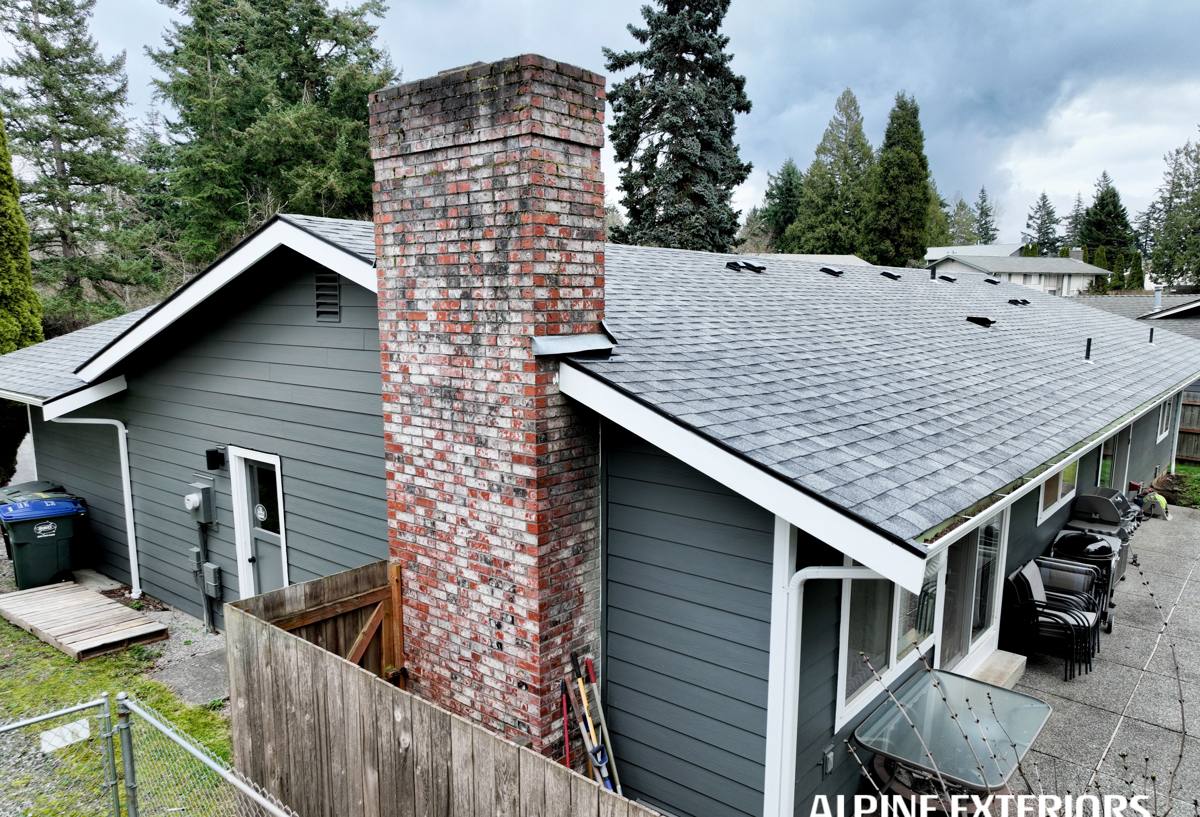
What Cemplank Gets Right
Cemplank is genuine fiber cement — a blend of cement, sand, and cellulose fiber, autoclave-cured for stability. That base chemistry gives it the same core advantages the whole category shares over wood or vinyl:
- Non-combustible core, which matters for insurance and fire-code considerations
- Dimensionally stable — it doesn't expand and contract with humidity the way wood lap siding does
- Resistant to insect damage and rot in a way that untreated wood siding cannot match
- Available in lap, panel, and shingle profiles that mimic traditional siding styles
If a homeowner already has Cemplank on their house and it was installed correctly, there's no reason to panic or assume it's failing. It's a real product built on the same basic science as what we install. Where things diverge is in the finish system, the climate engineering, the warranty structure, and the manufacturing consistency behind the board — and those differences add up over a 30- or 40-year ownership horizon.
Factory Finish: Baked-On vs. Field-Applied
This is the single biggest gap between the two products. James Hardie's ColorPlus finish is a multi-coat, baked-on factory finish applied and cured under controlled conditions before the board ever reaches a jobsite. It's engineered specifically to bond to fiber cement and resist UV fade, and it comes with its own dedicated finish warranty separate from the product warranty.
Cemplank siding is more commonly sold primed, meaning the topcoat gets applied on-site or shortly after installation by a painting crew. Field-applied paint is only as good as the conditions it goes on in and the crew applying it — and in Whatcom County, where damp, low-temperature stretches are common for much of the year, getting a field finish to cure and bond properly is a real challenge. A factory-applied, factory-warrantied finish removes that variable entirely.
Why This Matters More Here
Bellingham's marine climate means siding faces salt-laden air off the Sound, long stretches of driving rain, and months where moss and algae growth is a constant battle on north-facing walls. A finish that was cured in a controlled plant environment, formulated to resist moisture intrusion and biological growth, holds up differently than a coating applied in the field during our shoulder seasons.
Climate-Engineered Product Lines
James Hardie manufactures regional HZ (HardieZone) product formulations — different fiber cement recipes engineered for different climate zones, accounting for moisture exposure and freeze-thaw patterns. That's a manufacturing-level response to the fact that siding in the Pacific Northwest faces a different set of stresses than siding in Arizona or Florida.
Not every fiber cement competitor offers that same zone-specific engineering. When a product line isn't differentiated by climate zone, it's a one-size-fits-all approach — which may perform fine in moderate climates but leaves less margin in a wet, marine environment like ours.
Side-by-Side: Where the Products Compare
| Factor | Cemplank (typical) | James Hardie |
|---|---|---|
| Finish | Often primed, field-painted | Factory-applied ColorPlus finish with separate finish warranty |
| Climate engineering | General-purpose formulation | Region-specific HZ5/HZ10 formulations |
| Product warranty | Varies by product line and distributor | Non-prorated, transferable limited warranty (typically 30 years) |
| Installer network | Varies; no unified certification standard | Manufacturer-backed installer training and product knowledge program |
| Trim and accessory matching | Depends on regional distributor stock | Full matched trim, soffit, and accessory system |
| Market presence in PNW | Less consistent regional stocking | Widely stocked, established regional supply chain |
Warranty Structure: Read the Fine Print
Every siding manufacturer offers some kind of warranty, but the structure of that warranty is where the real value shows up — or doesn't. A prorated warranty that pays out a shrinking percentage of replacement cost as the years go by is worth much less than a non-prorated warranty that covers full material replacement for the stated term. Transferability to a new homeowner also affects resale value; a warranty that dies the moment the house sells is a warranty that only helps the person who's already moving out.
We install James Hardie in part because its warranty terms are well-documented, transferable, and non-prorated on the product itself, with the ColorPlus finish carrying its own separate coverage. When we quote a job, we want to be able to tell a homeowner exactly what's covered, for how long, and what happens if they sell the house in year twelve. That clarity is harder to guarantee with a product line where warranty terms can shift by distributor or region.
Installer Training and Manufacturing Consistency
Fiber cement is not a forgiving material to install wrong. Incorrect nailing patterns, insufficient clearance from grade or roof lines, improper caulking at butt joints, and missed flashing details are the actual causes of most fiber cement siding failures — not the base material itself. This is true across every brand, including Hardie.
Part of why we standardized on one manufacturer is that it lets our crews build deep, repeated expertise in one system's installation requirements — one set of manufacturer specifications, one set of manufacturer-published installation guides, one warranty claims process if something ever needs to be addressed. Splitting our crews' knowledge across multiple manufacturers' spec sheets doesn't serve our customers; it just increases the odds of a detail getting missed on installation day.
Why Bellingham's Climate Raises the Stakes
None of this is theoretical for a house in Whatcom County. Salt air off Bellingham Bay accelerates corrosion on fasteners and trim if they're not properly rated and installed. Driving rain, especially in exposed or elevated locations, tests every horizontal joint and window flashing detail on a home's exterior. And our long moss season — stretching from fall through spring — means anything that traps or holds moisture against a wall becomes a growth surface if the siding and finish don't resist it well.
A siding product and finish system that were engineered with a marine, high-moisture climate in mind have a real advantage here over a general-purpose product. That's not marketing — it's why regional formulation exists as a category in the first place.
What "Installed to Spec" Actually Means
Whichever fiber cement product ends up on a house, correct installation is non-negotiable. That includes:
- Proper clearance between siding and grade, roofing, and decks (typically a minimum of 6 inches from grade and 2 inches from roof surfaces)
- Correct fastener type and spacing per the manufacturer's published instructions
- Weather-resistant barrier and flashing integrated correctly at every window, door, and penetration
- Properly caulked and back-primed cut ends, especially at butt joints
- Field-touch-up paint that matches the factory finish exactly, used sparingly and only where the manufacturer allows
A homeowner comparing bids should ask about every one of these details regardless of which brand is being proposed. A low bid that skips clearance requirements or flashing details will cost more in the long run than the material savings up front.
Why We Standardized on James Hardie
We made the decision to install James Hardie exclusively for a combination of reasons that, together, tipped the scale: the factory-applied ColorPlus finish removes a major variable in our wet climate, the HZ5 formulation is engineered specifically for Pacific Northwest conditions, the warranty structure is transferable and non-prorated, and standardizing on one manufacturer lets our crews specialize instead of relearning installation details for every job. That combination is why Hardie is what goes on the homes we work on — not because every alternative is bad, but because this is the standard we're willing to put our name behind.
Questions Worth Asking Any Siding Contractor
- Is the finish factory-applied or field-painted, and what does that finish's warranty cover separately from the board itself?
- Is the product formulated for this climate zone, or is it a general-purpose formulation?
- Is the warranty prorated, and does it transfer to a new owner if the house sells?
- What manufacturer installation guide is the crew following, and are they trained specifically on that system?
- What clearance and flashing details will be used at grade, roof lines, and window openings?
If you're weighing siding options for a home in Bellingham or elsewhere in Whatcom County, we're happy to walk through what we'd recommend for your specific house and site conditions. There's no pressure and no obligation — just a straight answer and a free estimate.