 Bellingham Exterior
 Two Very Different Materials, One Big Decision
If you're re-siding a home in Bellingham, you've almost certainly narrowed it down to two finalists: vinyl and James Hardie fiber cement. They're the two most common siding materials installed in Whatcom County, and for good reason — both are widely available, both have a track record, and both look reasonable from the street. But they are not interchangeable products, and the differences matter more here than in a drier, milder climate.
This page lays out the real trade-offs, product by product, so you can make the call with your eyes open. We only install James Hardie fiber cement siding, so you should know that going in. But we'll give vinyl its due — it earns its place in this market for real reasons, and pretending otherwise wouldn't be honest.
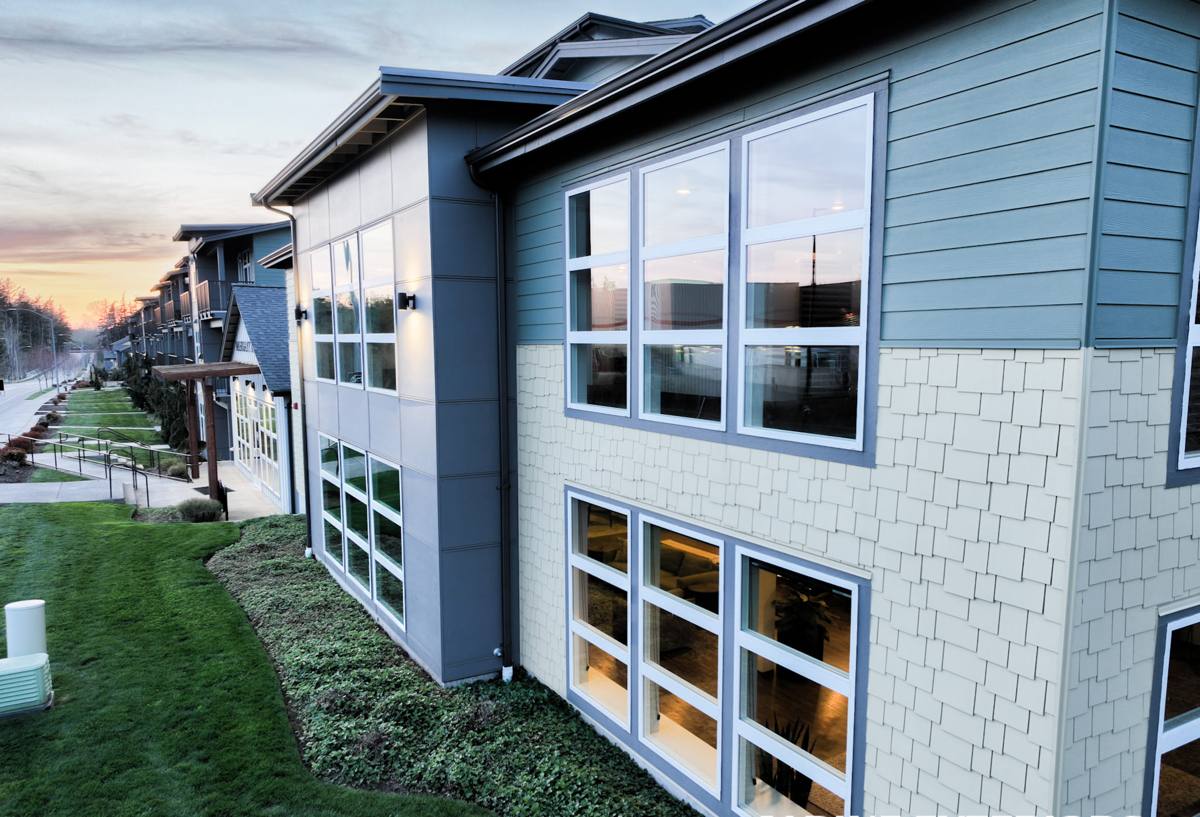
Why Bellingham's Climate Is Part of This Decision
Whatcom County sits on Bellingham Bay, which means salt-laden air is a constant companion for homes anywhere near the water. Add our long, wet winters, driving rain off the Strait, and a moss and algae season that can run eight or nine months out of the year on shaded north- and west-facing walls, and you get a climate that is genuinely hard on exterior materials. It's not a hurricane zone and it's not a desert — it's a slow, steady, moisture-and-organic-growth grind.
That kind of environment doesn't destroy siding overnight. It works on it gradually: moisture finds gaps, seams flex with temperature swings, algae and moss take hold wherever a surface stays damp, and UV (yes, even under our cloud cover) breaks down pigments over years. The material that holds up best here is the one engineered to resist moisture intrusion and hold its finish, not just the one that's cheapest to hang.
Vinyl Siding: What It Gets Right
Vinyl has stayed popular for decades because it solves real problems. It's worth naming what it does well before getting into where it struggles.
- Low upfront cost. Vinyl is generally the least expensive siding material to purchase and install, which matters on a tight renovation budget.
- No painting. Color is baked into the material, so there's no repainting cycle in year one.
- Lightweight and fast to install. Crews can move through a house quickly, which keeps labor costs down.
- Won't rot. Being a plastic product, vinyl itself doesn't absorb water and rot the way wood does.
Those are legitimate advantages, and for some homeowners — particularly on a rental property or a short-hold flip — they're the deciding factor. We're not going to tell you vinyl is a scam. It's a mainstream product that performs a certain way, and that way has real limits in a coastal Pacific Northwest climate.
Where Vinyl Struggles in a Marine, High-Moisture Climate
It Manages Water Around It, Not Water Itself
Vinyl panels are designed to shed water off their face, but they're installed with overlapping laps and hung loosely on nails to allow for expansion. That means the wall assembly behind the vinyl — the house wrap, the flashing, the window and door details — is doing almost all the real waterproofing work. Vinyl itself isn't sealed at the seams. In a climate with sustained driving rain and long wet stretches, any weakness in that background wall assembly gets tested constantly, and vinyl gives you very little independent backup.
Moss, Algae, and Fading
Vinyl's factory color is a surface pigment, not the deep, baked-on finish of a premium fiber cement product, so it fades unevenly over the years — especially on south- and west-facing walls that get the most UV. Meanwhile, the north- and shaded sides of Bellingham homes, under mature evergreens and in our damp winters, are exactly where moss and algae take hold on any siding material that stays wet for long stretches. Vinyl doesn't resist this any better than most other claddings, and its slick, low-texture surface can actually make some growth more visible once it sets in.
Expansion, Contraction, and Wind
Vinyl expands and contracts more than fiber cement across our seasonal temperature swings, which is why it's installed with loose nailing. Over time that can lead to visible waviness, oil-canning, or panels that rattle or work loose in sustained wind — not a dramatic failure, but a look that ages a house faster than the calendar would suggest.
Impact Sensitivity
Vinyl is thin and somewhat brittle in cold weather. A stray branch, a ladder bump, or a hard hail event can crack a panel, and matching an exact shade for a spot repair years later is often difficult since colors are discontinued and factory dye lots shift.
James Hardie Fiber Cement: The Case for It
James Hardie siding is made from cement, sand, and cellulose fiber, pressed and cured into a dense, non-combustible board. It's a fundamentally different material category than vinyl, and it behaves differently in every way that matters for this climate.
| Factor | Vinyl Siding | James Hardie Fiber Cement |
|---|---|---|
| Core material | PVC plastic | Cement, sand, cellulose fiber |
| Fire behavior | Combustible, can melt/deform near heat | Non-combustible |
| Finish | Color molded into plastic, fades over time | ColorPlus factory-baked finish, resists fading |
| Moisture behavior | Relies on wall assembly behind it | Engineered HZ formulations for wet/humid regions |
| Impact resistance | Can crack, especially in cold weather | Dense, resists dents and cracking |
| Typical upfront cost | Lower | Higher |
| Warranty structure | Varies by manufacturer, often prorated | Long-term, transferable manufacturer warranty |
James Hardie also makes climate-specific product lines — its HZ10 and HZ5 formulations are engineered for the moisture and humidity levels found in regions like ours, versus the drier-climate versions sold in the Southwest. That's a meaningful detail: the same brand name doesn't mean the same board everywhere, and getting the right HZ line matters for long-term performance here.
Why We Standardized on Hardie and Stopped Installing Vinyl
We used to get asked to install both. Over time, the pattern in what held up on Bellingham homes — and what we kept getting called back to look at — pushed us toward carrying one product line and doing it well rather than offering every option on the shelf.
Vinyl's core limitation isn't that it's a bad product in general — it's that its performance depends heavily on things installers and homeowners don't fully control: how well the original wall assembly was built, how much UV a particular wall gets, how sheltered a wall is from wind-driven rain. In a mixed, moderate climate those variables even out. In a marine climate with heavy annual rainfall and long damp stretches, they compound. Fiber cement's density, factory finish, and non-combustible core give it a wider margin for error and a longer service life under those same conditions.
We also didn't want to be in the business of chasing color-match vinyl repairs five years after installation, or explaining prorated warranty math when a homeowner calls about fading. Hardie's warranty structure and factory finish sidestep both problems.
What Correct Hardie Installation Actually Involves
Fiber cement only performs as advertised when it's installed to Hardie's published specifications — this is not a product where "close enough" holds up over time.
- Proper weather-resistive barrier and flashing behind every panel and at every penetration
- Correct fastener type, spacing, and embedment depth (over- or under-driven nails cause problems)
- Minimum clearance from grade, roof lines, and decks to keep the bottom edge out of standing water and splash-back
- Factory-primed or ColorPlus edges properly sealed or caulked at cuts
- Correct joint flashing and gapping to allow for the board's minor expansion and contraction
Skipping any of these doesn't show up as a failure in year one — it shows up as trapped moisture, paint failure, or edge swelling five to ten years down the road, which is exactly the kind of slow-motion problem this climate is good at hiding until it isn't.
Cost Over Time, Not Just Upfront
Vinyl will almost always win on day-one price. The more useful comparison is cost over the years you actually own the house: repainting cycles (vinyl doesn't need this, but faded vinyl generally can't be repainted well either — it usually gets replaced), spot repairs and color-matching, and how the house shows after a decade of Bellingham winters. Fiber cement costs more to install but is designed to go many years longer between any significant work, with a finish warranty behind it.
Questions Worth Asking Before You Decide
- How long do you plan to own this house — five years or twenty-five?
- How exposed is your lot to wind-driven rain off the Bay or direct salt air?
- Do you have shaded, moss-prone walls that will need regular cleaning regardless of material?
- Does your budget allow for the higher upfront cost of fiber cement in exchange for less maintenance later?
- Are you comparing real installed quotes, or a rough per-square-foot estimate that doesn't account for site conditions?
If you'd like an honest look at what your home actually needs — no pressure, no upsell script — we're happy to walk the property, look at your specific exposure and wall conditions, and give you a straight estimate.