 Bellingham Exterior
 An Honest Answer to a Question We Get a Lot
Homeowners across Bellingham and Whatcom County ask us the same thing almost every week: "Do you install vinyl siding?" The honest answer is no. Not because vinyl is a scam or a bad product in every application, but because after years of installing and repairing siding in this specific climate, we made a professional decision to standardize on one material system — James Hardie fiber cement — and stop installing several others, vinyl included. This page explains why, without exaggerating vinyl's downsides or pretending it doesn't have real advantages.
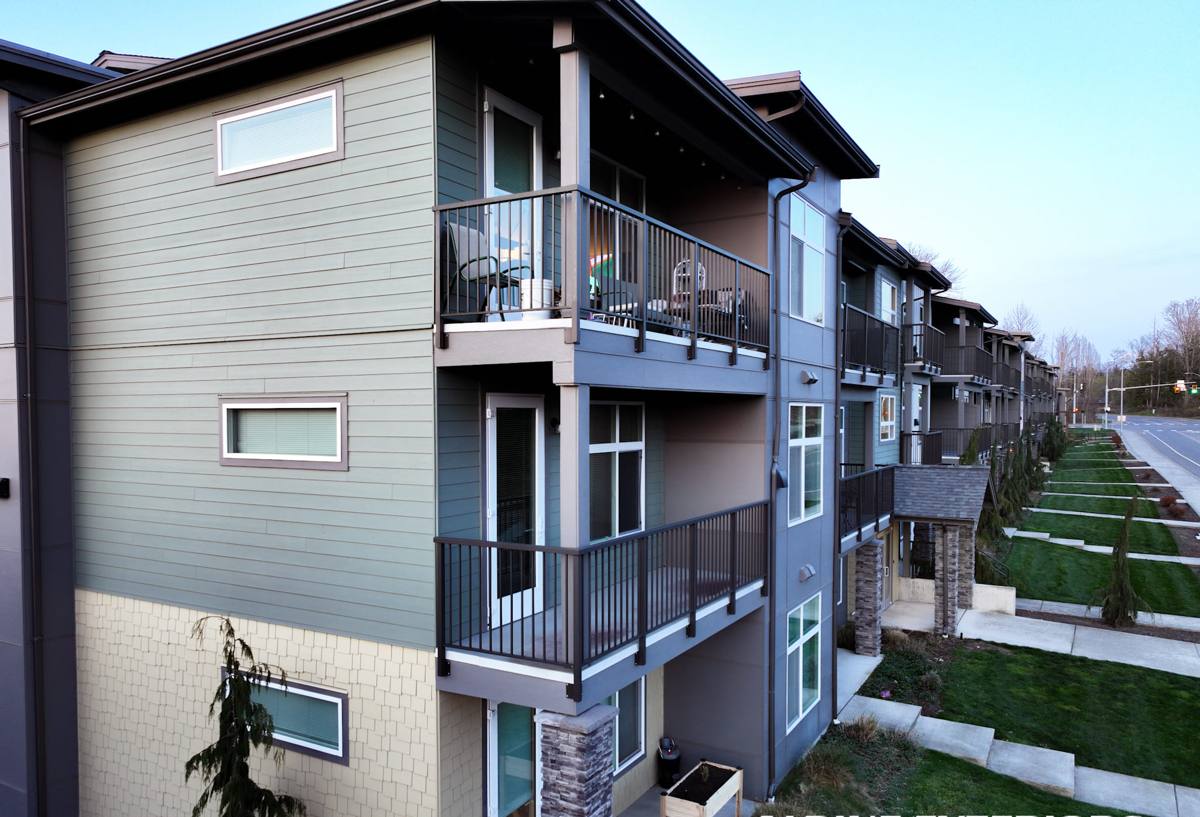
What Vinyl Siding Actually Gets Right
Vinyl earned its dominant market share honestly. It's worth naming what it does well before explaining why we walked away from it:
- Lower upfront material cost than almost any other cladding option
- No painting required — color is baked into the panel
- Lightweight, which makes it fast and inexpensive to install on straightforward wall lines
- Widely available in a huge range of colors, profiles, and price tiers
- Reasonably good performance in mild, dry climates with minimal wall penetrations
If you're shopping strictly on upfront price and your home is a simple rectangular shape with few architectural details, vinyl is not an irrational choice on paper. Our objection isn't to the material in the abstract — it's to how it performs on homes in this specific corner of the Pacific Northwest, and what happens once it's on the wall for fifteen or twenty years.
Why We Still Don't Install It
We made an operational decision to install a single siding system so we can guarantee the workmanship, understand every failure mode, and stand behind the result. Vinyl didn't make the cut for three connected reasons: how it behaves in our climate, how sensitive it is to installation quality, and what it hides.
How Vinyl Behaves in Bellingham's Marine Climate
Bellingham sits on the water, and Whatcom County runs wet for most of the year. That combination — salt air off Bellingham Bay, long stretches of driving rain, and a moss season that can run from fall through spring — is exactly the environment where vinyl's known weak points show up fastest.
Vinyl siding is a thin PVC panel that expands and contracts with temperature swings more than heavier claddings. Installers have to leave gap tolerances at every nail slot and corner post to let it move; get that wrong — even slightly — and panels buckle, ripple, or pull loose over a few seasons. Salt-laden air accelerates UV breakdown and can pit or dull the surface faster than inland installations. And because vinyl panels overlap in a shingle-lap pattern with open venting at the bottom edge, driving rain gets pushed behind the panels far more easily than most homeowners expect — which matters a great deal when your rainy season lasts most of the year.
Installation Sensitivity
Vinyl looks simple to install, and that's part of the problem. It's a "hung," not fastened-tight, cladding system — nails are meant to sit loosely in slotted holes so the panel can slide with temperature changes. Overdriving even a portion of the fasteners on a long wall run is one of the most common installation errors in the trade, and it's invisible until the first hot day or hard freeze causes visible waviness. Getting corner posts, J-channels, and starter strips right around windows, roof lines, and dormers — common on Bellingham's older Craftsman and Cape Cod-style homes — takes real precision. We'd rather put that precision into a system with less unforgiving tolerances.
Impact and Cold-Weather Brittleness
Vinyl is flexible in warm weather and noticeably more brittle in cold weather. A stray branch, ladder, or thrown object that would leave nothing on fiber cement can crack or shatter a vinyl panel on a cold January morning. Repairs are usually a full panel swap, and matching the color of a fifteen-year-old panel to new stock is rarely exact, since vinyl color batches drift over time and older runs fade unevenly.
The Moisture Question: What's Behind the Panel
This is the piece that matters most in a wet county. Vinyl siding is not a water barrier — it's a rain screen that's supposed to let incidental water drain back out through weep holes at the bottom of each course, relying entirely on the water-resistive barrier (housewrap) underneath to do the real work. That's a sound design on paper. In practice, over years of driving rain and wind-blown moisture common to this area, small amounts of water intrusion behind panels are common, and vinyl's overlapping, snap-together construction makes it harder to inspect than a face-nailed, flat-plank system. Moss and algae also find the shaded, slightly damp cavity behind vinyl panels a comfortable place to establish, which is a bigger factor here than in drier regions given how long our moss season runs.
None of this means every vinyl-sided home in Whatcom County has hidden rot. It means the margin for error in the housewrap, flashing, and drainage details underneath is smaller than most homeowners realize, and we'd rather install a cladding where the panel itself is a more forgiving second line of defense.
Appearance and Resale
Vinyl has closed a lot of the visual gap it used to have with wood-look claddings, but it still reads as vinyl up close — the sheen, the way it flexes underfoot pressure, the visible seams at panel ends. On resale, appraisers and buyers in this market increasingly recognize fiber cement as the higher-tier material, and it's common for listings to specifically call out Hardie siding as a selling point. That's a real, if secondary, factor in a decision this size.
Vinyl vs. Fiber Cement: A Side-by-Side Look
| Factor | Vinyl Siding | James Hardie Fiber Cement |
|---|---|---|
| Material | PVC plastic panel | Cement, sand, and cellulose fiber |
| Combustibility | Combustible, can melt or warp near heat sources | Non-combustible |
| Thermal movement | Significant expansion/contraction; installation-sensitive | Minimal movement; more forgiving to install |
| Impact resistance | Brittle in cold weather, prone to cracking | Resists impact well when installed to spec |
| Finish | Color molded into plastic; can fade unevenly | Factory-baked ColorPlus finish, engineered for UV and moisture |
| Moisture behavior | Rain-screen only; relies fully on underlying wrap | Dense panel plus proper flashing detail |
| Typical lifespan (PNW conditions) | 15-25 years before visible degradation | 30-50+ years with correct installation and upkeep |
| Warranty structure | Often prorated after initial full-coverage years | Strong, transferable non-prorated coverage |
| Upfront cost | Lower | Higher |
What We Install Instead: James Hardie Fiber Cement
We install James Hardie exclusively, and it's not a marketing decision — it's the product that solved the problems above for our climate. It's non-combustible, which matters given how many Bellingham homes sit near heat sources, grills, and — increasingly — wildfire smoke and ember exposure during dry summer stretches. Hardie's HZ5 product line is engineered specifically for wet, freeze-thaw Pacific Northwest conditions, with better moisture and impact performance than standard formulations. The ColorPlus factory finish is baked on under controlled conditions rather than field-painted or extruded with color mixed into plastic, so it holds up more evenly against UV and salt air over time. And because it's face-nailed as a dense plank rather than hung as a flexible, snap-together shell, small installation variances don't create the same long-term problems that they do with vinyl.
We back it with a strong transferable warranty, which matters to buyers as much as it does to the homeowner installing it.
Questions Worth Asking Before You Choose a Siding Material
- How does this material perform specifically in a wet, salt-air, marine climate — not just "in general"?
- Is the warranty full coverage for its full term, or does it step down (prorate) after a set number of years?
- How forgiving is this material of small installation errors, and how much does installer skill affect the outcome?
- What's actually happening behind the panel — is the material itself a moisture barrier, or does it rely entirely on the housewrap underneath?
- How does the material handle impact and cold-weather brittleness during our winter cold snaps?
- What does this material typically look like after 15-20 years in this specific region?
Our Bottom Line
Vinyl siding isn't a scam and it isn't garbage — it's a reasonable, budget-oriented product that performs acceptably in the right conditions. Bellingham's salt air, driving rain, and long moss season simply aren't the conditions vinyl was built to shine in, and after seeing how it ages here, we stopped installing it. We'd rather build a business around one material system we can install to a consistent standard and stand behind for decades than offer a menu of products with very different long-term outcomes.
If you're weighing siding options for a Whatcom County home, we're happy to walk your property, talk through what we see, and give you a straight answer — even if that answer points you toward a different contractor for a product we don't install. Reach out for a free, no-pressure estimate and we'll tell you exactly what we'd do and why.