 Bellingham Exterior
 Puget is one of the many residential pockets that make up Bellingham, and like most of the city, it sits close enough to Bellingham Bay and the broader Puget Sound system that the weather off the water shapes how a house here ages. Homes in this part of town deal with the same core stressors as the rest of coastal Whatcom County — salt-tinged marine air, rain that comes in sideways as much as it falls straight down, and a moss and mildew season that can run most of the year on shaded siding and roofing. We handle exterior work — siding, roofing, windows, and decks — throughout Bellingham, and Puget is one of the areas where getting the details right on the front end saves real money down the line.
What the Local Climate Actually Does to a House
Marine air isn't dramatic day to day, but it's persistent, and persistence is what wears down exterior materials over time. Salt-laden moisture in the air is harder on fasteners, flashing, and lower-grade finishes than a dry inland climate would be, and the damage tends to be slow and quiet rather than sudden — you often don't notice it until it's already well established. Add in wind-driven rain, which gets pushed into lap joints, trim seams, and wall penetrations at an angle rather than falling straight down, and you get water finding its way into places a calmer climate's building details wouldn't need to guard against as carefully.
Then there's moss. Mild temperatures, consistent dampness, and tree cover across much of Bellingham add up to extended moss and mildew growth on north-facing and shaded exterior surfaces — siding, roofing, decking, all of it. Any exterior material with even slight porosity, or one that holds moisture against the substrate rather than shedding it, becomes a place for that growth to take hold. It usually shows up first in the spots homeowners check least often: behind shrubs, under eaves, on the shaded side of the house.
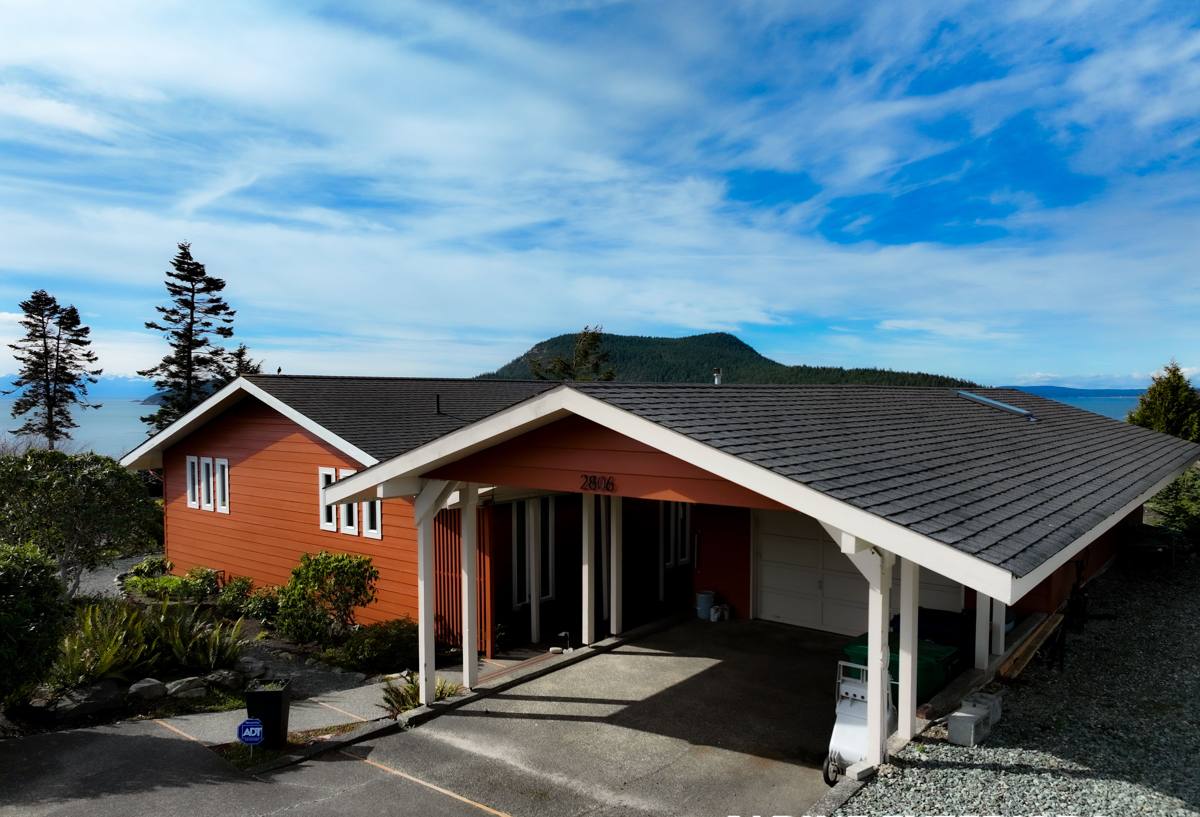
Siding Built for This Climate
We install James Hardie fiber cement siding exclusively. That's not a default we fell into — it's a decision based on what we've consistently seen on tear-offs and repair calls across this climate. Fiber cement doesn't absorb moisture the way wood-based products do, it doesn't warp or swell through repeated wet-season cycles, and its factory-applied ColorPlus finish resists fading and moisture intrusion far longer than paint applied on site. Hardie's HZ5 formulation is engineered specifically for regions with heavy sustained moisture, which fits Bellingham's climate better than a generic, one-size-fits-all siding spec.
Why We Don't Install Everything on the Market
We get asked fairly often about vinyl, LP SmartSide, Cemplank, Allura, primed spruce, and cedar. We don't install any of them, and it's worth being straightforward about why. Vinyl is affordable and low-maintenance in a general sense, but it can go brittle with age under sun exposure and depends entirely on the house wrap and flashing behind it to actually keep water out — an easy thing to get wrong and a hard thing to catch from outside once it's covered up. LP SmartSide and other engineered wood products use a resin-treated wood strand core that performs reasonably in drier climates, but it's more sensitive to moisture intrusion at cut edges and fastener points in a marine environment like this one. Cedar and primed spruce are attractive natural materials, but they need ongoing painting or sealing to stay watertight, and in a climate this wet, that maintenance schedule tends to slip — which shortens the material's real-world lifespan well before it fails on paper. None of these are bad products everywhere. We simply made a professional call that standing behind one system we trust completely, in this specific climate, serves our customers better than offering cheaper alternatives with trade-offs we'd have to explain away later.
Roofing That Handles Wind-Driven Rain and Moss
A roof in Bellingham deals with the same wind and moisture load as the siding, just from a different angle. Wind-driven rain works its way under shingles and flashing at a much higher rate than rain falling straight down, so the details that matter most are the ones a homeowner rarely sees directly: correctly lapped flashing at valleys and penetrations, proper underlayment, and attic ventilation that keeps moisture from condensing where it can't escape. Moss is a persistent issue on roofs across this part of Whatcom County — it holds moisture against roofing material and can work its way under shingle edges over time if it isn't kept in check.
Early Warning Signs Worth Catching
Granule buildup in gutters, dark streaking that goes beyond surface moss, and soft spots near flashing or penetrations are all worth a look before they turn into an interior leak. Catching these early is almost always cheaper than waiting until water has reached the decking or the ceiling below it.
Windows: The Barrier Most Homeowners Underestimate
Windows are one of the more common failure points on exterior walls, and it's rarely because the window unit itself is bad — it's because the flashing and installation around the opening got rushed. On a house exposed to wind-driven rain, a poorly flashed window is a direct path for water into the wall cavity, and that kind of damage can sit hidden inside a wall for years before it shows up as a stain or soft spot. We pay particular attention to sill pan flashing, head flashing, and how the window integrates with the weather-resistant barrier behind the siding — the details that don't show up in a sales pitch but determine whether the installation actually lasts.
- Older single-pane or poorly sealed windows often show condensation, drafts, or fogging between panes — signs the seal has already failed
- Window trim and casing on the weather-facing side of a house typically shows wear (peeling paint, soft wood, gaps) well before the rest of the exterior does
- A window replacement is a good opportunity to correct flashing details that may have been done poorly on the original install
Decks Built for a Wet Marine Climate
A deck in Bellingham spends most of the year exposed to moisture, and periods of direct sun and salt-tinged air the rest of the time. Fastener selection matters more here than it would in a drier, more sheltered region — corrosion-resistant hardware holds up where standard fasteners will stain, corrode, or fail over time. Proper board spacing for drainage, and correct flashing at the ledger board where a deck attaches to the house, are what actually determine whether a deck lasts or starts showing rot and soft spots within just a few years.
Comparing Exterior Approaches in a Climate Like Bellingham's
| Factor | Generic/Lower-Cost Approach | Approach We Use in Puget and Bellingham |
|---|---|---|
| Siding material | Vinyl, engineered wood, or primed wood — lower upfront cost | James Hardie fiber cement with factory ColorPlus finish |
| Fasteners & hardware | Standard-grade, prone to corrosion in marine air | Corrosion-resistant hardware suited to coastal exposure |
| Window flashing | Basic caulk-and-seal, no sill pan | Full sill pan and head flashing integrated with the water barrier |
| Roof underlayment | Minimum-code underlayment | Upgraded underlayment and detailing at valleys and penetrations |
| Maintenance outlook | Regular repainting, patching, panel replacement | Factory finish backed by manufacturer warranty; lower repaint burden |
Real costs depend on the specific house — its size, trim complexity, roof lines, and current condition — which is why we walk the property before quoting rather than pricing off square footage alone.
Signs a Puget-Area Home Needs Exterior Attention
- Moss or dark staining that returns quickly after cleaning, especially on shaded or north-facing walls and roof slopes
- Soft or spongy siding, particularly near the base of the wall or around window and door trim
- Peeling paint, bubbling, or visible warping on siding boards or trim
- Granule loss in gutters or curling shingles on the roof
- Visible gaps at siding seams, corners, or trim joints where water can track in
- A deck with soft boards, corroded fasteners, or staining near the ledger board
- Rising heating bills that may point to a wall or roof assembly that's no longer sealing properly
Why We Treat the Exterior as One System
Exterior problems rarely start where they show up. A roof valley that's leaking, a window that was flashed incorrectly years ago, or a deck ledger board trapping moisture against the house can all surface as siding damage even though the siding is just where the water finally becomes visible. Because we handle siding, roofing, windows, and decks rather than just one trade, we can walk a Puget-area property as one connected system and trace a problem back to where it actually started, instead of covering it up with new material while the underlying leak is still there.
What to Check Before Hiring for Exterior Work in Bellingham
- Ask specifically how the contractor handles wind-driven rain and flashing details, not just what siding brand they carry
- Confirm the contractor's Washington state license, bonding, and insurance are current
- Ask how they handle unexpected substrate damage found once old siding or roofing comes off
- Get clear terms on both the manufacturer's material warranty and the contractor's own workmanship warranty
- Ask how window and door flashing is integrated with the water-resistant barrier, since that's where most long-term leaks start
Why a Local Crew Matters
A crew that works in and around Bellingham regularly sees how marine air, wind-driven rain, and moss actually behave on real houses over a full year, not just how a product performs on a spec sheet. That experience shows up in small, practical decisions on install day — where extra flashing attention pays off, which wall and roof orientations stay wet longest, and which details are worth the extra time so a homeowner isn't dealing with a callback two winters later. It's a different kind of knowledge than what comes from working a wide territory without ever seeing how a specific neighborhood's houses hold up over time.
If your home in the Puget area of Bellingham needs new siding, roofing, window, or deck work — or you just want an honest read on what's really going on with an aging exterior — we're glad to take a look. Reach out using the form below to schedule a free, no-pressure estimate.