 Bellingham Exterior
 Why Birch Bay Siding Wears Out Faster Than Inland Homes
Birch Bay sits right on the water, and that changes the math on how long siding lasts. Homes a few miles inland in Bellingham or Whatcom County deal with plenty of rain, but a waterfront or near-waterfront property in Birch Bay is also fighting salt air, near-constant wind exposure, and long stretches of shade that never quite dry out between storms. Siding that's rated for "Pacific Northwest weather" in general terms doesn't always account for what a shoreline location adds on top of that.
Salt Air and Corrosion
Airborne salt doesn't just sit on the surface of a wall — it works into seams, fastener heads, and any spot where the finish has been compromised. Over years, that accelerates corrosion of exposed metal fasteners and trim, and it breaks down paint films faster than the same product would fade a few miles inland. Siding with a factory-applied, baked-on finish holds up to this kind of exposure far better than a field-painted surface, because there's no thin spot or missed stroke for salt and moisture to exploit.
Driving Rain and Wind-Driven Moisture
Wind off the water pushes rain sideways into walls instead of letting it run straight down and off. That means laps, seams, and butt joints that would stay relatively dry on a sheltered inland wall take a direct hit here. If the water-resistive barrier, flashing, and lap spacing underneath the siding aren't done correctly, wind-driven rain finds its way behind the cladding — and once moisture gets behind siding, it's the sheathing and framing that pay the price, not just the surface material.
Moss and a Long Shade Season
Whatcom County's moss season runs long, and shaded north- and west-facing walls near tree lines or close to the water can stay damp for days at a stretch. Moss and algae growth isn't just cosmetic — sustained dampness against a wall surface accelerates whatever degradation process is already underway, whether that's paint failure, wood fiber swelling, or fastener corrosion.
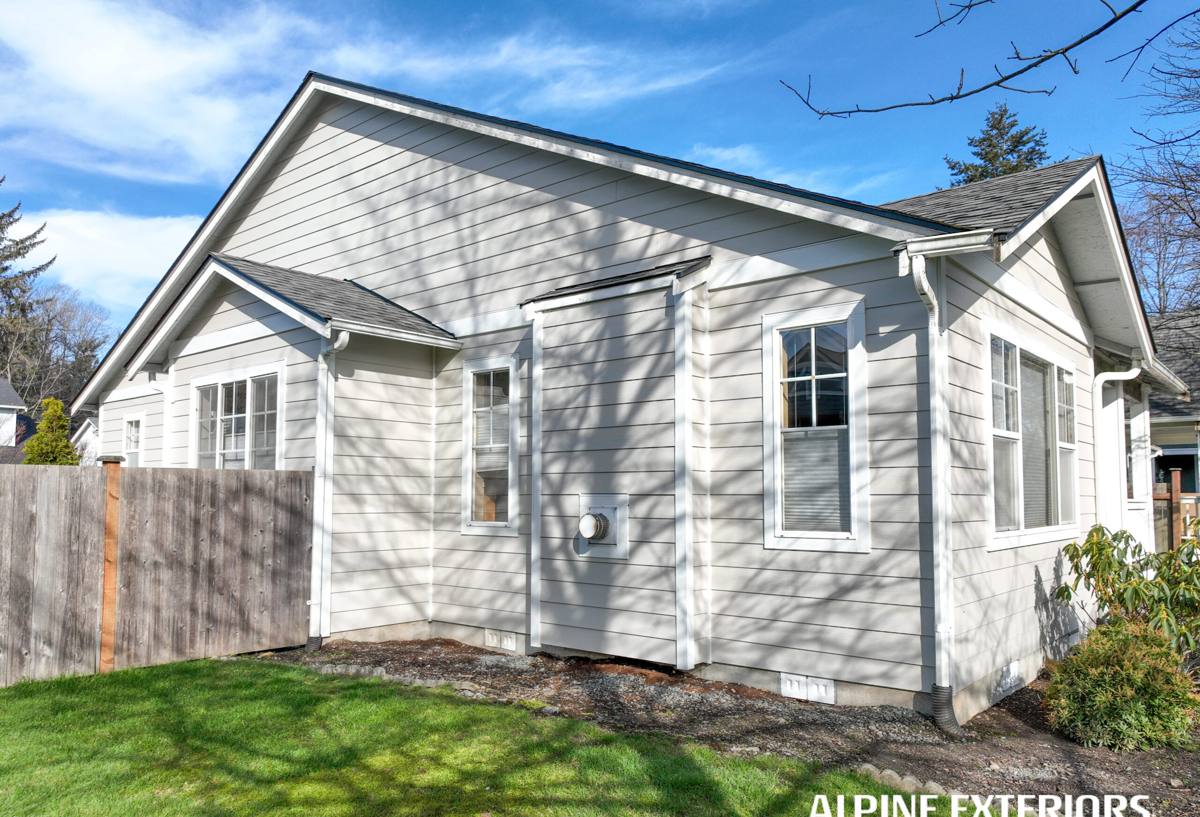
Signs Your Birch Bay Home Needs Siding Replacement, Not Another Repair
Patching is sometimes the right call. But once a few of these show up together, patch jobs stop being cost-effective and full replacement becomes the more honest answer:
- Soft, spongy, or crumbling spots when you press on the siding, especially near the bottom courses or around windows
- Paint that keeps failing within a year or two of repainting, even after prep work
- Visible warping, cupping, or separation at seams and butt joints
- Persistent moss or algae staining that returns within a season of cleaning
- Rust streaks below fastener heads or metal trim
- Interior signs — musty smell, peeling interior paint, or soft drywall — on exterior walls that face the water or prevailing wind
- Siding that's original to a home built more than 20-25 years ago and was never a fiber cement product
What a Correct Siding Replacement Actually Involves
Replacing siding well is not the same job as removing old boards and nailing up new ones in the same pattern. In a wind- and moisture-exposed location like Birch Bay, what happens underneath the new siding matters as much as the siding itself.
Tear-Off and a Real Look at What's Underneath
Full tear-off is the only way to actually inspect the sheathing and framing for rot, soft spots, or prior water damage that's been hidden behind the old cladding. Any compromised sheathing gets replaced before anything new goes up — covering damaged wood with new siding just delays the same problem.
Water-Resistive Barrier and Flashing
A correctly lapped water-resistive barrier, proper window and door flashing, and integrated flashing at every horizontal transition (roofline, deck ledgers, trim bands) are what actually keep wind-driven rain out of the wall assembly. This is the part of the job that's invisible once siding goes back on, and it's also the part most likely to be rushed or skipped by a crew that isn't used to coastal exposure.
Fastening, Clearances, and Joint Treatment
Fastener type, spacing, and depth all affect how well siding resists wind uplift and how long it resists corrosion. Proper ground clearance, deck and roof clearances, and correctly caulked or flashed joints keep bulk water from wicking into the bottom edge of the siding — one of the most common failure points on homes near the water.
Why We Install Only James Hardie Fiber Cement
We made a deliberate decision to install James Hardie fiber cement siding exclusively, and a location like Birch Bay is a good example of why. We don't install vinyl, LP SmartSide, cedar, primed spruce, or other fiber cement brands, and that's worth explaining honestly rather than glossing over.
ColorPlus Factory Finish vs. Field-Applied Paint
James Hardie's ColorPlus finish is baked on in a controlled factory environment, which produces a more consistent, more durable bond than paint applied on-site to any siding material. In a salt-air environment, that matters because factory finishes hold color and resist the fade and chalking that field-applied paint shows first, especially on the sun- and wind-exposed sides of a home.
Engineered for the Climate It's Installed In
James Hardie makes climate-specific product formulations (their HZ product lines) engineered for the moisture and freeze-thaw conditions of a given region, rather than a single one-size-fits-all formulation. That's a meaningfully different approach than a general-purpose engineered wood or vinyl product designed to perform acceptably everywhere but optimally nowhere in particular.
Non-Combustible and Dimensionally Stable
Fiber cement doesn't swell, rot, or support insect activity the way wood-based products can, and it's non-combustible, which matters for insurance and for peace of mind. It also doesn't expand and contract with moisture the way wood products do, which keeps seams and paint lines tighter over time.
How Hardie Compares for a Coastal Property
Every siding material has real strengths. The table below is how we honestly weigh them against the specific demands of a salt-air, high-moisture location like Birch Bay.
| Factor | Vinyl | Engineered Wood (e.g., LP SmartSide) | Cedar / Primed Spruce | James Hardie Fiber Cement |
|---|---|---|---|---|
| Salt air / coastal fade resistance | Fades and can become brittle over time | Depends heavily on paint maintenance | Needs frequent refinishing near the water | Factory ColorPlus finish holds up well |
| Moisture tolerance | Doesn't rot, but seams can trap moisture | Wood-based core is vulnerable if coating fails | Prone to swelling, cupping, rot if not maintained | Cement-based, doesn't swell or rot |
| Maintenance burden | Low, but limited repair options if damaged | Regular repainting/recaulking required | High — regular refinishing needed | Low; repaint cycle far longer than wood |
| Fire resistance | Can melt/deform under heat | Combustible wood-based core | Combustible | Non-combustible |
| Typical warranty structure | Varies widely by manufacturer | Manufacturer warranty, often with maintenance conditions | No manufacturer warranty (natural material) | Strong transferable manufacturer warranty |
None of this means the other products are bad products — it means we made a standard for the homes we put our name on, and fiber cement is the material we're willing to stand behind long-term in this climate.
Our Siding Replacement Process, Start to Finish
The steps don't change much site to site, but the details we pay attention to shift based on exposure. On a Birch Bay project, we're looking harder at wind exposure, drainage paths, and salt exposure on metal components from the very first walkthrough.
- On-site assessment — we look at existing siding condition, sheathing access points, wind exposure, drainage, and any moisture already present
- Written estimate — scope, product selection, color, and a clear breakdown of what's included
- Tear-off and inspection — old siding removed, sheathing checked and repaired as needed
- Water management installed correctly — WRB, flashing at every penetration and transition, proper laps
- James Hardie installation to manufacturer spec — correct fastening, clearances, and joint treatment
- Trim, caulking, and final detailing
- Final walkthrough — we go over the finished work with you before considering the job done
Why Local Experience in Birch Bay Matters
A crew that's worked in Birch Bay before already knows what a first-time crew has to learn on the job: which walls take the worst of the wind, how much worse moss and algae growth can be on shaded sides, and how much more attention flashing details need this close to the water. That's not a small thing — it's the difference between a siding job that looks right on installation day and one that's still performing correctly a decade later. We serve Birch Bay alongside the rest of Whatcom County out of Bellingham, and we treat coastal properties as their own category, not a slight variation on an inland job.
After Installation: What Upkeep Actually Looks Like
One of the practical benefits of switching to James Hardie in a location like this is how little ongoing maintenance it asks for compared to wood-based siding. A periodic rinse to knock off salt residue and moss buildup, an eye kept on caulking at trim joints, and prompt attention if anything ever gets physically damaged is most of what's needed. That's a meaningfully lighter maintenance load than repainting or recoating cycles that wood and engineered wood products require to keep performing near the water.
If your Birch Bay home is showing any of the wear signs above, or you just want an honest read on where your current siding stands, we're happy to take a look. Estimates are free, there's no pressure, and you'll get a straight answer about whether you need full replacement, targeted repair, or nothing at all yet — just fill out the form below to get started.