 Bellingham Exterior
 Why Decks Wear Out Faster in Sudden Valley
Sudden Valley sits in one of the shadier, more humid pockets of the Bellingham area. The heavy tree canopy and closeness to Lake Whatcom keep decks damp long after the rain stops, and that combination of shade and moisture is exactly what moss, algae, and slow wood rot need to take hold. Add in Whatcom County's long wet season and the salt-tinged air that moves through the region off the Sound, and you have a climate that is genuinely hard on outdoor structures — hardware corrodes faster, wood fibers stay saturated longer, and any weak point in a deck's construction gets found out within a few seasons instead of a few decades.
We see the same failure pattern on a lot of Sudden Valley decks: the surface boards still look okay from a distance, but the framing underneath, the ledger board attachment to the house, or the footings have been quietly failing for years. A deck built without the right flashing, spacing, or fastener choices for this specific microclimate will look fine right up until it doesn't.
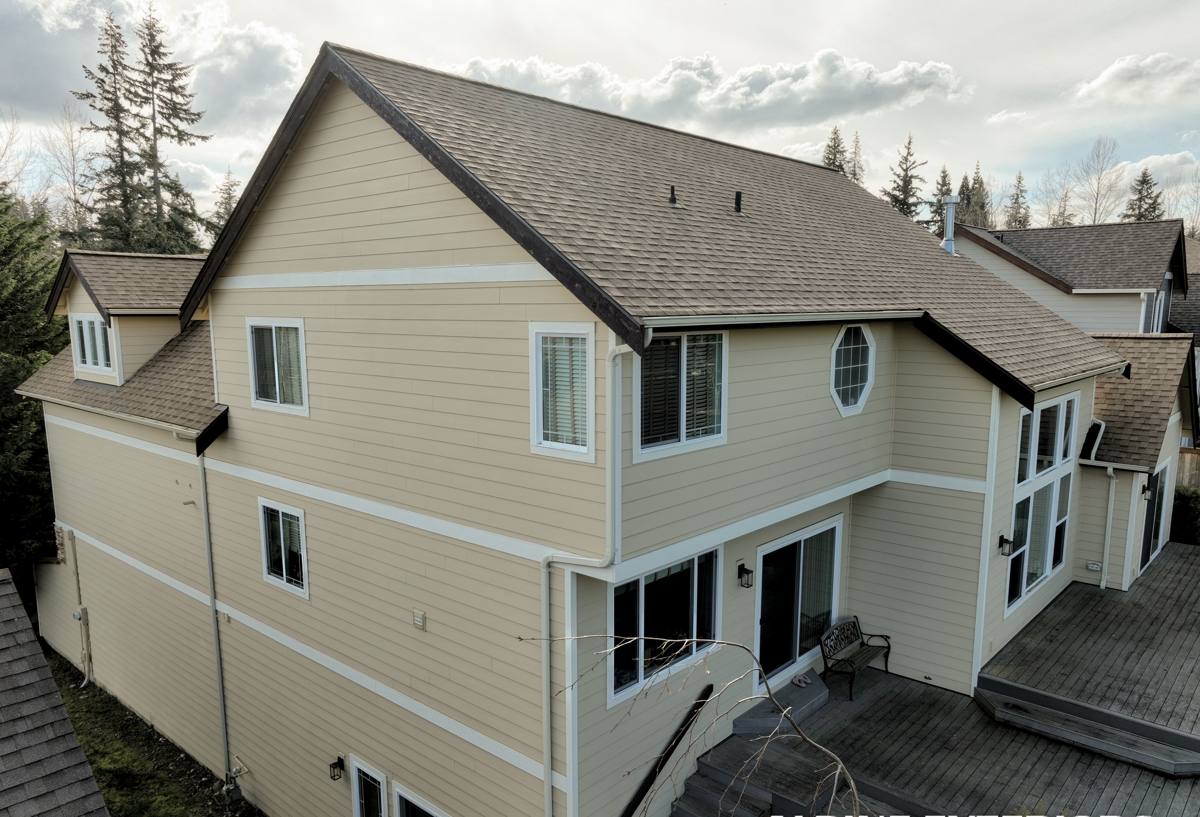
Signs a Deck Needs Replacement, Not Another Repair
Not every tired-looking deck needs to come out. But there's a point where patching boards or re-staining stops being a real fix and starts being a way to delay the inevitable. Watch for these signs:
- Soft, spongy spots in the decking or stair treads when you walk on them
- Green or black staining that comes back within weeks of cleaning
- Visible gaps, cracking, or splitting at board ends and around fasteners
- A ledger board pulling away from the house, or gaps where it meets the siding
- Wobble in the railing posts or stairs, which usually points to a post or footing problem, not just a loose railing
- Rust streaking from screws or bolts, a sign the fasteners are failing from the inside out
If more than one or two of these show up, especially the soft spots or ledger separation, it's usually a structural issue rather than a cosmetic one. That's when full replacement is the honest recommendation.
Moss Season and What It's Really Telling You
A little moss on a deck surface is normal in this part of Washington and isn't, by itself, a reason to replace anything. What matters is what's happening underneath. If moss is thick between boards, holding moisture against the wood for months at a time, it's accelerating decay in the framing below — joists, beams, and ledger connections you can't see from the top. On a shaded Sudden Valley lot, a deck can look "just needs a cleaning" on the surface while the structure underneath has already lost real strength.
What a Correct Deck Replacement Actually Involves
A deck replacement isn't just pulling up old boards and screwing down new ones. Done right, it starts from the ground up:
- Footings and posts. We check depth, size, and condition against current code — a lot of older Whatcom County decks were built on undersized or shallow footings that won't pass inspection today.
- Ledger attachment. This is the single most common failure point on wet-climate decks. Proper flashing between the ledger and the house siding keeps water from tracking behind the wall, which is a rot and moisture-intrusion risk for the house itself, not just the deck.
- Framing. Joist spacing, beam sizing, and hardware (joist hangers, structural screws, hot-dip galvanized or stainless fasteners) all need to match the load and the local corrosion environment.
- Decking surface. Board choice, gap spacing for drainage and airflow, and fastening pattern all affect how well the surface sheds water and resists moss buildup.
- Railings and stairs. Code-compliant height, baluster spacing, and stair rise/run — these get checked and updated even if the rest of the deck is a straightforward rebuild.
- Drainage underneath. On sloped or shaded Sudden Valley lots, water management under the deck matters as much as on top of it.
Choosing a Decking Material for This Climate
There's no single "best" decking material — there's a best material for your budget, your shade level, and how much upkeep you actually want to do. Here's how the common options hold up in a wet, shaded, moss-prone environment like Sudden Valley:
| Material | Moss/Moisture Resistance | Maintenance | Typical Lifespan |
|---|---|---|---|
| Pressure-treated wood | Fair — needs sealing and cleaning to keep water out | Annual cleaning and re-sealing recommended | 15-20 years with upkeep |
| Cedar | Good natural resistance, but still absorbs moisture over time | Regular cleaning, periodic oil or stain | 20-25 years with upkeep |
| Composite / capped composite | Very good — doesn't absorb water or feed rot the way wood does | Occasional washing, no staining or sealing | 25-30+ years, warranty-backed |
| PVC | Excellent — fully synthetic, minimal moisture uptake | Low — occasional washing | 30+ years |
In a heavily shaded, moss-heavy setting, composite and PVC decking earn their higher upfront cost back in reduced maintenance — you're not scrubbing and resealing every year to keep moss and mildew from taking hold. Wood is still a legitimate choice for homeowners who want that look and are willing to keep up with sealing on a regular schedule; we'll tell you straight whether your lot's sun exposure makes that realistic or not.
What Drives the Cost of a Deck Replacement
| Factor | Why It Matters |
|---|---|
| Deck size and shape | More square footage and multiple levels or angles increase material and labor |
| Decking material | Composite and PVC cost more upfront than wood but less over the deck's life |
| Framing condition | If posts, beams, or footings need replacing (common on older wet-climate decks), that adds structural work beyond a surface swap |
| Site access | Sloped, tree-covered, or tight-access lots — common around Lake Whatcom and Sudden Valley — can add time for material staging and equipment |
| Railings and stairs | Custom railing styles, glass panels, or multiple stair runs add cost beyond a basic code railing |
| Permitting | Structural decks generally require a permit; larger or elevated decks may need engineering review |
We give a written scope and price range after seeing the actual deck and site — not a phone-quote guess. Anyone quoting a firm number without walking the property is skipping steps that matter, especially on a sloped or shaded lot.
Our Process for Sudden Valley Deck Replacements
We keep this straightforward because homeowners deserve to know what's happening and when:
- On-site evaluation. We check the framing, footings, ledger, and surface, and tell you honestly whether you need a repair, a partial rebuild, or a full replacement.
- Written scope and material options. You get a clear plan and a price range before any demolition starts, with material choices laid out plainly — no upselling to composite if wood genuinely fits your situation.
- Permitting. We handle the permit process with the county so the work is inspected and compliant, not something that turns into a problem when you sell the house.
- Demolition and disposal. Old decking, framing, and hardware removed and hauled off — we don't leave debris piled on the property.
- Rebuild. Footings, framing, ledger flashing, decking, and railings installed to current code, with fastener and hardware choices matched to this area's moisture and corrosion exposure.
- Final walk-through. We go over the finished deck with you, including basic care guidance for whatever material you chose.
Why a Crew That Already Works Sudden Valley Matters
Sudden Valley isn't a typical in-town lot. Many properties sit on slopes, back up to trees, or have limited access for material delivery and equipment staging. A crew unfamiliar with the community can lose real time just figuring out logistics that a local crew already knows how to plan around. There's also the practical matter of navigating the community's private roads and, where applicable, working within any architectural or association guidelines specific to the neighborhood — something a contractor who hasn't worked there before may not think to check until it causes a delay.
Beyond logistics, a contractor who's replaced decks throughout the greater Bellingham and Whatcom County area knows what actually holds up here versus what looks fine on paper but fails in three to five years of driving rain and shade. That's not a marketing line — it's the difference between a deck that needs attention again in half a decade and one that doesn't.
A Few Questions Worth Asking Any Contractor
- Will you pull a permit for this project, and is the cost of that included?
- What fastener and hardware grade are you using, and is it rated for this climate?
- How will the ledger board be flashed against the house?
- What's the warranty on materials versus on your labor, and who do I call if something needs attention in year three?
- Can you show me examples of decking work you've done in this area?
A contractor who answers these plainly, without dodging or padding, is one worth trusting with the job.
Get a Straight Answer on Your Deck
If your Sudden Valley deck is showing soft spots, persistent moss, or a railing that's starting to wobble, it's worth having someone look at the framing before deciding what it needs. We offer free, no-pressure estimates — we'll tell you honestly whether it's a repair or a replacement, and what a correct rebuild would involve for your specific lot. Use the form below to get started.