 Bellingham Exterior
 Why Blaine's Coastal Climate Is Hard on Siding
Blaine sits at the far northwest corner of Whatcom County, right where the Salish Sea meets the Canadian border. That location shapes how siding ages here more than most homeowners realize. Homes near Semiahmoo Bay and Drayton Harbor take on a steady diet of salt-laden air, wind-driven rain coming off the water, and a moss season that can run from early fall through late spring in a wet year. None of that is unique to this stretch of coastline, but the combination — marine salt exposure layered on top of the general Pacific Northwest damp — is tougher on exterior materials than what a house twenty miles inland has to deal with.
Salt air is corrosive. It works on fasteners, flashing, and any exposed metal trim, and it accelerates the breakdown of finishes that aren't built to handle it. Driving rain doesn't just wet a wall — wind pushes it sideways and up under laps, trim, and penetrations that would stay dry in a calmer climate. And moss and algae need two things to take hold: moisture and shade, both of which Whatcom County's coastal exposures supply in abundance for a good chunk of the year. Siding that isn't engineered for this environment, or that goes up with shortcuts in the flashing and fastening details, shows the damage early — soft spots, staining, cupping, and paint failure well before it should.
Why James Hardie Fiber Cement Is What We Put on Blaine Homes
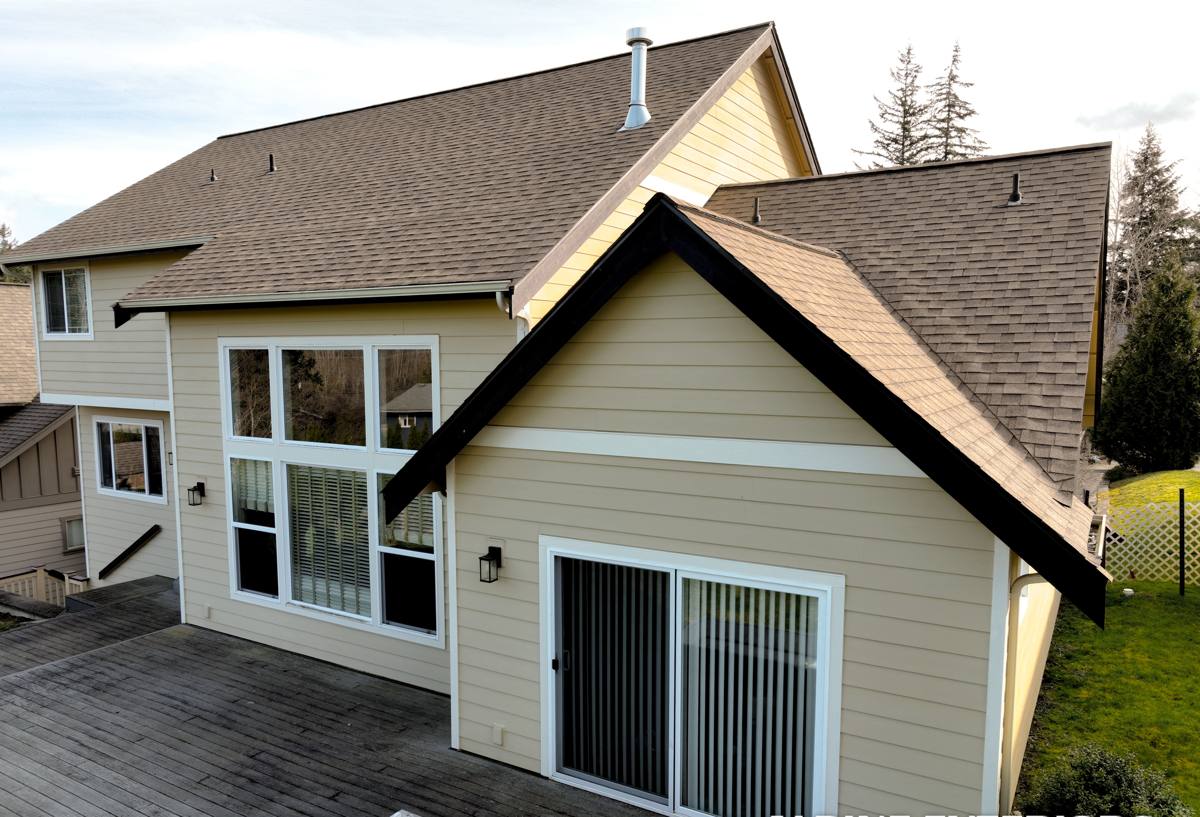
We install James Hardie fiber cement exclusively, and Blaine's climate is a big part of why. Fiber cement doesn't absorb moisture the way wood-based products do, and it won't rot, delaminate, or feed the moss and mildew growth that thrives in a wet marine environment. It's also non-combustible, which matters as much for insurance considerations as it does for fire safety.
James Hardie engineers its panels by climate zone, and homes in Whatcom County fall into the company's HZ5 category — built for regions with real moisture exposure and freeze-thaw cycling, as opposed to the HZ10 formulation made for hot, humid, non-freezing climates. That distinction isn't marketing. HZ5 boards are formulated to hold up to the wet-cold-wet cycle that a Blaine winter puts them through, which is a different stress than what a product engineered for the Southeast has to survive.
The factory-applied ColorPlus finish matters here too. It's baked on under controlled conditions and backed by its own finish warranty, so the color coat isn't fighting salt air and UV exposure the way a field-applied paint job would. Less repainting, and a finish that resists the chalking and fading that coastal sun and salt spray cause over time.
Hardie also backs its siding with a strong, transferable product warranty — a real advantage if you sell the house within the coverage period, since the protection follows the home rather than staying with the original owner. That's worth factoring in on a coastal property, where buyers often ask pointed questions about how the exterior has held up.
What a Correct Installation Actually Involves
James Hardie siding is only as good as the installation underneath it. In a coastal climate like Blaine's, the details that get skipped on a rushed job are exactly the ones that cause problems in year three or four, not year one — which is why a lot of bad installs look fine at first.
Water management comes first
Before a single piece of siding goes up, the wall needs a properly lapped weather-resistive barrier, correctly integrated flashing at every window, door, and penetration, and a drainage plane that lets any moisture that does get behind the siding find its way back out. On a house exposed to driving rain off the water, this layer is doing more work than the siding itself.
Fasteners and clearances
In a salt-air environment, fastener choice isn't a minor detail. We use corrosion-resistant fasteners rated for the exposure and follow Hardie's nailing patterns exactly — proper spacing, correct depth (not overdriven, not underdriven), and blind-nailing where the product line calls for it. We also hold the manufacturer's minimum clearances from grade, roof lines, and decks, because tight clearances are one of the most common ways moisture gets trapped against the bottom of a wall.
Joints, caulking, and trim
Hardie's engineered joint systems and factory-primed edges are designed to shed water, but only if the caulking, trim, and butt joints are installed to spec. We treat cut edges with touch-up per Hardie's guidelines so raw fiber cement isn't left exposed to the weather, and we keep sealant use to where it's actually specified rather than as a substitute for correct flashing.
Our Process, Start to Finish
- On-site assessment of the existing siding, sheathing, and any moisture or rot already present, with photos and a plain-language explanation of what we find
- Careful tear-off, checking sheathing condition as we go — this is often where hidden water damage from a prior installation shows up
- Repair or replacement of any compromised sheathing before anything new goes on the wall
- Installation of the weather-resistive barrier, flashing, and drainage details specific to your home's exposure
- Hardie panel, plank, or trim installation to manufacturer spec, with fastening and clearances checked as work progresses, not just at the end
- Final walkthrough so you can see the completed work and ask questions before we consider the job done
We don't treat siding as a cosmetic swap. On a coastal property, the siding is a big part of the building's defense against water, and we install it that way.
How James Hardie Compares to Other Siding Options in a Coastal Climate
Homeowners in Blaine often ask us to weigh in on alternatives before committing to a full replacement. Here's an honest look at how the common options hold up against the specific stresses of salt air, driving rain, and moss:
| Material | Moisture & Salt Air Resistance | Maintenance Burden | Fire Resistance | Typical Lifespan (correctly installed) |
|---|---|---|---|---|
| James Hardie fiber cement | Engineered for coastal/mixed climates (HZ5); does not rot | Low — factory finish, no regular painting | Non-combustible | 30+ years |
| Vinyl siding | Won't rot, but seams and panels can warp or loosen under wind-driven rain and salt spray over time | Low, but color fades and becomes brittle with UV/salt exposure | Combustible, can melt/deform near heat sources | 15-25 years |
| Cedar or wood siding | Absorbs moisture; needs a sound finish to resist rot and moss in a wet marine climate | High — regular refinishing and moss/mildew treatment | Combustible | 15-25 years with diligent upkeep |
| LP SmartSide (engineered wood) | Treated to resist moisture, but relies on field-caulked joints and paint film staying intact | Moderate — repainting and joint maintenance over time | Combustible | 20-30 years with consistent maintenance |
Every product on this list can perform if it's installed and maintained correctly. Our reason for standardizing on James Hardie isn't that the alternatives are unusable — it's that fiber cement's moisture behavior, factory finish, and non-combustible makeup line up best with what a house in this climate needs, with the least ongoing maintenance burden for the homeowner.
Living With Hardie Siding on the Coast: What to Expect
Hardie siding is low-maintenance, not no-maintenance. In a salt-air, high-moss environment like Blaine's, a little seasonal attention keeps it performing the way it's supposed to for decades.
- Rinse the exterior periodically to clear salt residue and organic buildup, especially on north- and shade-facing walls where moss takes hold fastest
- Keep gutters and downspouts clear so water isn't overflowing onto siding below
- Trim back vegetation and shrubs that hold moisture against the wall or block sun and airflow
- Check caulking at trim and joints every year or two and have any cracked or missing sealant addressed before winter rains set in
- Inspect after major windstorms for any loosened trim, fasteners, or flashing, particularly on wind-exposed and water-facing walls
- Address any soft spots, staining, or discoloration promptly rather than waiting for a full season to pass
Why It Matters That We Already Work in Blaine
Installing siding correctly in a coastal, salt-exposed part of Whatcom County isn't the same job as installing it on an inland lot with less wind and moisture exposure. A crew that hasn't worked this stretch of coastline before can miss the exposures that matter most here — which walls take the worst of the wind-driven rain, where moss and shade problems tend to concentrate, and how much heavier the fastening and flashing details need to be treated on a water-facing elevation.
We've done this work up and down Whatcom County's coastline, and that experience shows up in the decisions we make on your house before the first panel ever goes up — where we add extra flashing attention, which clearances we won't compromise on, and how we sequence a tear-off so your home isn't sitting open to the weather longer than it has to be.
Coastal properties in Whatcom County sometimes fall under shoreline or development-specific design guidelines, and permit requirements can vary by jurisdiction. We handle the permitting process and can work within whatever color or material guidelines apply to your property, so that's one less thing you have to sort out yourself.
What Correct Installation Costs You If It's Skipped
The real cost of a shortcut installation in this climate almost never shows up on the invoice — it shows up two to five years later, as moisture damage behind the siding, premature finish failure, or trim that's already corroding. Getting the water management, fastening, and clearances right the first time costs the same in labor whether the crew understands why those details matter here or not. The difference is entirely in whether the job holds up against what Blaine's weather actually does to a house.
If you're weighing a siding replacement or repair on a home in Blaine, we're happy to take a look and walk you through exactly what your house needs, with no pressure to commit. Reach out using the form below for a free estimate.