 Bellingham Exterior
 Why Decks in Columbia Wear Out Faster Than the Manual Says
Most decking products are rated and warrantied based on lab conditions or a generic national climate average. Columbia isn't average. This is one of Bellingham's older, established neighborhoods, with mature tree canopy over many lots, a short walk to Bellingham Bay, and a marine layer that keeps humidity high for most of the year. Add Whatcom County's long, low-intensity rainy season and you get decks that stay damp far longer after a storm than the manufacturer's spec sheet assumes. That extra dwell time is what actually shortens a deck's life — not any single hard freeze or downpour, but months of low-grade moisture sitting in end grain, fastener holes, and shaded corners.
Salt-laden air off the bay adds a second stressor: it accelerates corrosion in fasteners, joist hangers, and railing hardware, especially on decks that face west or sit low relative to the water. Combine that with shade from established trees and you get the third factor — moss and algae growth that starts earlier in fall and hangs on later into spring than it would on a sun-exposed deck across town. A deck built without these three things in mind — moisture dwell time, corrosion exposure, and moss season — will show problems years before a comparable deck in a drier, sunnier climate.
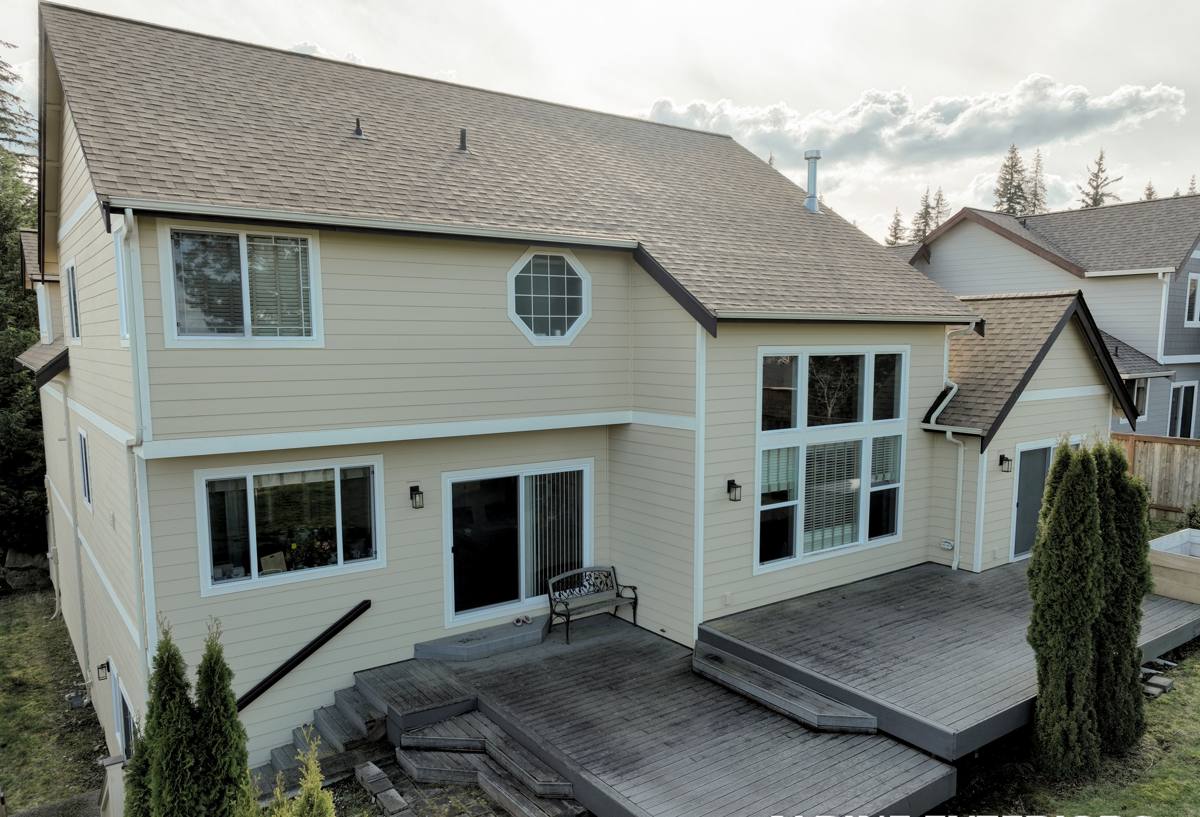
Repair or Replace? Reading the Signs
Not every tired-looking deck needs a full replacement. But in this climate, cosmetic problems are often a sign that something structural is already underway underneath. Before we recommend replacement over repair, we check for these:
- Soft or spongy decking boards, especially near the house or in shaded corners where moss holds moisture against the wood
- Rot or discoloration at the ledger board — the point where the deck attaches to the house, and the single most common failure point in this region
- Posts that are soft, cracked, or shifting at or below grade
- Rust streaks below joist hangers or fasteners, which usually means the hardware is failing from the inside out
- Railings that flex or feel loose when leaned on
- Persistent green or black staining that returns within weeks of cleaning, which points to a moisture problem rather than a surface one
- A deck more than 20-25 years old built to an older structural or fastening standard
If the framing and ledger connection are sound, targeted repair can make sense. If those core structural elements are compromised, patching the surface just buys a season or two before the same failures reappear.
The Ledger Board Test
Because so many Columbia homes are older builds with additions and decks retrofitted over the years, the ledger connection is where we spend the most time during any inspection. A deck can look solid from the yard and still be barely attached to the house if the original flashing was never installed correctly, or wasn't installed at all.
What a Correct Deck Replacement Actually Involves
Framing and Structure
Every replacement starts with the frame, not the decking. That means correctly sized beams and joists for the actual span and load, footings poured to the depth required for our soil and frost conditions, and posts set on proper bases rather than resting directly on soil or a paver. This is also where we correct anything from the original build that doesn't meet current code — a common finding on older Columbia decks that predate today's structural and guardrail requirements.
Flashing and Moisture Management
The ledger board gets a continuous flashing detail that sheds water away from the house, not into it. Every joist hanger, post base, and fastener point gets hardware rated for exterior and, where relevant, coastal exposure — standard interior-grade hardware corrodes too quickly this close to the bay. Decking gaps are set to allow airflow and drainage underneath, which matters more here than in drier climates because it's the difference between a deck that dries out between storms and one that never does.
Fasteners and Hardware
We use corrosion-resistant, code-rated fasteners and connectors throughout. This sounds like a small detail until you've pulled apart a ten-year-old deck where the visible boards look fine but the hidden hardware has rusted through — which is a far more common failure locally than most homeowners expect.
Choosing Materials for This Climate
There's no single "best" decking material — there's a best fit for how much upkeep you want to do and how the deck sits relative to shade, moisture, and salt exposure. Here's how the common options actually perform under Columbia's conditions:
| Material | Moisture & Moss Behavior | Maintenance | Typical Lifespan Here |
|---|---|---|---|
| Pressure-treated wood | Absorbs moisture readily; moss and algae take hold quickly in shaded spots without upkeep | Annual cleaning and periodic sealing required | 10-15 years before major issues |
| Cedar | Naturally more rot-resistant than treated pine, but still porous and needs sealing to resist moss staining | Regular cleaning and re-oiling to hold appearance | 15-20 years with upkeep |
| Composite (capped) | Sheds surface moisture well; moss can still grow on the surface in deep shade but doesn't penetrate the board | Occasional washing; no sealing or staining | 25-30+ years |
| PVC decking | Fully moisture-resistant core; best option for heavily shaded or low-airflow deck areas | Lowest upkeep of the group | 25-30+ years |
We install all of these and will talk through the honest trade-offs for your specific lot — how much sun the deck gets, how close it sits to grade, and what upkeep you're actually willing to do, since a low-maintenance material only pays off if it fits the site.
Our Deck Replacement Process
- On-site assessment — we inspect the ledger, framing, footings, and posts before quoting anything, since what's underneath drives the scope more than the decking material does
- Permit filing — deck replacements in Bellingham typically require a permit; we handle the filing and inspection scheduling
- Demolition — full removal of the old decking, railings, and any compromised framing
- Framing and flashing — new or repaired structure, correct ledger flashing, corrosion-resistant hardware throughout
- Decking and railing installation — installed per manufacturer spacing and fastening specs so any product warranty stays intact
- Inspection and walkthrough — city sign-off where required, then a walkthrough with you before we call the job done
Permits, Code, and Working With the City of Bellingham
Deck replacement almost always triggers a permit requirement, and for good reason — guardrail height, baluster spacing, footing depth, and ledger attachment are all code items that get checked, especially on a structure people stand on. We handle the permit process directly, which matters most on older Columbia properties where the existing deck may have been built or modified before current code existed. Bringing an old deck up to current standards isn't optional if you want it signed off, and it isn't something to discover halfway through a project.
What Columbia's Older Lots Mean for Your Deck
Columbia has a mix of established bungalows and infill homes on lots that have had decades for trees to mature. That canopy is part of the neighborhood's character, but it also means many decks here sit in partial or deep shade for a large part of the day. Shade slows drying time after rain, which is exactly the condition that lets moss get a foothold and hold on longer into the season than it would on an open, sun-exposed deck elsewhere in Whatcom County. Some lots also have enough slope that drainage under and around the deck needs real attention during framing, not just at the surface. None of this makes a deck impossible to build well here — it just means the build has to account for airflow, drainage, and material choice with this specific setting in mind, not a generic spec.
Protecting Your New Deck — A Maintenance Checklist
A well-built deck still needs some seasonal attention, especially through a long Whatcom County moss season. This is the minimum we recommend:
- Sweep leaves and debris off the deck surface regularly in fall, especially in shaded corners
- Keep nearby gutters clear so overflow isn't draining onto or under the deck
- Rinse off moss and algae growth before it stains or gets slick, using a deck-safe cleaner rather than a pressure washer set too aggressively
- Check railings and stair connections once a year for looseness
- For wood decks, reseal on the schedule the product calls for — don't wait until it's visibly gray and dry
- Glance under the deck once a year for signs of moisture pooling or hardware corrosion
Why Hiring a Crew That Already Works in Columbia Matters
Anyone can build a deck on a dry, sunny day. The difference shows up years later, in how the ledger flashing was detailed, whether the hardware was rated for salt exposure, and whether the framing accounted for how long this specific lot stays damp after a storm. A crew that already works in Columbia and the surrounding Bellingham area has seen how decks here actually fail — not in a manual, but on real jobs — and builds accordingly from the first footing. That local experience, combined with a working relationship with the city's permitting process, is what keeps a project on schedule and built to hold up, not just to pass inspection on day one.
If your deck is showing its age, or you're just not sure whether repair or replacement makes sense, we're happy to take a look. Reach out for a free, no-pressure estimate using the form below.