 Bellingham Exterior
 Edgemoor's Exposure Is Different From an Inland Bellingham Lot
Edgemoor sits close to Bellingham Bay, and that proximity changes what siding has to survive. Homes here deal with a combination most inland Whatcom County neighborhoods don't see at the same intensity: salt-laden air drifting off the water, driving rain pushed sideways by wind off the bay, and long stretches of shaded, damp weather that keep north- and west-facing walls wet for days at a time. Add in the mature tree canopy that gives Edgemoor its character, and you get siding that rarely gets a full afternoon of sun to dry out between storms.
None of that is a problem you can ignore with a coat of paint and hope. Salt air accelerates corrosion on fasteners and trim. Wind-driven rain finds every gap in flashing and caulk. And low sun exposure plus tree cover is exactly the recipe for moss and algae growth on siding, trim, and roof lines. A siding product and installation method that work fine on a dry, open lot in the county can fail years early on a shaded, bay-facing wall in Edgemoor.
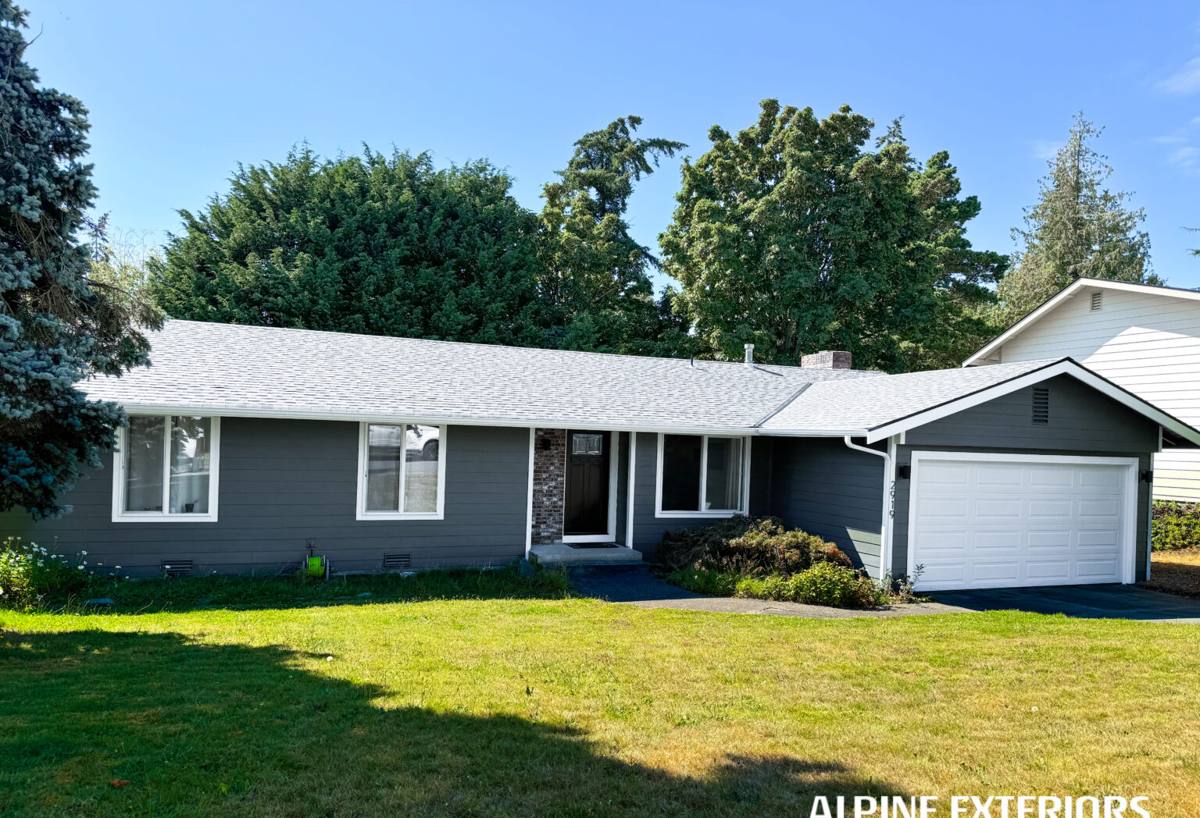
What Salt Air, Rain, and Moss Actually Do to Siding
Salt Air
Airborne salt is corrosive to metal and can gradually break down the surface of some siding materials, especially at seams, fasteners, and cut edges where protective coatings are thinnest. Over years, this shows up as fastener staining, trim corrosion, and premature wear at panel joints — problems that concentrate on the bay-facing sides of a home.
Driving Rain
Wind off the water doesn't just wet a wall, it drives moisture sideways and upward, forcing water into laps, seams, and penetrations that would stay dry on a calmer lot. If a wall assembly doesn't have a real drainage path behind the siding, that water has nowhere to go and ends up in the sheathing.
Moss and Algae
Shade from mature trees plus persistent moisture is ideal for moss, lichen, and algae. On some siding materials this growth holds moisture directly against the surface and, if left unaddressed, contributes to rot at the substrate. On a factory-finished fiber cement product, moss and algae are a surface cosmetic issue you can clean off — not a structural one, as long as the wall behind it stays dry.
Why We Install Only James Hardie Siding
We don't offer vinyl, LP SmartSide, Cemplank, Allura, primed spruce, or cedar. That's a deliberate standard, not a lack of options. On a lot like Edgemoor's, the material has to hold up to salt exposure, resist moisture at the seams, and keep its finish through repeated wet-dry cycles without the homeowner babysitting it every season. James Hardie fiber cement is engineered for exactly that combination:
- Non-combustible core — fiber cement doesn't feed a fire the way wood-based or wood-fiber composite sidings can, which matters more every fire season in Washington.
- ColorPlus factory finish — a baked-on finish applied under controlled conditions, which resists fading and chipping far better than field-applied paint, and holds up better to salt exposure than site-finished materials.
- HZ5 climate engineering — Hardie manufactures region-specific formulations; the HZ5 line is engineered for wetter, more moisture-exposed climates like ours, rather than a one-size-fits-all product.
- Dimensional stability — fiber cement doesn't swell, cup, or split from repeated wetting the way wood and some wood-composite products can over time.
- Transferable warranty — a real, documented warranty that carries value if the home sells, which matters in a neighborhood like Edgemoor where homes hold value over the long term.
We're not going to tell you every other product is worthless — vinyl is cheap and low-maintenance in the right setting, cedar has real curb appeal, LP SmartSide has a following. But on a bay-exposed, tree-shaded lot, the trade-offs on those products (moisture sensitivity, coating maintenance, seam performance, or long-term durability in salt air) are trade-offs we're not willing to put our name behind. Hardie is what we install because it's what performs here without asking the homeowner to compensate for the product's weak points.
Which Hardie Product Line Fits an Edgemoor Home
Edgemoor has a mix of architectural styles, from traditional Pacific Northwest homes to more contemporary builds, often set back among trees with a lot of visual privacy. The right Hardie product depends on the home's design and how much of the wall is exposed to weather versus shaded by trees.
| Hardie Product | Best Fit For | Why It Works Here |
|---|---|---|
| HardiePlank lap siding | Traditional and craftsman-style homes | Classic horizontal reveal, wide color range, proven performance in wet climates |
| HardiePanel vertical siding | Contemporary homes, accent walls, gable ends | Clean modern lines; fewer horizontal laps means fewer water-catching seams on exposed walls |
| HardieShingle | Homes wanting a shingle-style look without cedar's upkeep | Gets the staggered-shingle aesthetic with fiber cement durability and a factory finish |
| HardieTrim boards | Corners, window and door trim, fascia | Matches the siding's moisture resistance so trim doesn't become the weak point |
On heavily shaded, bay-facing elevations, we'll often recommend the smoothest available texture and a color from Hardie's ColorPlus palette that shows dirt and moss staining less between cleanings — a small decision that reduces how often a homeowner has to think about maintenance.
What Correct Installation Involves on a Bay-Facing Lot
Siding fails less often because of the board itself and more often because of what's behind it. On an exposure like Edgemoor's, the installation details matter more than they would on a sheltered inland lot.
Drainage Plane and Rainscreen
We install a water-resistive barrier and, on exposed elevations, a rainscreen gap behind the siding so any moisture that does get past the surface has a path to drain and dry instead of sitting against the sheathing. This is the single biggest factor in whether a wall assembly survives decades of wind-driven rain.
Flashing at Every Penetration
Windows, doors, hose bibs, light fixtures, and vents are where wind-driven rain gets in. Proper head, jamb, and sill flashing — installed in the correct sequence with the water-resistive barrier — keeps water moving outward instead of behind the siding.
Fastener Choice and Placement
Salt air is hard on fasteners. We use corrosion-resistant fasteners installed to Hardie's specifications, at the correct depth and spacing, because an overdriven or misplaced nail creates a point where water and salt exposure can compromise the panel over time.
Correct Gaps and Sealant Use
Hardie's installation instructions call for specific gaps at butt joints and trim, sealed with the right sealant — not caulked solid, which traps moisture instead of letting the assembly manage it. Skipping this is one of the most common corner-cutting mistakes on fiber cement jobs.
Our Process for an Edgemoor Siding Project
- On-site assessment. We walk the home, note which elevations take the most wind and rain, check for existing moisture damage, and look at tree cover and shade patterns that affect drying time.
- Tear-off and sheathing check. Old siding comes off and we inspect the sheathing underneath for rot or moisture damage before anything new goes up — this is where hidden problems from years of trapped moisture usually show up.
- Weather barrier and rainscreen installation. A code-compliant water-resistive barrier goes on, with a drainage gap on exposed elevations.
- Flashing at all penetrations. Windows, doors, and any wall penetrations get properly flashed before siding installation starts.
- Hardie siding installation to spec. Panels or planks go up with correct fastener type, spacing, and gaps, following Hardie's published installation instructions for our climate zone.
- Trim, caulking, and paint touch-up. Trim boards, corners, and any field-cut edges get sealed and finished per Hardie's requirements to preserve the warranty.
- Final walkthrough and cleanup. We review the finished work with the homeowner and haul away debris and old material.
Maintenance: What an Edgemoor Homeowner Should Actually Expect
Correctly installed Hardie siding is low-maintenance, not zero-maintenance. Given the moss and algae pressure in a shaded, bay-adjacent setting, a short seasonal routine keeps the siding looking good and protects the finish:
- Rinse siding with a garden hose (not a pressure washer aimed directly at seams) once or twice a year to remove salt residue, pollen, and surface grime.
- Check shaded, north- and west-facing walls in late fall and late winter for moss or algae buildup and clean gently with a soft brush and a mild cleaner labeled safe for fiber cement.
- Keep gutters clear so overflow doesn't run down the siding and create constantly wet strips that encourage moss growth.
- Trim back tree branches and shrubs that keep a wall in constant shade or brush directly against the siding.
- Inspect caulking at trim and penetrations every year or two and have any cracked or missing sealant redone before it lets water behind the siding.
- Touch up any exposed cut edges (from later modifications like a new fixture or vent) with matching Hardie-approved paint to keep that seam protected.
Why a Crew That Already Works Edgemoor Matters
A siding crew that hasn't worked bay-facing, tree-covered lots before tends to install the same way they would on a dry, open inland property — and that's exactly where the drainage and flashing details above get skipped, because they don't seem necessary until the first hard winter. A crew that already knows Edgemoor's exposure builds in the rainscreen gap, the extra attention to flashing, and the fastener choices as standard practice, not an upsell.
There's also a practical side: narrower, tree-lined lots and limited staging space are common in established Bellingham neighborhoods like this one. A crew that's worked the area knows how to plan material staging, scaffolding, and access without unnecessary disruption to landscaping or neighboring properties.
Cost Factors on an Edgemoor Siding Project
Every home is different, so we don't quote pricing sight unseen — but these are the factors that most affect cost on a project like this:
| Factor | Why It Affects Cost |
|---|---|
| Existing sheathing condition | Rot or moisture damage found at tear-off requires repair before new siding goes on |
| Wall complexity | Multiple gables, dormers, and trim details take more labor and material cutting than a simple rectangular wall |
| Access and staging | Tree cover, slope, and narrow lot access can affect scaffolding and material staging time |
| Product line and texture | HardiePanel, HardiePlank, and HardieShingle carry different material and installation costs |
| Rainscreen and flashing scope | Full rainscreen installation on heavily exposed elevations adds labor but pays off in longevity |
We provide a written, itemized estimate after an on-site walkthrough, so you know exactly what you're paying for and why.
Get a Straight Answer About Your Home
If you're weighing a siding replacement on an Edgemoor property, we're glad to come take a look, walk you through what we're seeing on your specific walls, and explain what a correct James Hardie installation would involve for your home. There's no pressure and no sales script — just a straightforward assessment. Request a free estimate using the form below and we'll schedule a time to walk the property with you.