 Bellingham Exterior
 Siding in Happy Valley Has to Work Harder Than Siding Elsewhere
Happy Valley sits close enough to Bellingham Bay that salt-laden air is a constant factor, and its tree-covered lots and rolling terrain mean a lot of homes get long stretches of shade, slower drying times after rain, and a moss season that can run most of the year. Add in the driving rain that comes sideways off Puget Sound during fall and winter storms, and you have a combination that punishes the wrong siding choice fast. Paint chalks and peels sooner than it should. Seams that weren't detailed correctly let moisture in behind the cladding, where it does the most damage before anyone notices. Wood-based products swell, split, and feed moss and algae growth in the shaded, damp pockets that are common throughout this part of Bellingham.
None of that means Happy Valley is a uniquely difficult place to side a house. It means the margin for error is smaller than it is in a drier climate, and the siding system, the installation details, and the crew doing the work all matter more here than they would somewhere with less moisture and less shade.
What This Looks Like on an Actual House
Homes here tend to fall into two categories: older homes with original wood or aging composite siding that has been fighting moisture for decades, and newer builds where vinyl or engineered wood products were installed to a budget rather than to the climate. In both cases, the failure points are predictable — around window and door trim where flashing was skipped or done wrong, at the bottom courses where splash-back keeps material wet, and on north- and west-facing walls where sun never fully dries the surface between rain events.
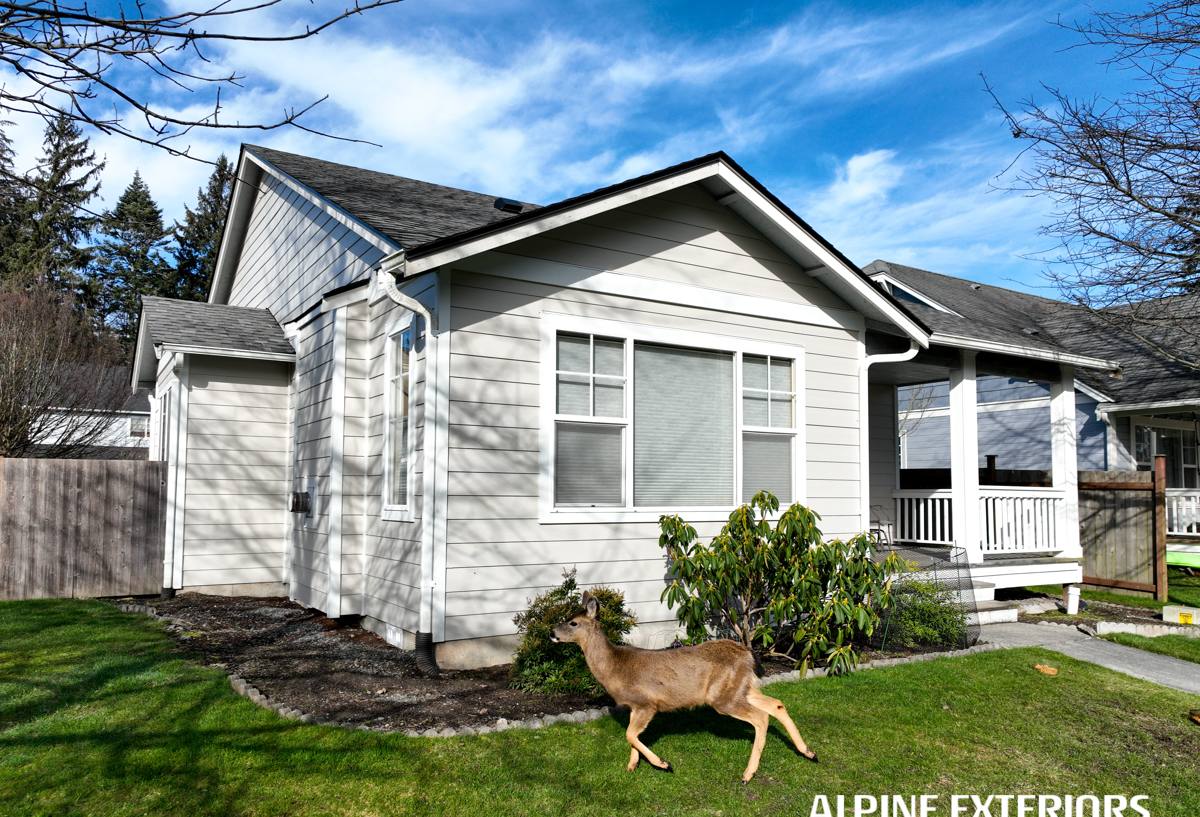
Why We Only Install James Hardie Here
We install James Hardie fiber cement exclusively — not as a marketing position, but because it's the product we're willing to put our name behind in a climate like this one. Hardie's HZ5 formulation is engineered specifically for climates with freeze-thaw cycles and sustained moisture exposure, which describes Whatcom County for a good chunk of the year. It's non-combustible, it doesn't swell or rot when it takes on water at a cut edge or a fastener hole, and the ColorPlus factory finish is baked on under controlled conditions rather than sprayed on-site, which matters a lot when a big part of your paint's job is standing up to UV, salt air, and constant damp.
We've made a deliberate call not to install vinyl, LP SmartSide, Cemplank, Allura, or primed wood siding. Every one of those products has legitimate uses and reasonable manufacturers stand behind them. Our decision is about what we've seen hold up on homes in this specific climate over the long run, and about being able to give a homeowner one warranty, one installation standard, and one answer when they ask "why this material" instead of a menu of trade-offs we're not comfortable defending.
Hardie vs. the Alternatives We Don't Install
| Material | How It Handles Local Moisture | Our Concern in This Climate |
|---|---|---|
| Vinyl | Sheds water on the surface but relies entirely on the water-resistive barrier behind it | Panels can warp or buckle with temperature swings and don't stop UV fading over time |
| LP SmartSide | Engineered wood strand product, treated but still wood-based | More sensitive to sustained moisture exposure at cut edges and seams than fiber cement |
| Cedar / primed spruce | Natural material, breathes but absorbs water directly | Needs recurring refinishing to keep moss, mildew, and rot at bay in a shaded, damp setting |
| James Hardie fiber cement | Dimensionally stable, doesn't absorb and swell the way wood-based products do | Installation detailing (gaps, flashing, fastening) still has to be correct — the material isn't foolproof on its own |
What a Correct James Hardie Installation Actually Involves
Hardie siding is only as good as the installation behind it. A lot of the siding failures we get called out to inspect in this area aren't material failures — they're installation shortcuts that let water get where it shouldn't. On a Happy Valley home, we pay particular attention to:
- A proper weather-resistive barrier installed shingle-style (upper layers overlapping lower ones) so any water that gets behind the cladding drains out instead of pooling
- Correct flashing at every window, door, and roofline intersection — this is the single most common place we find prior installs cut corners
- Manufacturer-specified gaps at butt joints and around penetrations, caulked with a sealant rated for the product, not just whatever was on the truck
- Fastening pattern and depth per Hardie's install guide — overdriven nails crack the board's protective edge and create a moisture entry point
- Minimum clearance from grade, decks, and roof lines so the bottom course isn't sitting in a splash zone or trapped against standing moisture
- Proper starter strip and z-flashing at horizontal transitions so water sheds outward instead of behind the wall assembly
Skipping any one of these doesn't show up as a problem in year one. It shows up in year five or seven as staining, soft trim, or paint failure in specific spots — which is exactly the pattern we see most often when we're called in to look at a previous installation that wasn't done to spec.
Our Process for a Happy Valley Siding Project
1. On-Site Assessment
We walk the exterior, check the condition of the sheathing and water-resistive barrier where accessible, and look specifically at the trouble spots common to this neighborhood — shaded walls, low-clearance areas, and window and door flashing. We'll tell you honestly if what's underneath needs repair before new siding goes on.
2. Tear-Off and Substrate Check
Old siding comes off in sections so we can inspect sheathing as we go rather than discovering rot after the whole wall is exposed. Any damaged sheathing or framing gets addressed before anything new goes up — new siding over a compromised substrate just hides a problem instead of fixing it.
3. Weather Barrier and Flashing
This is the step that determines whether the siding lasts twenty-plus years or needs attention in five. We install the water-resistive barrier and flashing to shed water at every seam, penetration, and transition before a single piece of Hardie goes on.
4. Hardie Installation
Panels or lap siding go on per manufacturer spec — correct fastening, correct gaps, correct clearances. Trim, corners, and fascia are detailed to match, using Hardie trim products so the whole system expands and weathers together.
5. Finish and Cleanup
Caulking, touch-up, and a final walkthrough with you before we leave. We clean up job-site debris and old material completely — we're not leaving a Happy Valley yard looking like a construction zone.
What This Costs and What Drives the Price
We don't quote firm numbers without seeing the house, but the factors that move the price on a Happy Valley project are consistent:
| Factor | Why It Matters |
|---|---|
| Substrate condition | Rotted sheathing or framing found during tear-off adds repair scope before new siding can go on |
| Home size and wall complexity | More corners, dormers, and trim details mean more cutting, flashing, and labor time |
| Siding profile chosen | Lap siding, panel systems, and shingle-style Hardie products differ in material and install time |
| Access and site conditions | Steep lots, mature landscaping, and tight setbacks — common in this neighborhood — can slow staging and scaffolding |
| Trim and detail work | Window and door surrounds, fascia, and corner treatments add labor beyond flat wall coverage |
Generally, a full James Hardie re-side runs into the mid five figures for an average single-family home, with the range shifting based on the factors above. A written estimate after we've actually looked at your walls is the only number worth relying on.
Why a Crew That Already Works This Neighborhood Matters
Siding work in Happy Valley isn't identical to siding work on the drier, more open side of Bellingham. Crews who work this neighborhood regularly know which walls need extra flashing attention because of tree shade, how to sequence a job around the wetter stretches of the year without leaving a house open to the weather, and what a typical Happy Valley lot's access and drainage look like before they ever show up with a truck. That familiarity shows up in fewer surprises mid-project and a finished install that's detailed for the conditions your specific walls actually face, not a generic install pulled from a manual written for a different climate.
Maintenance and Longevity Once It's Installed
Correctly installed James Hardie siding is low-maintenance, not no-maintenance. In a moss-prone area like this, that means:
- Rinsing siding annually to keep moss and algae spores from taking hold, especially on shaded north- and west-facing walls
- Keeping gutters clear so overflow doesn't run down the siding face repeatedly
- Trimming back vegetation that holds moisture against the wall or blocks airflow and drying
- Watching caulked joints and touching up if you see cracking, since caulk has a shorter service life than the siding itself
- Repainting on the manufacturer's recommended cycle rather than waiting for visible failure — ColorPlus finish holds up longer than field-applied paint, but it's not infinite
Signs Your Current Siding Is Due for Replacement
- Soft or spongy spots when you press on the siding, especially near the bottom courses or under windows
- Paint that's peeling or bubbling rather than just fading
- Persistent moss or dark staining that comes back within weeks of cleaning
- Visible gaps, warping, or cupping in panels or boards
- Rising energy bills that could point to a compromised weather barrier behind the siding
- Interior wall staining or musty smells on exterior-facing rooms
If you're seeing any of that on a Happy Valley home, or you're just planning ahead for a siding project, we're happy to take a look and give you a straight answer about what your house actually needs. The estimate is free, there's no pressure, and you'll get a real assessment either way — use the form below to get started.