 Bellingham Exterior
 Storm Damage Roof Repair for Sehome Homes
Sehome sits up on the hill above downtown Bellingham, close to Western Washington University and Sehome Hill Arboretum, which means the roofs up here take weather from every direction — wind funneling off Bellingham Bay, driving rain rolling in off the Sound, and a tree canopy that keeps everything shaded and damp for most of the year. When a windstorm or heavy rain event moves through Whatcom County, Sehome's mix of older bungalows, mid-century houses, and newer infill homes each respond differently to the same storm, and the damage isn't always obvious from the ground.
This page is about one job done right: storm damage roof repair for homes in the Sehome area. Not a general roofing pitch — the specific work of assessing what a storm actually did to your roof, stopping active leaks, and either repairing or replacing what's damaged without upselling you on work the storm didn't cause.
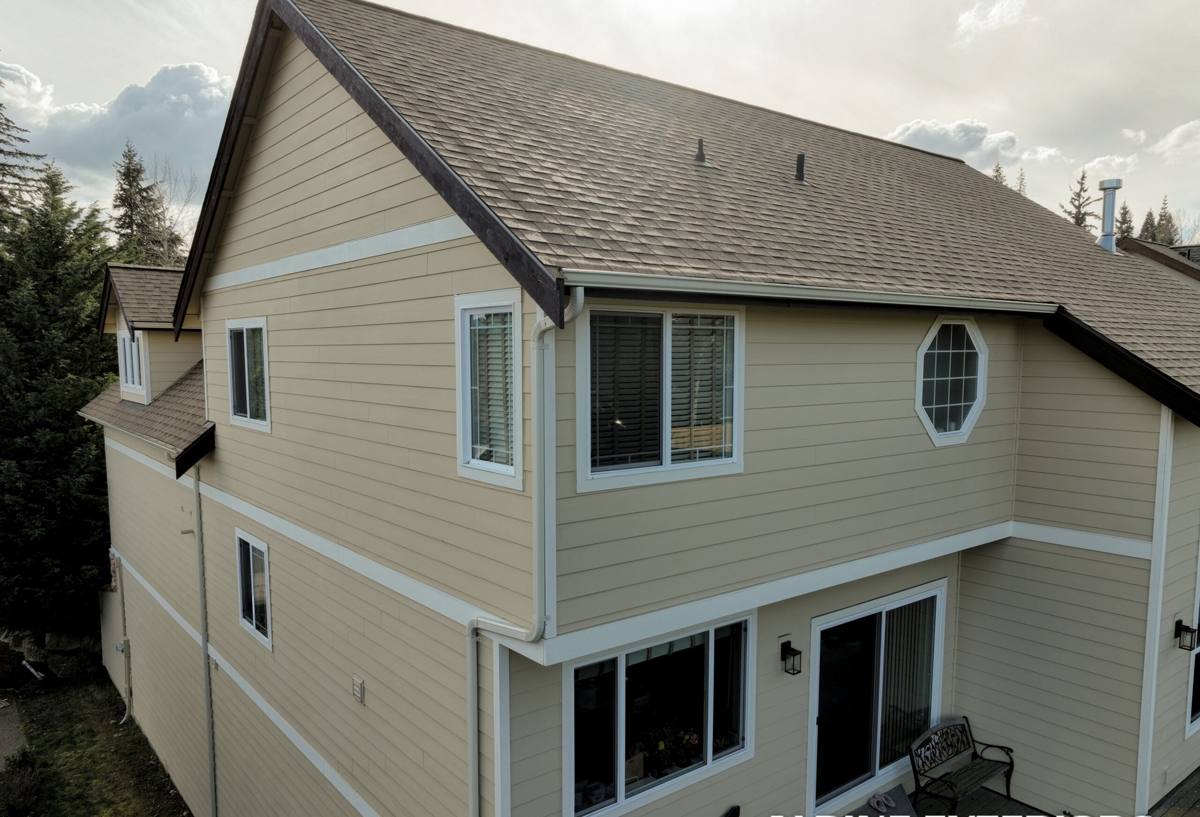
What Storm Damage Actually Looks Like Here
Bellingham doesn't usually get the kind of hail or hurricane damage you'd see elsewhere, but our storms cause a different set of problems that are easy to miss until they've been leaking for weeks:
- Wind-lifted shingles — gusts get under a shingle edge, break the seal, and the shingle looks fine until the next rain finds the gap
- Blow-off and missing shingles — most common on ridgelines and roof edges facing west/southwest, the direction our worst storms come from
- Limb and debris strikes — Sehome's mature trees are part of what makes the neighborhood pleasant, but they also drop branches in wind events, and a strike can crack shingles or punch through decking without leaving an obvious hole
- Flashing separation — around chimneys, skylights, and roof-to-wall transitions, flashing can work loose in wind and rain cycles well before shingles show any sign of trouble
- Gutter and downspout damage — bent, pulled-away, or clogged gutters that back water up under the roof edge instead of carrying it off
- Saturated moss mats — moss that's been building all season can hold enough water during a storm to add real weight and force water sideways under shingles
The tricky part is that most of this is invisible from the driveway. A roof can look completely normal after a storm and still have a lifted shingle or a stressed flashing joint that turns into an interior leak during the next rain.
Our Storm Damage Repair Process
Emergency Response and Tarping
If your roof is actively leaking or has visible damage after a storm, the first priority is stopping water intrusion — not selling you a full assessment on day one. We'll get a tarp or temporary patch on any exposed area to protect the decking and interior of the house while we schedule the full inspection. This step matters more than people expect: a few days of exposed decking in a Bellingham rain event can turn a shingle repair into a decking replacement.
Full Roof Assessment
Once the roof is protected, we walk the entire roof plane — not just the area you can see damage on. Storms rarely damage just one spot; wind and debris affect the whole roof, and we've found separate problem areas on the opposite side of the roof from where the visible damage was. We check shingles, flashing, vents, gutters, and decking, and we photograph everything as we go.
Honest Repair-or-Replace Assessment
You get a written explanation of what the storm damaged, what was already wearing out before the storm, and what our recommendation is — repair, partial replacement, or full replacement — along with the reasoning behind it. We don't pad storm damage reports to justify a bigger job, and we don't downplay real damage to win a smaller job. If your roof is close to the end of its service life anyway, we'll tell you that plainly rather than patching around it.
Documentation for Insurance
Most storm damage repair involves an insurance claim. We provide photo documentation, a written scope of damage, and repair estimates formatted the way adjusters expect to see them. We're happy to meet an adjuster on-site to walk the roof together, which usually moves a claim along faster than paperwork alone.
Repair vs. Replace: How We Decide
Not every storm-damaged roof needs to be replaced, and not every roof can be safely patched. Here's how we think through that decision:
| Factor | Leans Toward Repair | Leans Toward Replacement |
|---|---|---|
| Age of existing roof | Under 12–15 years, still has useful life left | Already near or past expected lifespan |
| Extent of damage | Isolated area, one slope or section | Damage spread across multiple roof planes |
| Decking condition | Solid, no rot or soft spots found | Soft decking, signs of long-term moisture damage |
| Shingle availability | Matching shingles still in production | Discontinued product, visible patch mismatch |
| Underlying moss/algae damage | Surface growth only, granules intact | Granule loss and mat buildup under shingles |
| Insurance scope | Adjuster approves targeted repair | Adjuster's scope supports full replacement |
Roof age and decking condition usually drive the decision more than the storm damage itself. A 6-year-old roof with a cracked section from a limb strike is almost always a repair. A 20-year-old roof that already had thinning granules before the storm hit it is a different conversation.
Materials and Methods for Sehome's Housing Mix
Sehome has a real mix of roof ages and types — older homes with roofs that have been re-covered more than once, newer builds with a single layer of dimensional shingles, and the occasional metal or cedar roof on an older property. That mix matters for repair work:
- Dimensional/architectural shingles — the most common roof in the neighborhood; repairs need shingles matched for both color and profile, since mismatched patches are one of the most common complaints homeowners have about past repair work
- Older 3-tab roofs — increasingly hard to match since production has shifted toward architectural shingles; sometimes a small repair area is better handled by pulling shingles from a low-visibility slope than trying to source an exact match
- Metal roofing — less common but present on some properties; storm repair here is about panel fastener integrity and flashing, not shingle replacement, and requires different tools and technique
- Cedar shake — found on some older Sehome homes; we're upfront that cedar takes more maintenance in our wet climate and moss pressure than other materials, and we'll tell you honestly what that means for long-term upkeep rather than just patching and moving on
On flashing and underlayment, we use materials rated for sustained wet exposure rather than the minimum code requirement, since a repair that meets code but fails again in two winters isn't actually a repair.
Moss, Salt Air, and Bellingham's Long Wet Season
Storm damage repair in Sehome doesn't happen in isolation from the rest of what our climate does to a roof year-round. Bellingham Bay's salt air accelerates corrosion on exposed metal fasteners and flashing, our driving rain finds any gap in a roof's defenses fast, and the long moss season — often eight or nine months of the year in shaded, tree-covered lots like much of Sehome — keeps roofs damp longer than drier climates ever would.
That combination means storm damage rarely happens to a "clean" roof. Moss has usually already been working on the granules and holding moisture against the shingle surface, and salt-tinged rain has already been working on any exposed fasteners. When we repair storm damage, we also flag moss buildup, clogged valleys, and corroding flashing nails we find along the way — not to upsell unrelated work, but because leaving them means the next storm does more damage in the same spot.
Why a Local Bellingham Crew Matters for Storm Repair
Storm damage repair is one of the few jobs where local really does matter more than price:
- Response time — after a regional storm, demand for tarping and emergency repair spikes across Whatcom County; a crew already working in Bellingham can get to Sehome the same day or next, where an out-of-area crew is often booked out for weeks
- Storm-chaser avoidance — after major wind events, traveling crews go door to door offering "free inspections" and pressure homeowners into signing contracts on the spot; a local company with a physical presence and reputation in the area isn't going anywhere after the job, which is exactly the point
- Insurance familiarity — we've worked with the adjusters who cover this area and know how to document a claim in a way that holds up to review
- Permit and code knowledge — Whatcom County and City of Bellingham requirements for roof work don't change based on who's doing the job, and a crew that pulls permits here regularly won't slow your repair down with avoidable mistakes
What to Do — and Not Do — After a Storm
How you handle the first 24–48 hours after storm damage affects both the repair and any insurance claim:
- Do photograph visible damage from the ground — don't get on the roof yourself, especially on a wet or steep slope
- Do check attic and ceiling areas for new water stains or drips
- Do call for emergency tarping if there's an active leak or exposed decking
- Do contact your insurance company to open a claim before major repair decisions are made
- Don't sign a contract with a door-to-door crew you can't verify locally
- Don't let a tarp sit for weeks — it's a temporary fix, not a repair
- Don't assume "no visible damage" means no damage — get a professional look if a significant storm has passed through
Get a Free, No-Pressure Storm Damage Assessment
If a recent storm has left you with a leak, missing shingles, or just a nagging feeling that something's not right up there, we're glad to come take a look. The estimate is free, there's no pressure to sign anything on the spot, and if the damage is minor we'll tell you that instead of finding a reason to upsell. Fill out the form below and we'll get in touch to schedule a time to assess your Sehome roof.