 Bellingham Exterior
 Why Blaine's Coastal Position Wears Out Roofs Faster
Blaine sits at the top of Whatcom County, right on Semiahmoo Bay and Drayton Harbor, a few minutes from the Peace Arch border crossing. That location is part of what makes the town special, but it's also exactly why roofs here take more abuse than roofs twenty miles inland. Salt-laden air off the water works its way into every exposed fastener, flashing seam, and vent boot on a roof. Combine that with wind-driven rain coming straight off the Strait of Georgia and a shoulder season that seems to stretch from October through May, and you've got a climate that punishes shortcuts. We've seen roofs on the Bellingham side hold up fine for another five years doing things that would already be failing on a Blaine roof facing the water.
None of this means Blaine homes need exotic materials or gimmicks. It means the basics — proper underlayment, correct fastener choice, real ventilation, and flashing detail done right the first time — matter more here than almost anywhere else in Whatcom County. This page is about what that actually looks like for asphalt shingle roofs specifically, since it's still the most practical, cost-effective roofing choice for the vast majority of Blaine homes when it's installed correctly.
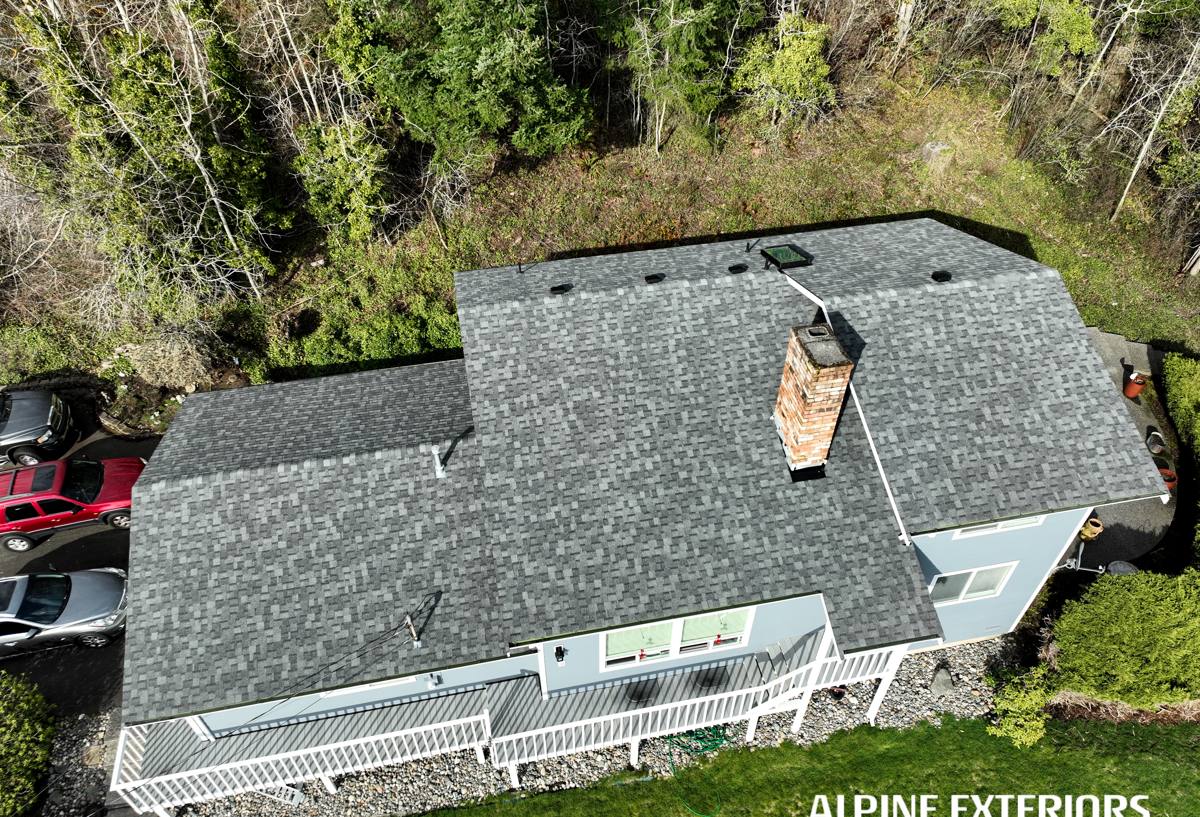
What a Correct Asphalt Shingle Install Requires in This Climate
Asphalt shingles are a proven, well-understood product. The problems we get called out to fix almost never trace back to the shingle itself — they trace back to installation decisions that skip a step because it's faster or cheaper. In a marine climate like Blaine's, those shortcuts show up as leaks, granule loss, and moss within a few years instead of holding for the shingle's rated life.
The non-negotiables for coastal Whatcom County
- Full synthetic or self-adhered underlayment across the whole deck, not just at eaves and valleys
- Ice-and-water shield at eaves, valleys, and around every penetration — driving rain finds gaps that gravity-fed rain never would
- Corrosion-resistant fasteners rated for coastal exposure, not standard interior-grade staples or nails
- Balanced intake and exhaust ventilation sized to the actual attic, not a generic ridge vent slapped on regardless of soffit intake
- Metal flashing at every wall, chimney, and dormer transition, properly stepped and counter-flashed rather than caulked over
Skip any one of these and the roof might look fine for a year or two. In Blaine, the salt air and the volume of rain expose the weak point faster than they would in a drier, inland part of the county.
Choosing the Right Shingle for Salt Air and a Long Moss Season
Not every asphalt shingle is a good fit for a property sitting close to the water. We look at a few things before recommending a product for a Blaine roof:
Algae and moss resistance
Copper-infused or algae-resistant granules are worth the modest upcharge on most Blaine homes, especially anything with north-facing slopes, mature tree cover, or shade from neighboring structures. Moss and blue-green algae don't just look bad — moss lifts shingle edges as it grows, and that's how water finds its way underneath.
Wind rating
Storms coming off the Strait of Georgia can put real uplift pressure on a roof edge. We spec shingles with wind ratings that match or exceed what the manufacturer's installation instructions require for the fastening pattern used, and we follow the higher fastener count at rakes and eaves rather than the minimum.
Why we don't push the cheapest three-tab option near the water
Basic three-tab shingles are a legitimate product and still show up on plenty of good roofs. Our standard for waterfront-adjacent Blaine properties leans toward laminated (architectural) shingles instead, because the extra thickness and layered construction hold up better against wind-driven rain and give more margin before granule loss becomes a real issue. That's a judgment call based on maintenance burden and long-term performance, not a knock on any manufacturer's product line.
Our Process, Start to Finish
Every Blaine roofing job follows the same sequence, whether it's a full replacement or a targeted repair. We don't skip steps to save a visit.
- Inspection and honest assessment — we get on the roof, check the deck condition, look at ventilation and flashing, and tell you plainly whether you need a repair, a partial reroof, or a full replacement. Not every problem needs a new roof.
- Written scope and material selection — you get a clear plan showing exactly what's being replaced, what underlayment and fasteners we're using, and why, before any work starts.
- Tear-off and deck inspection — old material comes off down to the deck so we can actually see what's underneath. Soft or rotted decking gets replaced, not covered over.
- Underlayment and flashing — this is where most of the long-term performance of the roof gets decided, and it's the step that's easiest to shortcut and hardest to catch after the fact.
- Shingle install — correct nailing pattern, correct exposure, correct starter course at eaves and rakes.
- Ventilation check — intake and exhaust confirmed balanced before we call it done.
- Cleanup and magnetic sweep — yard, driveway, and gutters cleared of debris and stray fasteners.
- Final walkthrough — we go over the finished roof with you before we consider the job complete.
Ventilation, Underlayment, and Flashing — The Parts You Don't See
Homeowners understandably focus on the shingle color and style, but the parts of a roof that determine whether it lasts fifteen years or thirty are the parts you never see once the job is done.
Poor attic ventilation traps moist air against the underside of the roof deck, which in this climate accelerates rot and can void a shingle warranty regardless of how good the shingle itself is. We size intake at the soffits and exhaust at the ridge to work together, not just add vents for the sake of having them.
Flashing failure is the single most common cause of the leaks we get called to fix on older Blaine homes — usually at a chimney, a sidewall, or a low-slope transition where someone relied on caulk or roofing cement instead of properly lapped metal. Caulk is a maintenance item, not a permanent flashing solution, and it fails faster in salt air than almost anywhere else.
Moss, Algae, and Realistic Long-Term Maintenance
A "long moss season" isn't an exaggeration for Blaine — shaded, north-facing slopes near the water can stay damp for months at a stretch. A well-installed roof with algae-resistant shingles will still eventually see some growth in those conditions; the goal is slowing it down and keeping it from causing damage, not pretending it will never happen.
What actually helps
- Keeping overhanging branches trimmed back so slopes get more sun and airflow
- Gentle, low-pressure cleaning rather than pressure washing, which strips protective granules
- Zinc or copper strips near the ridge on shaded slopes, which release trace metal ions that inhibit moss growth over time
- Clearing gutters and valleys before the fall rains, since trapped debris holds moisture against the shingle edge
We're upfront that no roof in this part of Whatcom County is maintenance-free. The right materials and installation reduce how much maintenance you need — they don't eliminate it.
Cost Factors for a Blaine Roofing Project
Every roof is priced individually after an actual inspection, but these are the factors that most often move the number up or down on Blaine properties specifically:
| Factor | Why it matters here |
|---|---|
| Proximity to the water / salt exposure | Drives fastener and flashing material upgrades on more exposed elevations |
| Roof pitch and complexity | Valleys, dormers, and multiple planes add flashing detail and labor time |
| Deck condition under old shingles | Rot from long-term moisture exposure isn't visible until tear-off |
| Shade and moss history | May justify algae-resistant shingles or zinc strips as a long-term cost saver |
| Existing ventilation setup | Undersized or unbalanced systems often need correction as part of the job |
| Access and staging | Waterfront and hillside lots can affect equipment placement and material staging |
Broadly, a straightforward asphalt shingle reroof on an average Blaine home runs in the range most Whatcom County homeowners expect for a mid-size single-family roof, with the specifics above pushing individual quotes up or down. We'll always explain which factors are driving your number, not just hand you a total.
Signs Your Blaine Roof Needs a Closer Look
- Granules collecting in gutters or at downspout outlets
- Shingle edges curling, cupping, or lifting, especially on north-facing slopes
- Visible moss or dark algae streaking, particularly in shaded areas
- Staining on interior ceilings or in the attic near chimneys or sidewalls
- Daylight visible through the roof deck from inside the attic
- Rusting or loose flashing around vents, chimneys, or wall transitions
- A roof over 20 years old that's never had a professional inspection
Catching any of these early is almost always cheaper than waiting for an active leak, since water damage to decking and framing adds cost that has nothing to do with the shingles themselves.
Why a Crew That Already Works Blaine Makes a Difference
A roofing crew that mostly works inland jobs can install a technically correct roof and still miss the details that matter specifically near Drayton Harbor and Semiahmoo Bay — the fastener corrosion resistance, the flashing sequence on a wind-exposed elevation, the ventilation balance for a house that stays damp longer than one a few miles inland. We work across Whatcom County, including Bellingham and the coastal communities up toward the border, so we're not guessing at what Blaine's climate does to a roof over time — we're accounting for it in the spec before the first shingle goes down.
That local pattern recognition is also what lets us give you a straight answer during the inspection instead of a generic sales pitch. If a repair will genuinely hold for a few more years, we'll say so. If the deck is compromised and a full replacement is the honest recommendation, we'll show you why.
If you're dealing with an aging roof, active leaks, or you just want an honest read on where things stand, we're glad to come out and take a look. The estimate is free, there's no pressure attached to it, and you can use the form below to get started.