 Bellingham Exterior
 Siding Replacement in Barkley: What Bellingham's Marine Climate Demands
Barkley is one of Bellingham's newer, more consistently developed neighborhoods, with a housing stock that mostly dates from the last two and a half decades rather than the early-1900s stock found closer to downtown or in the Columbia and Sunnyland areas. That newer age doesn't make siding replacement a non-issue — it changes what the issue usually is. Instead of century-old cladding finally giving out, we're more often called to Barkley to deal with siding that was installed correctly for its era but wasn't built for the punishment Whatcom County's marine climate delivers year after year: near-constant wet-season moisture, driving wind-borne rain, and a moss and algae season that can run eight months or longer.
Bellingham sits close enough to Bellingham Bay and the greater Puget Sound to pick up salt-laden air on top of the rain, and Barkley's mix of open, exposed lots and tree-lined pockets means some homes get near-constant damp shade while others take rain squalls head-on. Both conditions are hard on siding, just in different ways. This page covers what a proper siding replacement looks like for a Barkley home specifically, why we only install James Hardie fiber cement to do it, and what our process looks like from first inspection to final walkthrough.
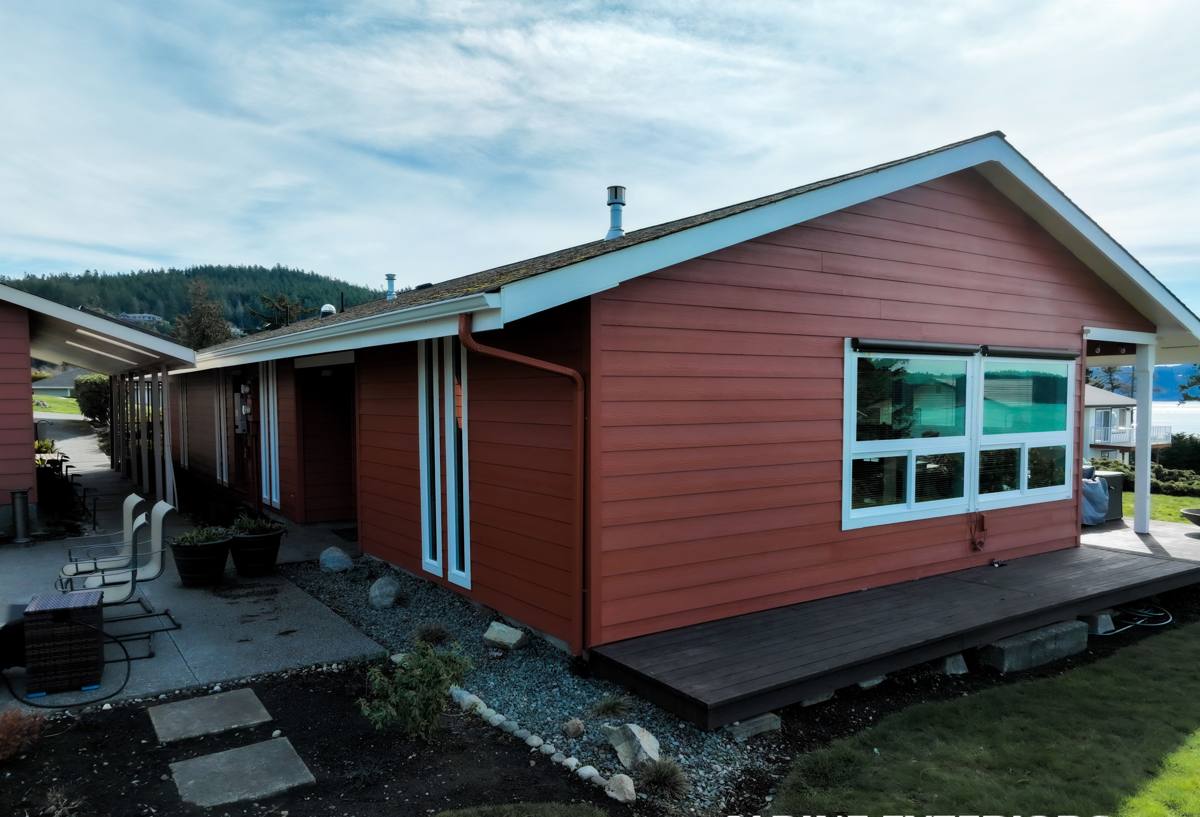
What Barkley's Housing Stock Tells Us About Siding Wear
Because Barkley developed largely as a planned residential and mixed-use area starting in the late 1990s and 2000s, a lot of homes here were sided with whatever was standard and cost-effective at the time of construction — commonly vinyl, engineered wood products like LP SmartSide, or in some cases cedar on higher-end builds. Twenty-plus years into Bellingham's weather, that original siding is now reaching the point where problems compound rather than stay isolated.
- Vinyl siding in this climate tends to show its age through warping, panel bowing at the seams, and moisture finding its way behind the panels where it has nowhere to evaporate. Vinyl doesn't rot itself, but what's underneath it can.
- Engineered wood siding (LP SmartSide and similar) depends heavily on caulking and paint film staying intact. Once that film cracks or a seam opens, the wood-strand substrate absorbs moisture and swells, and that damage is often already spreading by the time it's visible from the ground.
- Cedar siding, even well-maintained, needs re-staining or re-painting on a cycle that most owners fall behind on. In Barkley's damp shade pockets especially, cedar holds moisture longer between dry spells, which accelerates cupping and soft spots.
None of this means those products were a mistake when installed — it means twenty-plus Bellingham winters is close to the point where most claddings need real attention, and a straight repaint or spot-patch rarely solves the underlying moisture issue anymore.
Moss, Algae, and Driving Rain: The Local Trifecta
Three climate factors do most of the damage to siding in Barkley and across greater Bellingham:
Salt Air
Even set back from the water, Barkley gets enough marine air moisture to accelerate corrosion on exposed metal fasteners and trim, and to keep siding surfaces damp longer after rain than an inland climate would. Moisture that lingers is moisture that finds a way in.
Driving, Wind-Driven Rain
Whatcom County's rain doesn't just fall — a good portion of it arrives sideways during winter storm systems. That matters enormously for how siding is installed, not just what it's made of. Flashing details, house wrap laps, and butt-joint sealing all have to be built to shed wind-driven water, not just vertical rain.
Long Moss and Algae Season
Bellingham's wet season stretches from fall through spring most years, and shaded north- and east-facing walls in particular stay damp for extended stretches. That's exactly the environment moss and algae need to establish on a siding surface, and once they take hold they hold moisture against the material underneath, making the underlying problem worse over time.
What a Correct Siding Replacement Actually Involves
A siding job that just swaps old panels for new ones without addressing what's underneath is a job that fails again in a decade — sometimes sooner in a climate like this one. A correct replacement in Barkley includes:
- Full tear-off and inspection of the wall sheathing behind the old siding, not just the visible surface. This is where hidden rot, soft sheathing, or failed old house wrap actually gets found.
- Repair of any damaged sheathing or framing before anything new goes up. Covering a wet or compromised wall with new siding just hides the problem.
- A continuous, correctly lapped weather-resistive barrier (house wrap) installed shingle-style so water is directed out and down, never trapped behind the cladding.
- Proper flashing at every window, door, deck ledger, and roofline intersection — the details that matter most in wind-driven rain and are the most commonly shortcut on lower-bid jobs.
- Correct fastening and clearances specific to the product being installed, including ground clearance and gaps at inside/outside corners to allow for expansion and drainage.
- Manufacturer-spec caulking and sealant use — over-caulking gaps that are supposed to drain, or under-sealing joints that need it, are both common mistakes that shorten a siding job's life.
Why We Install Only James Hardie Fiber Cement
We don't install vinyl, LP SmartSide, Cemplank, Allura, primed spruce, or cedar. That's not because those products have no place in the market — it's because after years of siding replacement work across Bellingham and Whatcom County, we standardized on one system that holds up consistently to this specific climate and stopped installing the others.
James Hardie fiber cement is non-combustible, which matters given the wildfire smoke seasons the Pacific Northwest has seen in recent summers, and it doesn't rely on a paint or stain film the way wood-based products do to stay weather-tight — the material itself is engineered to resist moisture absorption. Hardie's ColorPlus factory-applied finish is baked on under controlled conditions, which gives a more consistent, longer-lasting color than field-applied paint, and its HZ5 product line is engineered specifically for climates with prolonged moisture exposure and freeze-thaw cycling, which fits Whatcom County's winters well. It also carries a strong transferable warranty, which matters to Barkley owners who may sell within the product's lifespan.
None of that means Hardie is maintenance-free — it still needs to be installed to spec, caulked correctly, and painted eventually if not using ColorPlus finish. But it removes the moisture-absorption and film-failure issues that drive most of the siding calls we get in this area, and it holds up to salt air and driving rain better than the alternatives we used to install.
Comparing Siding Options for a Barkley Home
| Material | Moisture Behavior in This Climate | Maintenance Cycle | Typical Lifespan Here |
|---|---|---|---|
| Vinyl | Doesn't absorb water itself, but traps moisture behind panels; warps in sustained damp/heat cycling | Low, but panels aren't repairable individually if damaged | 15–25 years before visible failure |
| LP SmartSide / engineered wood | Depends on intact paint film; swells and delaminates once compromised | Repaint and re-caulk on a regular cycle | 15–20 years before major issues in wet-shade areas |
| Cedar | Absorbs moisture readily; cups and softens if refinishing lapses | Re-stain or repaint every few years | Highly dependent on maintenance discipline |
| James Hardie fiber cement | Engineered to resist moisture absorption; non-combustible | Occasional caulk check; repaint only if not ColorPlus finish | Decades, with strong transferable warranty |
Our Process for a Barkley Siding Replacement
Every job starts with an on-site inspection, not a phone estimate. We walk the exterior, check the shaded and exposed sides separately since they often tell different stories, and look for the moisture and rot patterns typical of Bellingham's climate before quoting anything. From there:
- We scope the tear-off and confirm what we expect to find underneath based on the home's age and current siding type.
- We price the job with sheathing repair as a contingency line, not a surprise change order sprung on you mid-project.
- We schedule around Bellingham's wet season where possible, since a torn-off wall left exposed too long in driving rain is its own risk.
- We install house wrap, flashing, and the Hardie system to manufacturer spec, with clearances and fastening checked as we go, not just at the end.
- We do a final walkthrough with you before calling the job done, covering care, caulk lines, and what a normal maintenance check looks like going forward.
What to Check Before Hiring Anyone for This Work
Siding replacement is one of those jobs where a bad install looks fine for the first year or two and then fails all at once. Before hiring any contractor for a Barkley siding job, it's worth confirming:
- Are they licensed and insured to do exterior work in Washington, and can they show it without hesitation?
- Do they tear off and inspect sheathing, or just re-side over what's there?
- Do they specify house wrap and flashing details in writing, not just "new siding installed"?
- Have they worked in Bellingham or Whatcom County specifically, where wind-driven rain and moss season are routine, not exceptional?
- Do they install to the manufacturer's published fastening and clearance specs, which is what keeps a warranty valid?
Why Local Experience in Barkley Specifically Matters
A crew that already works this neighborhood knows which walls in Barkley tend to run damp longer, which lots catch the wind off open ground versus which are sheltered by mature trees, and roughly what condition to expect behind siding of a given age and type before the first panel comes off. That's not guesswork we bring from a different region — it's pattern recognition built from doing this work repeatedly in Bellingham's specific climate. It also means a contractor who isn't guessing at permitting or code details that apply locally, and who can plan a tear-off around the wet season realistically instead of leaving a wall exposed and hoping.
If your Barkley home's siding is past its best years or you're just weighing options before it becomes an emergency, we're happy to walk the exterior with you and give a straight, no-pressure estimate — no obligation, and no pitch beyond what we honestly think your home needs. The form below gets that conversation started.