 Bellingham Exterior
 Why Birch Bay Homes Are Hard on Windows
Birch Bay sits right on the water, and that changes what a window has to survive year after year. Salt-laden air corrodes hardware and finishes faster than it does even a few miles inland. Driving rain off the Strait pushes water sideways into gaps that would stay dry on a more sheltered lot. And the long gray stretch of fall through spring gives moss and algae months to establish themselves on sills, tracks, and anything with a horizontal surface. None of this is unique to one house — it's the baseline condition for the whole shoreline stretch of Whatcom County, and it's why a window that performs fine in a drier part of Bellingham can still struggle in Birch Bay.
The practical result is that windows here fail in specific, predictable ways: corroded weep holes that stop draining, swollen or rotted sashes where finish coatings wore through, seals that give out early from constant damp-dry cycling, and hardware that seizes up from salt corrosion. A custom window job for this area isn't about upgrading for its own sake — it's about specifying and installing windows that are actually built for what the site throws at them.
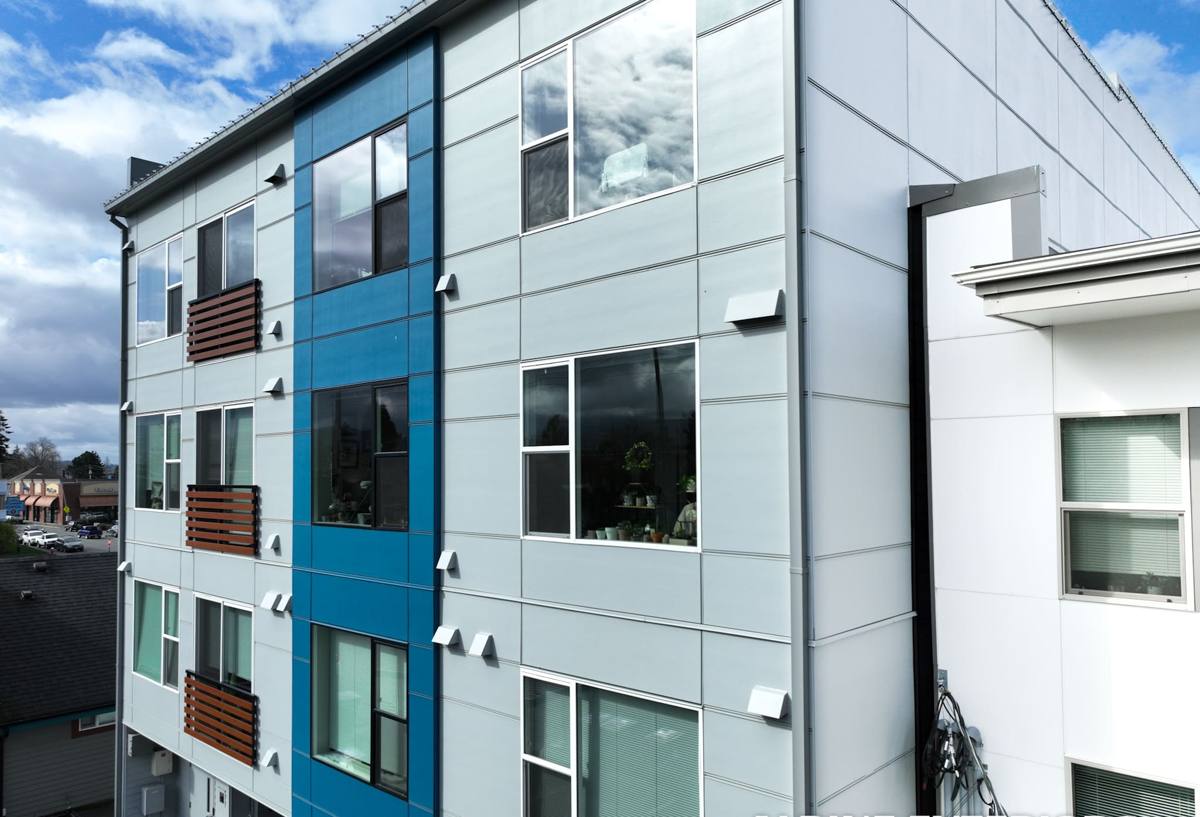
What "Custom" Actually Means for a Birch Bay Window Project
Custom doesn't necessarily mean unusual shapes or high-end architectural glass, though it can. Most of the custom work we do in Birch Bay is about getting the window built to the exact opening — especially in older beach cottages and additions where openings were never perfectly square to begin with — and specifying materials and hardware that match the exposure the house actually has.
Retrofit vs. New Construction Windows
Most replacement work in existing Birch Bay homes uses retrofit (insert) windows, which fit into the existing frame without disturbing siding. That's often the right call on a home where the siding and trim are in good shape. But on houses with water damage around the openings, or where we find rot once trim is pulled, a full-frame new-construction window with fresh flashing is the more honest fix — it costs more up front but addresses the actual moisture path instead of covering it over.
Sizing and Opening Condition
Before we quote anything, we check the framing around each opening for rot, soft wood, or prior water intrusion. On a saltwater-exposed lot, this step matters more than it does elsewhere, because water that's been getting in slowly for years can hollow out a sill or jamb without showing much on the surface.
Material Choices That Hold Up Near the Water
Every window material has trade-offs, and none of them is automatically wrong — the right choice depends on the specific exposure, the home's style, and the owner's tolerance for maintenance.
| Material | Salt Air Performance | Maintenance | Notes |
|---|---|---|---|
| Vinyl | Good — won't corrode or rust | Low; occasional cleaning | Reliable value option; hardware quality varies by brand |
| Fiberglass | Very good — dimensionally stable, resists corrosion | Low | Handles temperature swings and moisture well; higher upfront cost |
| Aluminum-clad wood | Fair to good, if cladding and flashing are done right | Moderate | Attractive option but installation sensitivity is higher in this exposure |
| All-wood | Poor without diligent upkeep | High | We generally steer owners away from unclad wood on direct-exposure walls near the bay — not because the wood is bad, but because the maintenance burden in this climate is real and unforgiving |
Hardware matters as much as frame material. Standard steel hinges, locks, and cranks corrode quickly this close to salt water. We spec stainless or marine-grade hardware on bay-facing openings whenever the window line offers it, because replacing seized hardware every few years costs more over time than paying for the better option once.
Getting the Water Management Right
Most window failures we see in Birch Bay aren't glass failures — they're water management failures. Driving rain off the water finds any gap in flashing, sealant, or drainage and works it open over time. Getting this right is less glamorous than picking a window style, but it's the part of the job that actually determines whether the window lasts.
- Sill pan flashing under every opening, sloped to drain water back outside the wall
- Weather-resistant barrier integrated with the flashing, shingle-lapped so water sheds downward and outward
- Head flashing that extends past the jambs and ties into the drainage plane above the window
- Weep holes kept clear and unobstructed by trim or sealant
- Compatible sealants and tapes — mixing incompatible products is a common cause of early failures we get called to fix
- Backer rod and sealant at the interior and exterior perimeter, not just one or the other
On a direct-exposure lot, we also pay attention to which way the prevailing weather comes from and treat bay-facing and south/west walls with extra care — more conservative flashing details, marine-grade fasteners, and sealants rated for continuous UV and salt exposure.
Energy Performance and Condensation in a Marine Climate
Whatcom County's marine climate means mild temperatures but near-constant humidity for much of the year. That combination creates condensation risk that owners in drier climates don't deal with as much. A well-installed, properly sealed window with a good low-E glass package reduces interior condensation by keeping the interior glass surface warmer, which matters for window longevity as well as comfort — chronic condensation rots sills and finishes from the inside out.
Double-pane, low-E, argon-filled units are the standard baseline we recommend for this area; triple-pane can make sense on north-facing or particularly exposed walls, but it's not always worth the added cost on a moderate-climate coastal home like most of what's in Birch Bay. We'll walk through the actual U-factor and condensation-resistance numbers for the specific product line rather than sell on brand name alone.
Screens, Tracks, and Salt Buildup
Fine mesh screens and metal tracks accumulate salt residue faster near the water, which accelerates wear and makes windows harder to operate. We recommend corrosion-resistant screen frames and track materials on bay-facing windows, and a simple periodic rinse-down extends the life of both considerably.
What a Proper Installation Involves
The window unit itself is often the easy part. The installation sequence is where quality actually gets decided:
- Remove old window and inspect the full opening for rot, mold, or prior water damage
- Repair or replace any compromised framing before anything new goes in
- Install sill pan flashing and integrate it with the existing or new weather barrier
- Set the window plumb, level, and square, shimmed correctly to avoid stressing the frame
- Insulate the gap between window and framing without overpacking, which can bow the frame
- Flash the head and jambs, lapped correctly for drainage
- Seal the interior and exterior perimeter with compatible products
- Test operation, drainage, and locking hardware before calling the job done
Skipping or rushing any one of these steps is how a good window ends up performing like a cheap one within a few years — especially in an exposure as demanding as Birch Bay's.
Why a Crew That Already Works This Area Matters
A contractor who works Birch Bay regularly already knows which details need extra attention on a bay-facing wall versus a sheltered one, has seen how different window lines actually hold up locally rather than just what the marketing says, and won't need to relearn the local permitting and inspection process for every job. That familiarity shows up in fewer callbacks and fewer surprises once trim gets pulled off an old opening.
It also matters for warranty follow-through. A window installation warranty is only as good as the contractor who's still around and willing to stand behind it — a crew with an established local presence in Whatcom County is a more reliable bet for that than an out-of-area installer passing through on a one-off job.
Questions Worth Asking Before You Hire
- Do you flash every opening with a sill pan, or only when you find a problem?
- What hardware and screen materials do you recommend for a bay-facing wall specifically?
- Will you inspect the framing before quoting a final price, or is the quote based on a quick look?
- What's covered under your workmanship warranty, separate from the manufacturer's product warranty?
- Can you explain the difference between a retrofit and full-frame install for my specific situation?
Cost Factors Worth Understanding
Window replacement pricing varies a lot based on site conditions, and anyone quoting a flat per-window price without seeing the opening is guessing. The factors that actually move the number:
| Factor | Effect on Cost |
|---|---|
| Retrofit vs. full-frame replacement | Full-frame costs more due to siding/trim work and flashing, but fixes underlying moisture issues |
| Frame material (vinyl, fiberglass, clad wood) | Fiberglass and clad wood typically cost more than vinyl; higher exposure areas often justify the upgrade |
| Hidden rot or water damage found in the opening | Adds repair cost, but skipping this repair guarantees an early failure |
| Hardware upgrades (marine-grade, stainless) | Modest cost increase, significant longevity gain in this exposure |
| Glass package (double vs. triple pane, low-E options) | Triple-pane and upgraded coatings add cost; usually most worthwhile on the most exposed walls |
| Number of openings and access difficulty | Second-story, tight-clearance, or hard-to-access openings take more labor time |
We'd rather walk a homeowner through these trade-offs honestly than quote a number that doesn't survive contact with what's actually behind the old trim.
Maintenance That Extends Window Life Near the Bay
Even a well-installed window benefits from basic upkeep in this environment. A periodic rinse of frames, tracks, and screens removes salt residue before it accelerates wear. Keeping weep holes clear of debris and moss buildup preserves drainage. Checking exterior sealant joints once a year for cracking or separation catches small problems before they become water intrusion. And a quick look at hardware operation — locks, cranks, hinges — flags corrosion early enough to address it rather than replace it.
If you're weighing window replacement or a custom install for a Birch Bay home, we're happy to take a look at what you've got, explain what we find, and put together a straightforward estimate — no pressure, no upsell on things your house doesn't need. The estimate is free; use the form below to get started.