 Bellingham Exterior
 Why Birch Bay Siding Wears Differently Than Homes Farther Inland
Birch Bay sits right on the water, and that changes what siding has to survive day to day. Homes a few miles inland in Bellingham deal with plenty of rain, but Birch Bay adds a steady dose of salt-laden air blowing off the water, wind-driven rain that hits walls at an angle instead of falling straight down, and a shaded, humid microclimate that keeps moss and algae growing for most of the year. None of that is dramatic on any given day. It's the cumulative effect that causes problems — fasteners corroding faster, caulk joints failing sooner, and moisture finding its way behind siding that would otherwise be fine.
Repairing siding on a home like this isn't just about matching a color or patching a hole. It's about understanding why that section failed in the first place and making sure the repair doesn't fail again in eighteen months for the same reason.
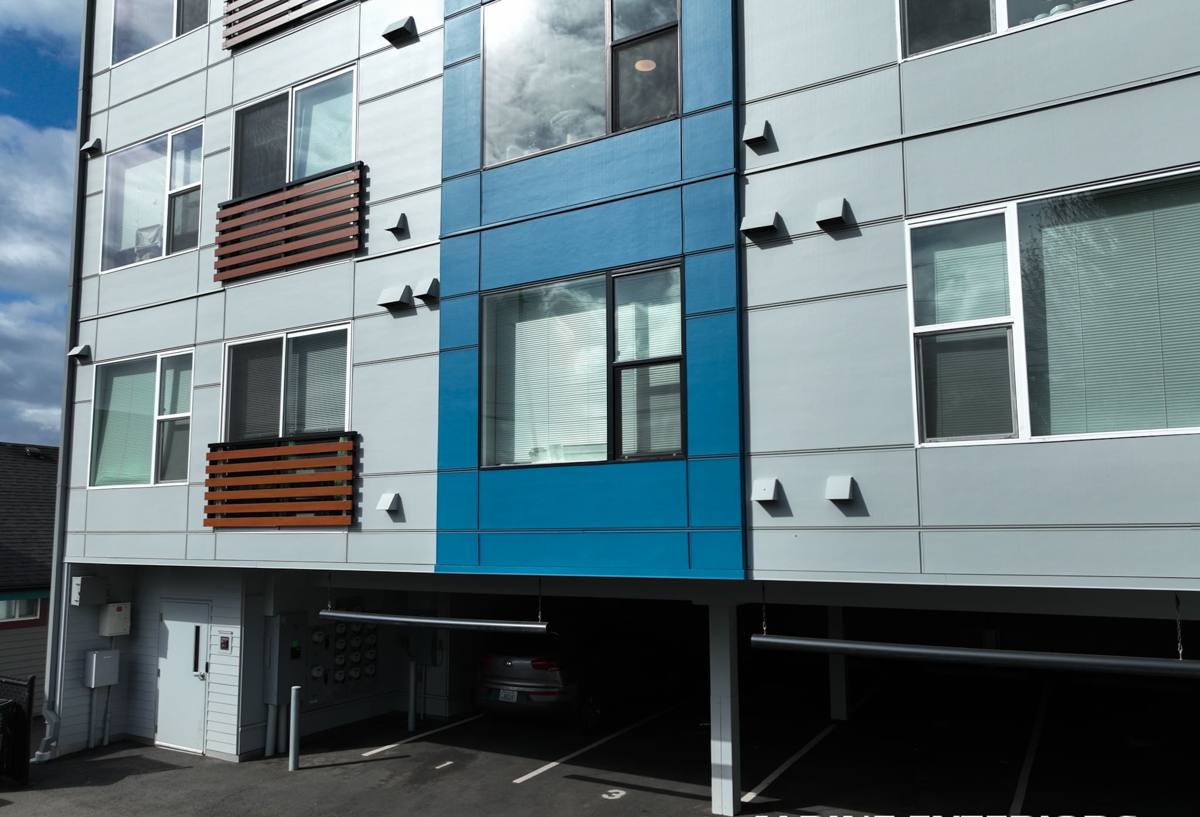
The Three Culprits: Salt Air, Driving Rain, and Moss
Salt Air
Airborne salt accelerates corrosion on fasteners, flashing, and any exposed metal trim. When nails or screws holding siding panels in place start to rust, they lose grip and panels can loosen, warp, or pull away slightly from the wall — which opens a path for water to get behind the siding.
Driving Rain
Wind off the water pushes rain sideways into wall assemblies, not just down over them. That means seams, laps, and butt joints that would shed water fine in a calmer climate can take on water in Birch Bay if they weren't installed with the right overlap and sealant in the first place. This is one of the most common root causes we find behind siding that looks fine on the surface but is soft or damaged underneath.
Moss and Algae
Shaded, north-facing walls and anything under tree cover stays damp longer here than it would a few miles inland. Moss and algae hold moisture against the siding surface, and over time that constant dampness breaks down caulk, degrades paint finishes, and — on the wrong materials — can lead to swelling or softening of the substrate itself.
Signs a Birch Bay Home Needs Siding Repair
Most siding damage in this area doesn't announce itself with an obvious hole. It shows up as smaller signals that are easy to miss until they've been developing for a while:
- Soft or spongy spots when you press on the siding, especially near the bottom of walls or under windows
- Visible gaps, warping, or bowing in individual panels or boards
- Paint that's peeling, bubbling, or flaking in a localized area rather than evenly across the whole wall
- Dark streaking, persistent moss, or algae growth that keeps coming back after cleaning
- Rust staining running down from fastener heads or trim
- Cracked or missing caulk at joints, corners, and around windows and doors
- Any spot where you can see daylight or feel a draft from inside near an exterior wall
Any one of these on its own might be minor. Several together, or any sign near a corner, window, or roofline where water concentrates, is worth having looked at before it spreads.
What a Correct Siding Repair Actually Involves
A repair that only replaces the visible damaged piece often misses the point. If moisture got behind that section, the underlying weather barrier, flashing, and framing need to be checked too — otherwise you're covering a problem instead of fixing it.
A repair done right in a coastal environment like Birch Bay typically includes:
- Removing enough surrounding material to see the full extent of the damage, not just the visible portion
- Inspecting the weather-resistive barrier underneath for tears, gaps, or failure at seams
- Checking flashing around windows, doors, and any penetrations in the repair area, since failed flashing is a frequent hidden cause of water intrusion
- Assessing sheathing and framing for soft spots or rot before anything new goes back on
- Using fasteners and materials rated for coastal exposure so the repair doesn't corrode and fail again
- Matching the replacement siding in profile, reveal, and finish so the repair blends rather than standing out as a patch
- Re-sealing and re-caulking properly at every joint, not just cosmetically at the surface
Skipping any of these steps is how homeowners end up paying for the same repair twice.
Repair or Replace? How to Think About It
Not every damaged section needs full replacement, but sometimes a repair is a temporary fix that delays a bigger job. Here's how we generally walk homeowners through that decision:
| Factor | Repair Is Usually Enough | Replacement Should Be Considered |
|---|---|---|
| Extent of damage | Isolated to one or two sections | Spread across multiple walls or elevations |
| Underlying structure | Sheathing and framing are sound | Rot or soft framing found during inspection |
| Age of existing siding | Siding is relatively young or mid-life | Siding is near or past its expected service life |
| Cause of damage | One-time event (impact, isolated flashing failure) | Ongoing moisture pattern from wind/salt exposure |
| Material match | Matching material is available | Original material is discontinued or a poor long-term fit for the site |
We'll give you an honest read on which category your home falls into — we're not going to talk you into a full replacement a targeted repair would solve, and we're not going to patch something that's going to need redoing next season.
Why the Siding Material Matters for Repairs Here
We install and repair James Hardie fiber cement siding exclusively, and in a location like Birch Bay that's not a marketing preference — it's a practical one. Fiber cement doesn't absorb and swell with moisture the way wood-based products can, and it doesn't degrade under UV and salt exposure the way some other siding materials do over time. James Hardie's HZ5 product line is engineered specifically for wetter, more humid climate zones like the Pacific Northwest, with a formulation and factory-applied ColorPlus finish built to hold up against exactly the conditions Birch Bay sees: sustained moisture, temperature swings, and salt air.
That matters for repairs specifically because a repair is only as good as the material going back into the wall. Patching a moisture-damaged section with a material that has the same vulnerability just resets the clock on the same failure. When we repair Hardie siding, we're working with a product designed to resist the conditions that caused the original damage — not just replacing like-for-like and hoping for a better outcome.
If your home currently has a different siding material and is showing repeated damage in the same spots, that's worth a conversation. Sometimes the right answer is a durable repair; sometimes it's transitioning that section — or eventually the whole home — to a material built for this environment.
Our Process for Birch Bay Siding Repairs
1. On-Site Inspection
We look at more than the obvious damage — we check surrounding panels, corners, window and door flashing, and any areas showing moss, staining, or soft spots, since coastal moisture problems rarely stay contained to one board.
2. Honest Assessment
We tell you what we find, including whether it's a straightforward repair, a repair that needs to address underlying moisture or flashing issues, or a case where replacement is the more sensible long-term move.
3. Written Scope and Estimate
You get a clear explanation of what work is being done, what materials are being used, and why — no vague line items.
4. The Repair Itself
We remove damaged material, address anything found underneath, and install matching James Hardie siding with fasteners and flashing details suited to the exposure this home actually faces.
5. Final Check
We walk the repair with you, confirm the finish matches the surrounding siding, and make sure joints and caulking are sealed correctly before we consider the job done.
Why It Matters to Hire a Crew That Already Works This Area
Siding repair isn't identical everywhere in Whatcom County. A crew that mostly works drier, more sheltered inland neighborhoods may not think to check flashing details or fastener corrosion the way a crew that regularly works waterfront and near-waterfront properties does. Working in Birch Bay and the surrounding Bellingham area regularly means we've seen how salt air, wind exposure, and persistent shade affect siding here specifically — which parts of a home tend to fail first, and what a repair actually needs to hold up long-term rather than just looking finished on the day we leave.
It also means we're familiar with the practical realities of working on homes in this area — from seasonal weather windows to the kind of exposure a given lot faces depending on how close it sits to the water and which direction it fronts.
Maintaining Your Siding Between Repairs
Good repairs last longer when they're paired with a little regular upkeep. In a climate like Birch Bay's, we recommend:
- Rinsing siding periodically to remove salt residue and surface grime before it builds up
- Keeping gutters clear so overflow doesn't run down and saturate wall sections
- Trimming back vegetation and tree cover that keeps walls shaded and damp
- Addressing moss or algae growth promptly rather than letting it establish
- Doing a visual walk-around once or twice a year, checking caulk lines, corners, and areas around windows
- Having any soft spots, gaps, or recurring stains looked at before they turn into a larger repair
Get an Honest Look at Your Siding
If you're seeing soft spots, staining, persistent moss, or gaps in your siding, it's worth having someone who knows this specific climate take a look before the damage spreads further. We offer free, no-pressure estimates for Birch Bay homeowners — we'll tell you plainly what we see, what it needs, and what your options are, with no obligation to move forward. Use the form below to get started.