 Bellingham Exterior
 Building Decks for Blaine's Coastal Conditions
Blaine sits right on the water at the northern edge of Whatcom County, and that location shapes everything about how a deck should be built here. Homes close to Semiahmoo Bay and Drayton Harbor deal with a combination most inland Whatcom County properties don't: salt-laden air moving off the water, driving rain that comes in sideways during winter storms, and a long stretch of the year when shade and moisture team up to grow moss on any surface that will hold it. A deck built to a generic spec sheet will survive a season or two before those three factors start showing up as loose fasteners, soft spots, and a slick green film underfoot.
We build decks in Blaine the way the location actually demands, not the way a national framing guide assumes. That means paying close attention to fastener choice, drainage, and material selection from the first conversation, not adding those details in as an afterthought.
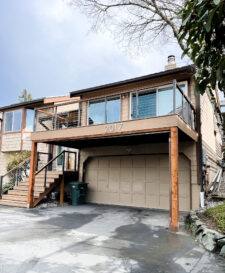
What Blaine's Climate Does to a Deck Over Time
Salt Air and Metal Fatigue
Airborne salt accelerates corrosion on anything metal — nails, screws, joist hangers, railing hardware. On a deck built with standard interior-grade or even basic exterior fasteners, that corrosion can start within a few years, well before the wood or decking itself is ready to be replaced. Once fasteners start failing, the structural integrity of the whole deck is in question, not just its appearance.
Driving Rain and Water Intrusion
Blaine gets its share of wind-driven rain off the water, and that rain doesn't just fall straight down — it gets pushed under railings, into ledger board connections, and along any gap where flashing was skipped or done poorly. A deck ledger that isn't properly flashed against the house is one of the most common sources of hidden rot we find, because the damage happens behind the board where it's not visible until it's serious.
Moss, Algae, and Extended Damp Seasons
Whatcom County's wet season runs long, and shaded or north-facing decks in Blaine can stay damp for weeks at a stretch. That's ideal growing conditions for moss and algae, which don't just look bad — they hold moisture against the decking surface and make boards slick and dangerous underfoot. Deck surfaces, spacing, and even board orientation all affect how much moss takes hold and how easy it is to keep off.
What a Correctly Built Deck Involves
A deck that's going to hold up on the Blaine waterfront needs more attention paid to a handful of details that are easy to skip and expensive to fix later.
- Corrosion-resistant fasteners and hardware rated for coastal or marine-adjacent exposure, not standard exterior-grade
- Proper ledger board flashing where the deck attaches to the house, sealed to shed water away from the structure
- Adequate board spacing and airflow underneath to let the structure dry out between rain events
- Footings and posts set to local frost and soil requirements, inspected before backfill
- Decking material chosen for how it handles standing moisture and moss growth, not just upfront cost
- Railing systems with hardware that won't seize or streak with rust within a few years
- A drainage plan for the space under and around the deck so water doesn't pool against the foundation
Skipping any one of these doesn't usually show up as a problem on day one. It shows up two, three, or five years in, as soft framing, streaked railings, or a deck surface that's never quite dry.
Choosing the Right Decking Material for a Blaine Property
There's no single "best" decking material for every home — it depends on the site's sun exposure, how close it is to the water, and how much upkeep the owner wants to do. Here's how the common options actually compare under Blaine's conditions.
| Material | Moisture & Salt Air Behavior | Moss Resistance | Maintenance |
|---|---|---|---|
| Pressure-treated wood | Good if properly sealed and re-sealed on schedule; fasteners are the weak point | Needs regular cleaning; moss takes hold easily in shade | Annual or biennial sealing/staining |
| Cedar | Naturally decay-resistant, but softens faster in constant damp without upkeep | Moderate; benefits from cleaning | Regular sealing to preserve appearance and resistance |
| Composite decking | Doesn't absorb water like wood; handles salt air well | Better than wood, but not immune — needs periodic washing | Low; occasional cleaning |
| PVC/capped composite | Excellent moisture resistance, minimal absorption | Good, with occasional washing to prevent surface film | Lowest; mainly cleaning |
We don't push one material as the automatic answer for every Blaine job. A shaded, water-facing deck is a different problem than a sunny, sheltered one, and the honest recommendation depends on the site.
Our Process for a Blaine Deck Build
1. On-Site Assessment
We walk the property, look at sun and wind exposure, drainage patterns, and how close the deck will sit to salt-air conditions, then talk through what that means for material and hardware choices.
2. Design and Material Selection
We lay out the deck footprint, railing style, and material with the site's actual conditions in mind — not a one-size-fits-all package — and walk through the real cost and maintenance trade-offs of each option.
3. Permitting
Most deck projects in Whatcom County require a building permit depending on size and height. We handle that process as part of the job so it's not left to the homeowner to sort out.
4. Construction
Framing, flashing, and fastening are done to the coastal-condition standard described above, with inspections at footing, framing, and final stages.
5. Walkthrough and Care Guidance
Before we consider the job done, we walk the finished deck with the homeowner and go over what maintenance actually looks like for the material chosen — cleaning schedule, sealing schedule if applicable, and what to watch for.
Keeping Moss and Mildew Off a Blaine Deck
No decking material is completely maintenance-free in this climate, but the amount of upkeep varies a lot by material and by how the deck was built in the first place. A few habits keep any Blaine deck safer and longer-lasting regardless of what it's made of.
- Sweep debris off regularly, especially in fall — trapped leaves and needles hold moisture against the surface
- Wash the deck surface at least once or twice a year to remove early moss and algae growth before it takes hold
- Keep gutters and downspouts clear so runoff isn't draining directly onto or under the deck
- Trim back vegetation that's shading the deck and keeping it damp longer than necessary
- Check railing hardware and fasteners periodically for early rust or corrosion, especially closer to the water
- Re-seal wood decking on schedule rather than waiting until it visibly needs it
What Deck Building Actually Costs in a Coastal Setting
Deck pricing depends on size, material, height off grade, railing style, and site access, so any number without a site visit is a rough guide at best. That said, a few factors tend to move the price more in a Blaine-type coastal setting than they would inland.
| Cost Factor | Why It Matters Here |
|---|---|
| Fastener and hardware grade | Corrosion-resistant hardware costs more upfront but avoids early hardware failure |
| Decking material | Composite and PVC cost more per square foot than wood but reduce long-term upkeep |
| Site exposure | Decks facing open water or prevailing wind may need extra attention to flashing and drainage detail |
| Height and structure | Elevated decks require more engineering for footings, posts, and railings |
| Permitting | Whatcom County permit requirements vary by size, height, and site — factored into project timeline and cost |
We give straightforward numbers based on what your property actually needs, not a padded estimate or a lowball that leaves out hardware and flashing work.
Why a Crew That Already Works in Blaine Matters
Deck building isn't the same job in every part of Whatcom County. A crew that mostly builds decks in drier, more sheltered inland settings can still do competent framing and still get the coastal details wrong — the flashing gets treated as optional, the fastener grade gets downgraded to save cost, and the homeowner doesn't find out until the deck is a few years old. Working in Blaine and the surrounding Whatcom County waterfront regularly means we default to the coastal-grade approach as standard practice, not as an upsell. That's the difference between a deck that needs real attention in year three and one that's still solid a decade in.
Get a Free, No-Pressure Estimate
If you're planning a new deck or replacing one that hasn't held up to Blaine's salt air and rain, we're happy to take a look and give you an honest read on what your property needs. Fill out the form below for a free estimate — no pressure, no hard sell, just a straight answer about the right approach for your site.