 Bellingham Exterior
 Roofs in Blaine Face a Different Kind of Wear
Blaine sits at the far northern edge of Whatcom County, close enough to open water that salt-laden air is a daily fact of life, and far enough north that winter storms tend to arrive sideways. That combination is harder on a roof than most homeowners realize. Salt air accelerates corrosion on exposed metal fasteners, flashing, and vent caps. Driving rain, pushed by wind off the water, finds gaps that would never leak in a calmer climate. And because this part of Whatcom County stays damp for most of the year, moss and algae get a long runway to establish themselves on north-facing slopes and shaded valleys. None of this means a roof in Blaine is doomed — it means a repair here has to account for things a roofer working inland might not think twice about.
We work on homes throughout the Bellingham area, and the roofs we see in Blaine tend to show a consistent pattern: fastener corrosion at metal flashing points, granule loss and moss buildup on north-facing sections, and soft or delaminating decking near chimneys, skylights, and roof-to-wall intersections where wind-driven rain has been finding its way in for longer than the homeowner has noticed. A correct repair addresses the actual cause of the leak or wear, not just the spot where water showed up inside the house.
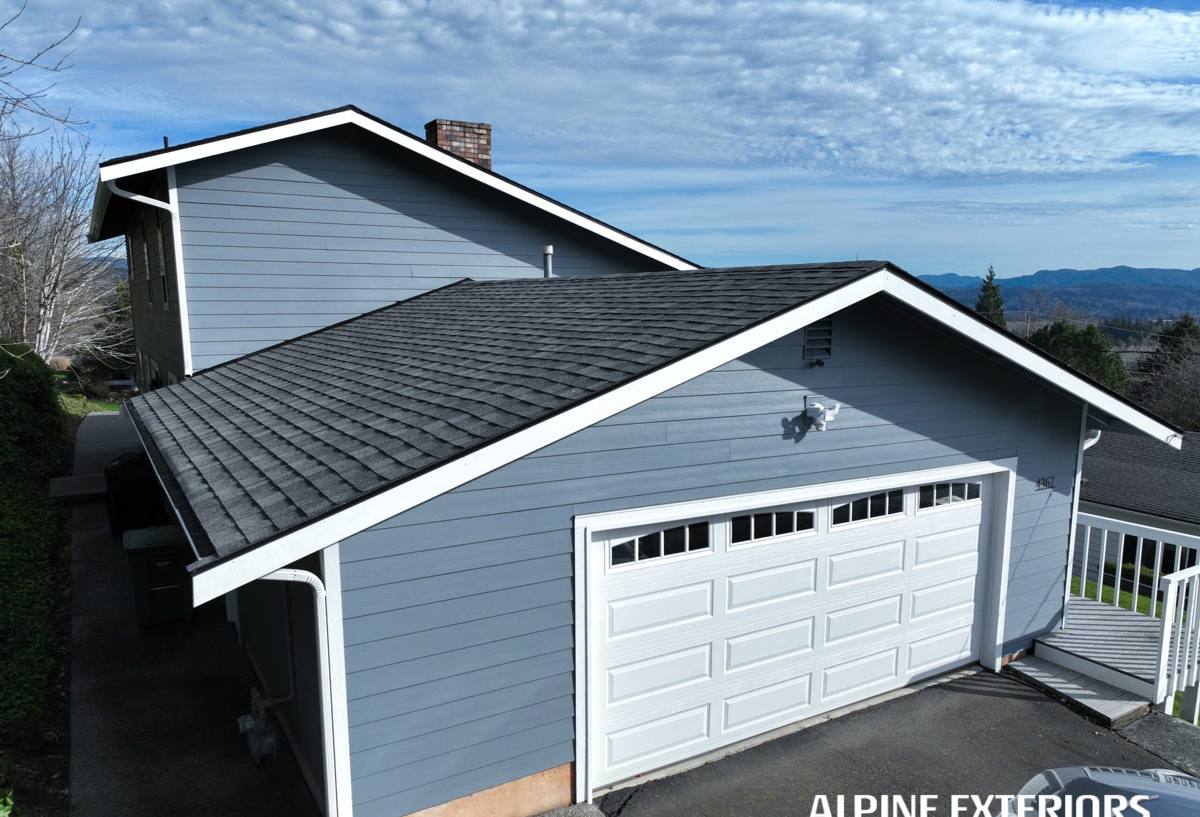
Signs a Blaine Roof Needs Repair Now
Roof problems rarely announce themselves clearly. By the time you see a stain on a ceiling, water has often been getting in for months. Here's what we tell homeowners to watch for between inspections:
- Granules collecting in gutters or at the base of downspouts — a sign the roofing material is wearing thin
- Dark streaking or a green-black cast on north-facing slopes, which usually means moss or algae has taken hold
- Curling, cracked, or missing shingles, especially after a windy winter storm
- Rusted or lifted flashing around chimneys, skylights, and vent pipes
- Soft spots underfoot when walking the roof, or sagging visible from the ground
- Daylight visible through the roof deck from inside the attic
- Water stains on interior ceilings or walls, particularly near exterior walls or chimneys
- Peeling paint or a musty smell in upstairs rooms, which can point to slow moisture intrusion long before a visible leak appears
Any one of these on its own might be minor. Two or three together usually mean it's time for a professional look before a small repair turns into a bigger one.
What a Correct Roof Repair Actually Involves
A roof repair done right is not just patching the spot where water is getting in. It means finding the actual entry point, which is sometimes several feet from where the stain shows up inside, and fixing the underlying cause so the same spot doesn't fail again next winter.
Flashing and Sealing
Flashing — the metal used around chimneys, skylights, vent pipes, and roof-to-wall transitions — is where most leaks actually originate, not in the open field of shingles. In a salt-air environment, flashing corrodes faster than it does inland, and corroded flashing loses its ability to shed water properly. A correct repair replaces failing flashing rather than just re-sealing over it, since sealant on top of corroded or lifted metal is a short-term fix at best.
Underlayment and Decking
If water has been getting past the roofing material for a while, the underlayment beneath it and the wood decking beneath that may already be compromised. Soft, delaminated, or rotted decking has to be cut out and replaced — patching shingles over damaged decking just hides the problem and shortens the life of the repair. This is also where driving rain does the most hidden damage in Blaine, since wind-driven water can work its way under shingles that would keep out a straight-down rain just fine.
Matching Materials
Whenever possible, a repair should match the existing roofing material in type, color, and weight so the patch doesn't stand out or create a weak seam. On older roofs where exact matches aren't available, we talk through the tradeoffs honestly rather than installing a mismatched patch and hoping it blends in.
Roofing Materials Common on Blaine-Area Homes
Different roofing materials hold up differently to salt air, moss, and sustained rain. Here's how the most common types compare for repair purposes in this climate:
| Material | How It Handles This Climate | Typical Repair Considerations |
|---|---|---|
| Asphalt composition shingle | Good moisture resistance; moss and algae can shorten lifespan if not managed | Granule loss and cracked shingles are common; matching older shingle color can be difficult |
| Cedar shake | Attractive but needs more upkeep in a wet, mossy climate | Individual shakes can be replaced, but widespread moss damage often signals more repairs are coming |
| Metal roofing | Sheds water and moss well overall, but fasteners and cut edges are vulnerable to salt-air corrosion | Repairs focus on fastener replacement and re-sealing panel seams and penetrations |
| Torch-down or membrane (low-slope) | Common on additions and porch roofs; performs well if seams stay intact | Seam separation and ponding water are the usual repair triggers |
We don't push one material over another as a blanket rule. The right call depends on the home's existing roof, its age, and what the homeowner wants to spend on upkeep going forward — we lay out the honest tradeoffs and let the homeowner decide.
Our Repair Process, Start to Finish
Inspection First
Every repair starts with getting on the roof, not just looking at it from the ground. We check the obvious problem area first, then work outward — flashing points, valleys, penetrations, and the eaves — because a leak's source is often not where it shows up inside the house. We also check the attic when accessible, since sheathing and insulation tell us how long a problem has actually been going on.
A Clear, Honest Scope
Before any work starts, we explain what we found, what needs to be fixed, and why. If a repair is genuinely a repair — not a roof that needs full replacement — we say so. If we find that the damage is more extensive than a patch can reasonably address, we say that too, along with why.
The Repair Itself
We remove damaged material back to sound decking, replace what's compromised, install new flashing and underlayment where needed, and match the surrounding roofing material as closely as possible. Fasteners and flashing get chosen with the local salt-air exposure in mind rather than defaulting to whatever is cheapest.
Cleanup and Follow-Up
We clear debris, check gutters near the repair area for granules or moss buildup that could cause problems later, and leave the site the way we found it. If the repair area had moss contributing to the damage, we talk through simple maintenance steps to keep it from coming back.
Moss, Algae, and the Marine Climate: The Ongoing Maintenance Piece
A repair fixes the current problem. Keeping it fixed means dealing with why moss and algae take hold in the first place. North-facing slopes, roofs shaded by trees, and valleys that stay damp longer after a rain are the spots that need attention most. Moss holds moisture directly against roofing material, and over a long moss season — which in this part of Whatcom County can run most of the fall through spring — that constant dampness works its way under shingle edges and around fasteners.
Simple, low-cost habits go a long way between repairs:
- Keep gutters and downspouts clear so water isn't backing up under the roof edge
- Trim back overhanging branches that keep sections of the roof shaded and damp
- Have moss physically removed rather than just treated, since dead moss still holds moisture against the roof
- Schedule a roof check after major windstorms, not just once a year on a fixed schedule
- Address small flashing or fastener issues promptly — they're inexpensive to fix early and expensive to ignore
Repair or Replace? How We Help You Decide
Not every roof problem calls for a full replacement, and not every roof problem should be patched indefinitely either. The honest answer depends on the roof's age, how much of it is affected, and how many prior repairs it's already had.
| Factor | Leans Toward Repair | Leans Toward Replacement |
|---|---|---|
| Age of roofing material | Well within expected lifespan | Near or past the material's typical service life |
| Extent of damage | Isolated to one area (flashing, one slope, one penetration) | Widespread across multiple slopes or repeated trouble spots |
| Decking condition | Sound decking under the affected area | Soft or rotted decking found in multiple locations |
| Repair history | First or second repair on this roof | Roof has needed several repairs in recent years |
We walk through where a given roof falls on this table honestly, including when a repair is clearly the right and more affordable call. We're not in the business of selling replacements to homeowners who don't need one yet.
Why a Crew That Already Works Blaine Matters
Roofing crews who mainly work drier, inland areas sometimes underestimate what a Blaine roof deals with year-round — the salt air, the wind-driven rain, the long stretch of moss season. That shows up in small but important decisions: what fastener to use, how much flashing overlap is actually enough given the wind exposure here, and which parts of a roof are worth extra attention because of shading and orientation, not just what's textbook-standard.
Working regularly in and around Bellingham and the rest of Whatcom County also means we're familiar with the building patterns common to homes in this area, and we're not learning the climate on someone's dime. A repair that's built for this weather the first time saves the homeowner from paying for the same fix twice.
Get a Straight Answer About Your Roof
If you're seeing granules in the gutter, moss creeping across a slope, or a stain that wasn't there last season, it's worth getting a second set of eyes on it before winter weather makes the problem worse. We offer free, no-pressure estimates for roof repair work in Blaine and throughout the Bellingham area — use the form below to get one scheduled.