 Bellingham Exterior
 Metal Roofing Built for Cordata's Weather, Not Just Its Curb Appeal
Cordata sits far enough north in Bellingham that it catches the full range of what Whatcom County throws at a roof over a year: long stretches of driving rain off the water, a moss season that can run from fall through spring, and a steady, low-grade dose of salt-tinged air pulled in from Bellingham Bay and the Salish Sea. None of that is dramatic on any single day. It's the accumulation that wears roofs out early — algae staining shingles, moss lifting edges, fasteners corroding quietly under trim. A metal roof, installed correctly, is one of the few roofing systems built to shrug off all three of those pressures at once instead of just one.
This page is specifically about metal roofing for Cordata homes — not a general overview of every roofing option. If you're comparing materials, our broader roofing pages cover that. Here we're talking through what actually matters when a metal roof goes on a house in this part of Bellingham: the climate factors, the install details that separate a correct job from a leaky one, and what our process looks like start to finish.
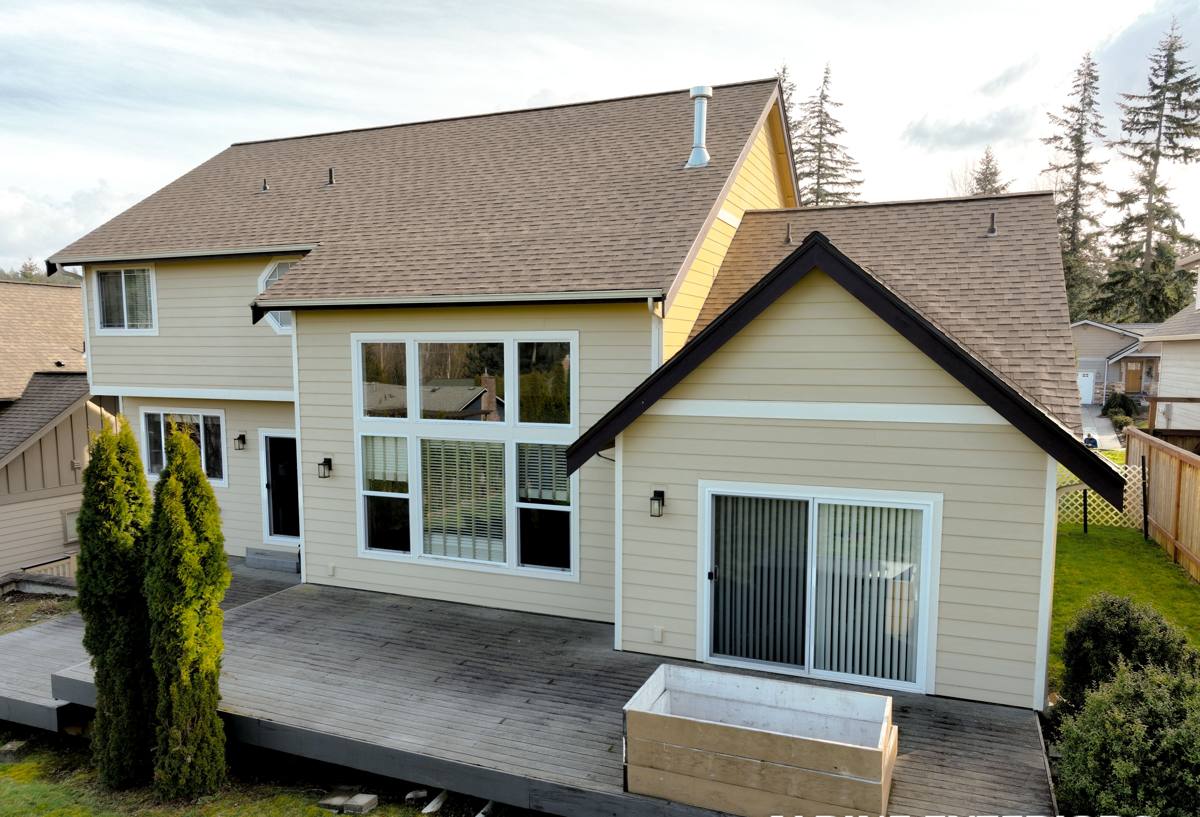
What Driving Rain and a Long Moss Season Do to a Roof Here
Whatcom County doesn't get the heaviest rainfall totals in the state, but it gets frequent, wind-driven rain that comes in at an angle instead of straight down. That matters more than total inches. Wind-driven rain finds its way under loose shingle tabs, through poorly lapped flashing, and into any gap where a roofer cut a corner. Over enough winters, that's how attic leaks start — not from one storm, but from dozens of ordinary ones.
Moss is the other constant. Cordata's tree cover and the region's damp, mild winters give moss and algae exactly the conditions they need: shade, moisture that doesn't dry out quickly, and organic debris collecting in valleys and along eaves. On asphalt shingles, moss roots into the granule surface and lifts tabs as it grows, which is how small leaks start even on a roof that isn't that old. On a correctly installed metal roof, there's no granule surface for moss to grip, and the smooth, sloped panels shed both rain and moss spores far more effectively.
Salt Air's Slower, Quieter Effect
Coastal proximity means airborne salt settles on exterior surfaces, including roofing metal, flashing, and fasteners. It's not going to eat through a properly coated steel or aluminum panel, but it will find and accelerate corrosion at any weak point — an uncoated fastener, a scratched panel edge, dissimilar metals in contact with each other. This is a detail-level issue, not a material-choice issue, and it's exactly where installation quality decides whether a metal roof lasts twenty-five years or forty-plus.
Why Metal Roofing Makes Sense for This Specific Climate
We don't push metal roofing as the right answer for every house or every budget. But for Cordata's combination of rain, moss, and coastal air, it solves problems that other materials manage rather than eliminate.
- Steep water shedding: Metal panels move water off the roof fast, reducing the standing moisture that feeds moss and algae growth.
- No absorbent surface: Unlike asphalt granules or wood shakes, metal doesn't hold moisture against itself, which limits the freeze-thaw and rot cycles common in this climate.
- Long service life: A correctly installed metal roof is typically rated for multiple decades, which matters when you're weighing the higher upfront cost against how often you'd otherwise be re-roofing.
- Better wind performance: Properly fastened metal panels resist uplift better than shingles in the gusty fall and winter storms that move through the county.
- Lower long-term maintenance when the coating and fastener system are matched to coastal-air conditions.
Panel Types: What's Actually Available and How They Compare
"Metal roofing" covers a range of products, and the right one depends on your roof's slope, your budget, and how much you value a completely concealed fastener system versus a more economical exposed-fastener panel.
| Panel Type | How It's Fastened | Best For | Trade-Offs |
|---|---|---|---|
| Standing seam | Concealed clips, no exposed screws on the panel face | Homes wanting the longest service life and cleanest look | Higher material and labor cost |
| Exposed-fastener panel | Screws driven through the panel face into structure | Budget-conscious projects, outbuildings, some steep-slope homes | Fasteners and their gaskets need periodic inspection and eventual replacement |
| Stone-coated steel | Concealed or exposed depending on system | Homeowners who want a shingle or shake look with metal's durability | More installation detail work around coating and cut edges |
For most Cordata homes, we lean toward standing seam or a well-detailed exposed-fastener system, because concealed or properly gasketed fasteners hold up far better against the combination of moisture and airborne salt than a roof with hundreds of exposed penetration points. Whichever system fits your project, the coating spec matters as much as the panel style — we'll walk through that during your estimate rather than guessing at it here.
What a Correct Metal Roof Installation Actually Involves
Metal roofing punishes shortcuts more visibly than asphalt does, because there's no forgiving granule layer to hide a bad detail. A correct install includes several things that are easy to skip and hard to notice until years later:
Underlayment and Deck Prep
Metal roofs need a synthetic or self-adhered underlayment rated for the panel type and slope, plus a sound, properly ventilated deck underneath. Skipping ventilation upgrades is one of the most common corner-cutting moves we see on tear-offs — it traps moisture against the underside of the panels and defeats a lot of what metal is good at.
Fastener and Metal Compatibility
Mixing incompatible metals — say, the wrong fastener alloy against a steel or aluminum panel — sets up galvanic corrosion that accelerates in salt-tinged coastal air. Every fastener, flashing piece, and trim component needs to be matched to the panel material, not just "close enough."
Flashing at Every Transition
Valleys, chimneys, vent penetrations, and wall transitions are where the vast majority of roof leaks originate, on any material. Metal roofing requires custom-formed flashing at each of these points rather than generic trim, especially in a wind-driven rain climate where water gets pushed sideways and upward under poorly lapped pieces.
Panel Layout and Expansion Allowance
Metal panels expand and contract with temperature swings. Panels fastened without room to move can buckle or pull fasteners loose over time — a detail that has nothing to do with panel quality and everything to do with installation experience.
Our Process on a Cordata Metal Roofing Project
- On-site assessment: We inspect the existing roof, deck condition, ventilation, and any moss or moisture damage before recommending a system.
- Honest scope and estimate: You get a clear breakdown of panel type, underlayment, flashing detail, and what it will cost — no vague allowances.
- Tear-off and deck repair: Old roofing comes off, and any soft or water-damaged decking is replaced before anything new goes down.
- Underlayment and ventilation: Proper underlayment and any needed ventilation upgrades go in first, since these are invisible once the panels are on.
- Panel and flashing installation: Panels are installed with matched fasteners, correct expansion spacing, and custom flashing at every valley, penetration, and transition.
- Final walkthrough: We go over the finished roof with you, including what routine maintenance looks like going forward.
Maintenance in a Wet, Mossy Climate
Metal roofing needs far less upkeep than shingles, but "far less" isn't "none." In Cordata's climate, the practical maintenance items are:
- Clearing debris from valleys and gutters each fall before the wet season sets in
- Checking for moss or algae buildup in shaded areas, even though metal resists it far better than shingles
- Periodic visual inspection of fasteners and flashing, especially after major windstorms
- Keeping overhanging branches trimmed back to reduce shade, debris, and abrasion against panels
What to Ask Before Hiring a Metal Roofing Contractor in Cordata
- Do they specify a coating and fastener system rated for coastal, salt-air exposure?
- Will they custom-form flashing on-site, or rely on generic stock trim?
- Do they address deck ventilation as part of the scope, not as an upsell later?
- Can they explain the expansion allowance for the specific panel profile they're quoting?
- Do they have manufacturer training or certification for the panel system they're proposing?
Why Local Experience in Bellingham and Whatcom County Matters
Metal roofing is not a one-size-fits-all install. A crew that mostly works drier inland regions may not think twice about wind-driven rain details or salt-air fastener compatibility, because it's never been the deciding factor on their jobs. Working regularly in Bellingham and across Whatcom County means we're pricing, detailing, and specifying with this exact climate in mind — not adapting a generic approach after the fact. That shows up in the flashing details, the coating specs we recommend, and the maintenance guidance we give you at handoff.
If you're weighing a metal roof for your Cordata home, we're happy to walk the roof with you, talk through panel options honestly, and give you a free, no-pressure estimate. Use the form below to get started.