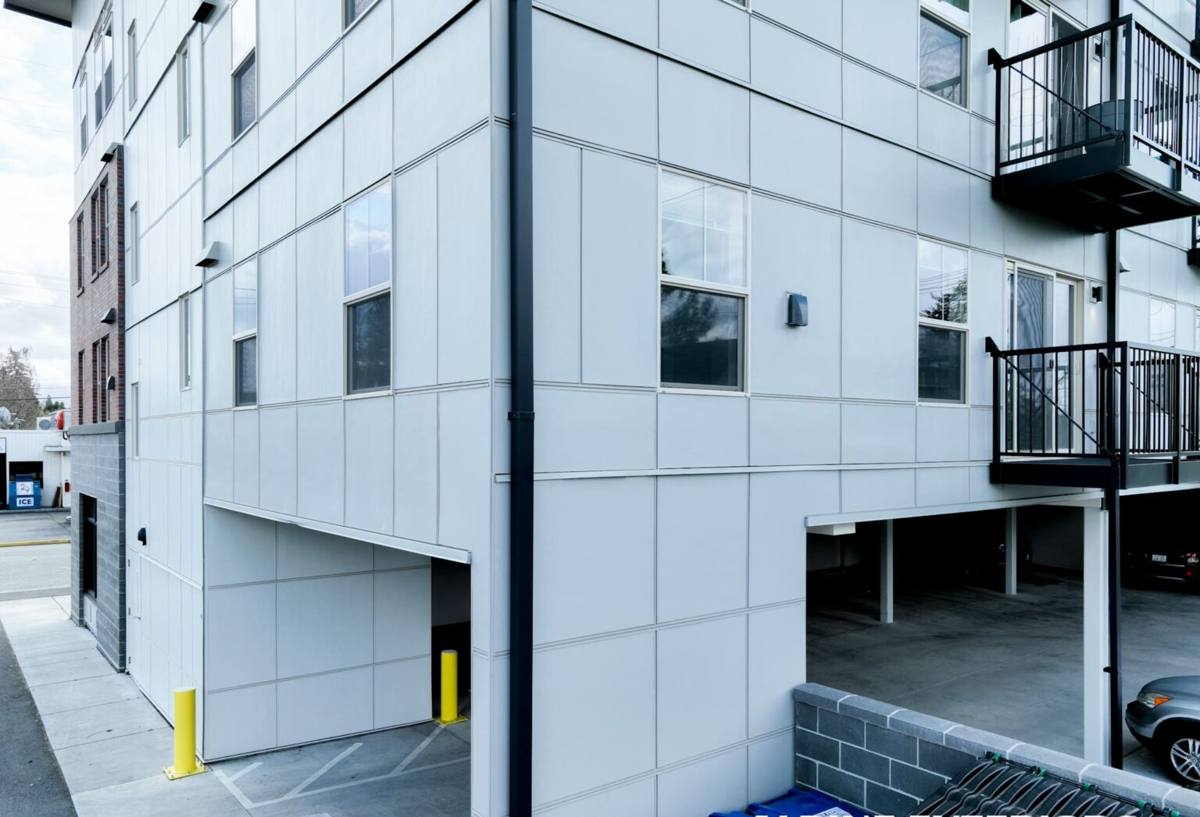
 Bellingham Exterior
 Windows in Cordata Face a Different Set of Problems
Cordata sits far enough inland from Bellingham Bay that people sometimes assume salt air isn't a factor here — but moisture-laden marine air moves through all of Whatcom County, and it settles into window frames, sills, and hardware the same way it does closer to the water. Add in the driving, sideways rain that comes with our winter storm systems and the long stretch of gray, damp months that let moss and algae take hold on anything that stays wet, and you've got a climate that is genuinely hard on windows. Most window failures we see in this neighborhood aren't about the glass — they're about what's happening around the glass: framing, flashing, and sealant that were never installed to handle this much sustained moisture.
A window that's a poor fit for our climate doesn't fail dramatically. It fails slowly — a little fogging between panes, a soft spot at the bottom corner of a sill, a draft that shows up every winter and gets worse each year. By the time it's obvious, there's usually water damage behind the wall that costs more to fix than the window itself.
What Correct Window Installation Actually Involves
Window installation looks simple from the outside — pull the old unit, set the new one, caulk the edges. Done that way, it's also the fastest route to a callback in two or three years. A correct installation in a wet climate like ours is mostly about what happens before the window ever goes in the opening.
The parts homeowners don't see
- Removing and inspecting the old framing for hidden rot before assuming the sheathing is sound
- Installing a proper drainage plane and flashing tape so any water that gets past the window sheds down and out, not into the wall cavity
- Setting a sloped sill pan so water can't pool at the bottom of the opening — the single most common failure point we find on older installs
- Using the right sealant and backer rod at the right joints, not caulk smeared over everything as a catch-all
- Shimming and fastening so the window operates square and doesn't rack over time, which is what eventually breaks seals and locks
None of that shows once the trim is back on. It's also exactly the part that determines whether the window lasts fifteen years or thirty-five.
Our Process for Cordata Homes
1. On-site assessment
We look at each window individually — not every window in a home fails for the same reason, and not every window needs full replacement. Some just need better flashing and a new sash; others have compromised framing that has to be addressed first.
2. Honest scope and pricing
We tell you what we found, what we recommend, and why — including if we think a repair makes more sense than a full replacement for a given window. We don't upsell a whole-house job when three windows need attention.
3. Removal and structural check
Old windows and trim come out carefully so we can actually see the framing underneath. If there's rot or water staining, we address it before anything new goes in — sealing over a wet frame just delays the failure.
4. Flashing, sill pan, and drainage first
This is the step that gets skipped on rushed jobs and is the one we won't skip. It's the difference between a window that sheds our winter rain and one that slowly rots the wall around it.
5. Install, seal, and test
Windows are set square, shimmed, fastened, and sealed at the correct joints. We check operation — smooth opening, tight locking, no racking — before we call it finished.
6. Cleanup and walkthrough
We walk the job with you, explain any maintenance the specific window style needs, and leave the site clean.
Choosing a Window That Holds Up Here
There's no single "best" window material — the right choice depends on the exposure of each wall, your budget, and how much upkeep you want to take on. Here's how the common options actually perform in a climate like ours:
| Material | Moisture Performance | Maintenance | Typical Trade-offs |
|---|---|---|---|
| Vinyl | Won't rot; handles damp climates well | Low — occasional cleaning | Frame can look bulkier; limited color options |
| Fiberglass | Excellent — very stable in wet, temperature-swinging conditions | Low | Higher upfront cost than vinyl |
| Wood | Needs consistent protection or it takes on moisture damage over time | High — regular painting/sealing | Best appearance for older or historic homes; highest upkeep in our wet season |
| Wood-clad (wood interior, metal/vinyl exterior) | Good — exterior shell protects the wood | Moderate | Cladding seams need to be well-sealed to avoid trapped moisture |
| Aluminum | Weak on its own — conducts cold and can condense heavily | Moderate | Generally a poor fit for this climate unless thermally broken |
For most Cordata homes, we lean toward vinyl or fiberglass on exposed elevations because they're not dependent on a maintenance schedule to keep moisture out. Solid wood still has a place — especially where matching an existing look matters — but it needs an honest conversation about the upkeep it requires in a climate this wet, not a sales pitch that skips over it.
Glass and seal considerations
Double-pane, low-E glass is the standard for our region and does a good job managing both heat loss and condensation. What matters just as much as the glass package is the quality of the seal between panes — a failing seal shows up as fog or moisture between the glass, and it's a manufacturing and installation issue, not something that can be cleaned or fixed after the fact. It's worth asking any contractor what warranty coverage applies to seal failure specifically, separate from the general product warranty.
Signs a Window Needs Attention
A quick self-check most homeowners can do in an afternoon:
- Fog, haze, or visible moisture between the panes of glass
- Soft or spongy wood at the sill, especially on the exterior
- Visible gaps, drafts, or a noticeable temperature difference near the window in winter
- Paint that's peeling or bubbling on or near the frame, which often points to trapped moisture
- Difficulty opening, closing, or locking — a sign the frame has shifted or racked
- Moss, algae, or dark staining building up on horizontal trim or sills
- Visible condensation on the interior glass on cold mornings, more than would be normal for the room
Any one of these on its own isn't necessarily an emergency, but a window showing two or more of them has usually been letting moisture in for a while.
What Drives the Cost of a Window Project
| Factor | Why It Matters |
|---|---|
| Number of windows | Per-window cost usually drops on larger jobs due to shared setup and crew time |
| Window size and type | Large, custom, or specialty shapes (bay, picture, casement) cost more than standard sizes |
| Material | Vinyl is typically the most budget-friendly; fiberglass and wood-clad cost more upfront |
| Condition of existing framing | Hidden rot or water damage adds repair scope that isn't visible until removal |
| Access and building height | Second-story or hard-to-reach windows take more time and equipment |
| Trim and finish work | Matching existing exterior trim or interior casing adds labor |
We give real numbers based on what we find at your home — general ranges without seeing the actual windows and framing don't mean much, and we'd rather give you an honest estimate than a low number that changes once we open a wall.
Why Hiring a Crew That Already Works This Neighborhood Matters
A crew that regularly works in Cordata and the surrounding Bellingham area already knows what this climate does to a house — where water tends to collect on local roof and wall configurations, what moss buildup usually means underneath it, and how much flashing and drainage detail actually holds up through a Whatcom County winter versus what only looks fine on install day. That's not something you get from a crew that installs windows the same way regardless of region. It shows up in the small decisions — sill pan slope, flashing overlap, sealant choice — that don't matter in a dry climate but matter every single winter here.
It also means we're accountable locally. If something needs a second look after the install, we're not driving in from out of the area — we're already working in the neighborhood.
Get a Straightforward Estimate
If you're noticing drafts, moisture, or wear on your windows — or you're just planning ahead — we're happy to take a look and give you an honest read on what your home actually needs. No pressure, no inflated scope. Use the form below to request a free estimate for your Cordata home.