 Bellingham Exterior
 Why Sehome Decks Take More Punishment Than People Expect
Sehome sits close enough to Bellingham Bay that salt-laden air is a fact of life, and that air does real work on an outdoor structure over time. Combine it with the long stretch of driving rain that runs from fall through spring, plus a moss season that can linger for months in shaded, north-facing yards, and you have three separate forces all working against the same deck at once. None of this means a deck can't last decades in Whatcom County — it means the deck has to be designed and built with those forces in mind from the first footing to the last board.
A lot of deck problems we see in this neighborhood aren't dramatic failures. They're slow ones: fasteners that corrode faster than expected, framing that stays damp two days longer than it should after a storm, or decking that looks fine on top while moisture works underneath it. A deck built for Sehome's specific conditions avoids most of that by getting the unglamorous details right.
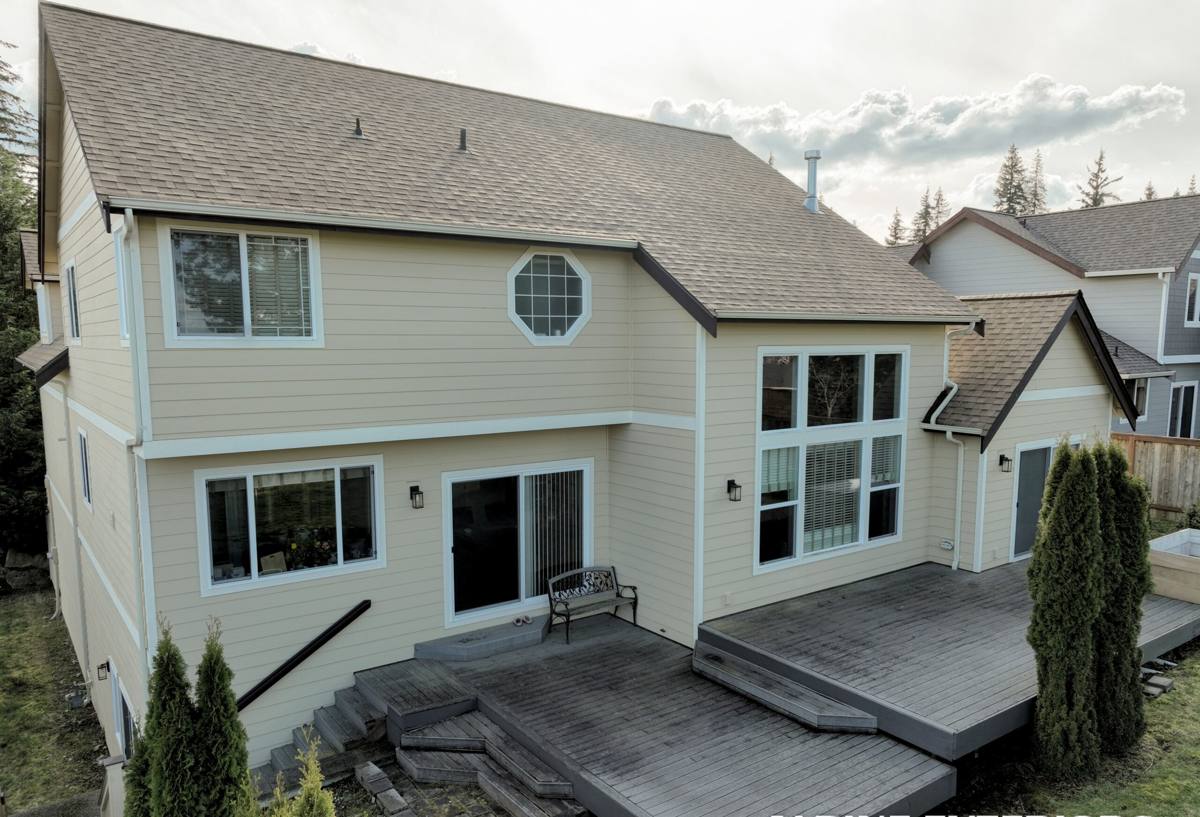
What Salt Air and Driving Rain Actually Do to a Deck
Salt Air and Metal Fasteners
Homes closer to the water deal with airborne salt that accelerates corrosion on anything metal — nails, screws, joist hangers, bolts. Standard hot-dip galvanized hardware holds up reasonably well inland, but in coastal-influenced neighborhoods like Sehome, it can start showing rust streaks and pitting years before it should. That corrosion isn't just cosmetic; a corroded joist hanger or ledger bolt is a structural weak point.
Driving Rain and Water Intrusion
Rain that comes in at an angle, which is common with Bellingham's weather patterns, gets into places vertical-only rain never would — under railings, behind ledger boards, into end grain on decking. Wood and composite decking both handle top-down rain fine. What causes problems is water that gets trapped and can't drain or dry, which is a design and detailing issue more than a material one.
Moss and Sustained Dampness
Shaded areas of Sehome yards, especially under mature trees or on the north side of a house, can stay damp for weeks at a time in winter. That's exactly the environment moss and algae need to take hold on decking surfaces, and once established, moss holds even more moisture against the boards — a cycle that speeds up wear if the deck wasn't built with airflow and drainage in mind.
What a Correctly Built Deck Needs in This Climate
| Deck Component | Standard Approach | What We Adjust for Sehome's Climate |
|---|---|---|
| Fasteners and hardware | Standard galvanized hardware | Higher corrosion-resistant coatings or stainless steel in exposed and near-grade locations |
| Ledger attachment | Bolted ledger with basic flashing | Full ledger flashing detail that sheds water away from the house band board, not just at the top |
| Framing spacing | Manufacturer minimum joist spacing | Tighter spacing or added blocking where composite decking is used, since composite behaves differently than wood under load and moisture |
| Under-deck airflow | Minimal clearance to grade | Adequate clearance and, where possible, grading or gravel below to keep framing from sitting in damp soil |
| Surface drainage | Standard board gapping | Consistent gapping and, on solid substrates, positive slope so water doesn't pool and feed moss growth |
Choosing a Decking Material for a Sehome Yard
There's no single "best" decking material — the right choice depends on how much sun and shade the deck gets, how much maintenance the homeowner wants to do, and budget. Here's how the common options actually perform in this kind of climate.
Pressure-Treated Wood
The most affordable option and still a solid choice, but it needs regular sealing to perform well here — skipping that maintenance in a wet, shaded yard is where wood decks get into trouble. In sunnier parts of a Sehome lot it can go longer between treatments than in shaded corners.
Cedar and Other Natural Woods
Naturally more rot- and insect-resistant than treated lumber and a good fit for homeowners who want a classic look, but it comes at a higher price point and still needs periodic finishing to keep its color and resist the moisture load from our rainy season.
Composite Decking
Composite resists rot and doesn't need staining, which makes it appealing given how long our wet season runs. It isn't maintenance-free, though — in shaded, damp spots it can still develop surface mold or algae if it isn't cleaned periodically, and it's more sensitive to correct framing and spacing during installation than solid wood is. We only install it to the manufacturer's structural specifications, which is one reason we don't cut corners on framing spacing to save a step.
Why We're Selective About What We Install
We don't push one material on every job. Instead, we walk the actual site — how much shade it gets, how exposed it is to wind off the bay, what the homeowner's maintenance appetite is — and recommend what will actually hold up there, with the honest trade-offs laid out up front.
Foundations and Framing: The Part Nobody Sees
A deck's long-term performance is decided mostly below the decking boards. Footings need to be sized and set to local frost and soil conditions, posts need proper post bases that keep wood off concrete and away from standing water, and framing needs enough clearance and airflow underneath to dry out between rain events instead of staying damp for days. In a climate where "damp for days" describes a lot of the calendar, this is where cutting corners shows up first — usually as soft spots, sagging, or hardware failure years down the road, long after the surface still looks fine.
Moss Management and Long-Term Maintenance
No deck built here is entirely moss-proof — that's just the reality of a long Pacific Northwest wet season. But a deck that's designed with drainage and airflow in mind needs far less intervention than one that wasn't. A few things make the biggest difference over the life of the deck:
- Board spacing and slope that let water run off instead of sitting
- Framing clearance that allows the underside to dry out, not just the top
- Keeping nearby vegetation trimmed back so shaded areas get at least some sun and airflow
- An annual rinse or gentle cleaning before moss gets a foothold, rather than after
- Resealing wood decking on the schedule the finish actually calls for, not "when it looks bad"
We can talk through a realistic maintenance schedule for your specific deck and yard conditions as part of the estimate — it's different for a sun-exposed south-facing deck than for one tucked under trees.
Our Deck Building Process in Sehome
We keep the process straightforward and communicate at each step, because most of the frustration homeowners describe with past projects comes from not knowing what's happening or why.
- On-site assessment — we look at sun exposure, drainage patterns, existing structure (if replacing a deck), and how the space will actually be used.
- Material and design discussion — honest comparison of options for your budget and the site's specific exposure, not a one-size-fits-all pitch.
- Permitting — we handle the paperwork with the City of Bellingham or Whatcom County, depending on the project's location and scope.
- Demolition and site prep (if applicable) — including proper disposal of old materials.
- Foundation and framing — footings, posts, ledger, and joists built to the standards outlined above.
- Decking, railing, and finish work — installed to manufacturer spec with attention to gapping and drainage.
- Final walkthrough — we go over care and maintenance specific to your deck's material and sun/shade exposure.
Permits and Local Requirements
Most decks above a certain height or attached to the house require a building permit, and requirements can differ depending on whether a property falls under City of Bellingham or Whatcom County jurisdiction. Setbacks, railing height, guard spacing, and ledger attachment methods are all points inspectors look at closely on deck projects. We handle the permit process as part of the job so homeowners aren't left navigating that on their own.
Why a Crew That Already Works in Sehome Matters
A deck builder who works this neighborhood regularly already knows which streets sit in near-constant shade, which lots catch the brunt of wind off the bay, and which permitting office to talk to for a given address. That familiarity isn't just convenience — it shows up in fewer surprises during the project and a deck that's built for the yard it's actually going into, not a generic template. It also means we're not learning Whatcom County's inspection expectations on your project.
Questions Worth Asking Before You Hire a Deck Builder
- Do they carry current liability insurance and, where required, bonding?
- Will they pull the required permit themselves, or leave that to you?
- Can they explain why they're recommending a specific decking material for your yard's sun and shade?
- Do they specify hardware and fastener grade in writing, not just "standard hardware"?
- Are they willing to walk you through footing and framing details before the deck is closed up?
If you're planning a new deck or replacing one that's showing its age, we're happy to take a look and put together a straightforward, no-pressure estimate based on your specific property and how you plan to use the space. Reach out through the form below to get started.