 Bellingham Exterior
 Why Decks Wear Out Faster in Fairhaven
Fairhaven sits close to Bellingham Bay, under a mix of mature tree canopy and open water exposure, which means local decks take on two kinds of punishment at once. Salt-laden air off the water accelerates corrosion on fasteners, hardware, and any metal railing components. At the same time, the tree cover that gives Fairhaven's older streets their character also keeps decks shaded and damp for long stretches of the year, which is exactly what moss and algae need to take hold.
Add in Whatcom County's driving rain — often blown sideways by wind coming off the water rather than falling straight down — and you get moisture working its way into joints, fastener holes, and ledger connections that a drier climate would never stress. None of this is exotic weather, but it is relentless, and it's the reason a deck built with corner-cutting hardware or the wrong decking material can look fine for a season or two and then fail all at once.
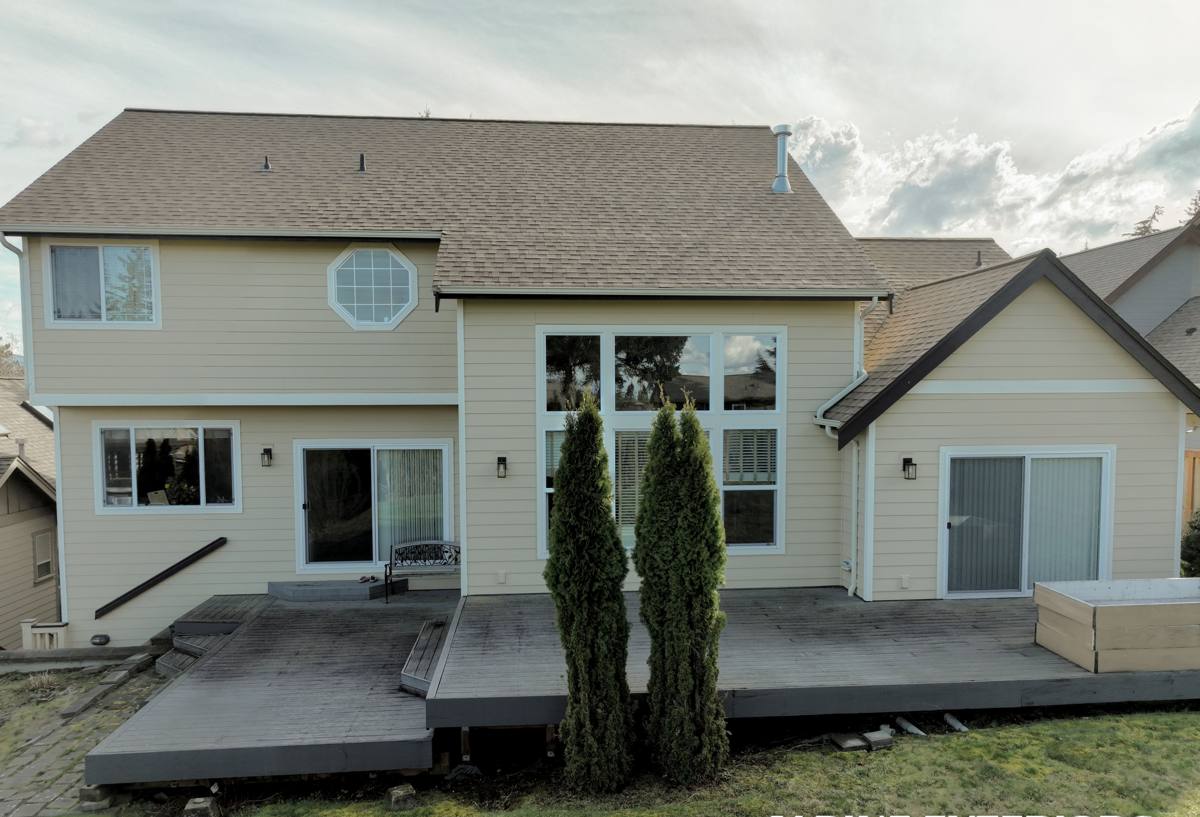
Signs a Fairhaven Deck Needs Replacement, Not Repair
Not every tired-looking deck needs to come out. But there's a point where patching boards or re-sealing the surface is just delaying a bigger problem, especially once the structure itself is compromised. Here's what tells us a full replacement is the honest recommendation rather than another round of repairs:
- Soft, spongy, or spring-back decking when you walk across it, especially near the house or stair landing
- Visible rot or dark staining at the ledger board where the deck attaches to the house
- Rusted, loose, or missing joist hangers and fasteners underneath the deck
- Persistent moss or algae growth that returns within weeks of cleaning
- Railings that flex or wiggle under normal hand pressure
- Posts or footings that have shifted, heaved, or show visible rot at ground contact
- A deck built before current guardrail and fastening codes, with no documented upgrades since
If you're seeing two or more of these, replacement is usually the more honest — and often more cost-effective — path than chasing repairs on a structure that's already telling you it's done.
What a Correct Deck Replacement Actually Involves
Structure First, Surface Second
The decking boards are the part homeowners see, but the framing underneath is what determines whether the deck lasts. That means properly sized joists on the correct spacing for the decking material chosen, joist hangers rated for the load, and a ledger board that's flashed and fastened to keep water from ever reaching the house's rim joist. In a climate like Bellingham's, ledger flashing isn't optional — it's the single most common failure point we see on decks that were built cheaply or fast.
Footings and Posts
Footings need to be sized and set below frost depth per Whatcom County code, with posts properly connected using corrosion-resistant hardware rather than just toe-nailed or bolted with standard fasteners. Given the salt air near the bay, we treat hardware grade as a real decision, not an afterthought — standard zinc-coated fasteners corrode faster here than they would further inland.
Fasteners and Hardware
This is where a lot of decks quietly fail years before the boards look bad. We use fasteners and connectors rated for the specific decking material and exposure — stainless or heavy hot-dip galvanized hardware near the water, not the minimum-code option. It costs more up front and saves the homeowner from a deck that looks solid on top while rusting apart underneath.
Choosing the Right Decking Material for Fairhaven's Climate
There's no single "best" decking material — the right choice depends on how much sun exposure the deck gets, how much maintenance the homeowner wants to do, and budget. Given Fairhaven's shade-and-moisture combination, here's how the common options actually compare in real conditions, not marketing terms:
| Material | Moss/Moisture Resistance | Maintenance | Typical Lifespan |
|---|---|---|---|
| Pressure-treated wood | Good if sealed regularly; grain traps moisture in shaded areas | Annual cleaning and re-sealing recommended | 10-15 years with upkeep |
| Cedar | Naturally rot-resistant, but surface still needs care in shaded, damp spots | Periodic sealing to maintain appearance and moisture resistance | 15-20 years with upkeep |
| Composite decking | Very good — doesn't absorb water the way wood does, but caps still need cleaning where moss can grow on the surface film | Occasional washing, no sealing or staining | 25-30 years |
| PVC decking | Excellent — fully synthetic, minimal moisture absorption | Low — periodic washing only | 25-30+ years |
In shaded, water-adjacent settings like much of Fairhaven, we lean toward recommending composite or PVC for homeowners who want to spend less time on upkeep, while wood remains a solid choice for those who prefer the traditional look and are willing to stay on top of sealing. We'll walk through the honest trade-offs for your specific site — sun exposure matters as much as the material itself.
Our Deck Replacement Process
1. On-Site Assessment
We look at the existing structure, the ledger connection, footing condition, and how the site's sun and moisture exposure will affect material choice — not just the visible surface.
2. Plan and Permit
Whatcom County and the City of Bellingham require permits for most deck replacement work, particularly anything involving footings, framing, or guardrail height changes. We handle the permit process so the finished deck is code-compliant and documented — which matters for resale and insurance down the road.
3. Demolition and Disposal
The old deck comes out, including any compromised framing, footings that don't meet current code, and corroded hardware. We don't reuse structural components that show rot or corrosion, even if it would save a step.
4. Framing and Flashing
New ledger flashing, joists, hangers, and footings go in to current code, sized for the decking material and expected load.
5. Decking, Railing, and Stairs
Decking is installed with proper spacing for drainage and material expansion, railings are set to current guardrail height and baluster spacing requirements, and stairs are built to code for rise and run.
6. Final Walkthrough
We walk the finished deck with the homeowner, cover basic maintenance expectations for the material chosen, and make sure everything's been inspected and signed off before we call it done.
Permits, Code, and Fairhaven's Character
Deck replacement in Bellingham typically requires a permit, and guardrail height, baluster spacing, and footing depth are all governed by current building code — not the code that was in effect when an older deck was originally built. This matters in a neighborhood like Fairhaven, where a good number of homes are older and were built well before current safety standards existed. Bringing an aging deck up to code isn't just paperwork; it's the difference between a structure that's actually safe for kids, pets, and gatherings and one that only looks fine.
Some areas within and around Fairhaven's historic core may also have design or review considerations depending on the property. We check what applies to your specific address before finalizing a plan, rather than assuming one size fits all.
Protecting Your New Deck from Moss and Salt Air
A well-built deck still needs some ongoing care in this climate, and a little maintenance goes a long way toward avoiding another premature replacement:
- Sweep leaves and debris off the deck surface regularly, especially in fall, so moisture and organic matter don't sit against the boards
- Rinse hardware and railings periodically if the deck faces open water, to slow salt-related corrosion
- Trim back overhanging branches where possible to reduce shade and let the surface dry between rains
- Reseal wood decking on the schedule recommended for the specific product used
- Check fastener and railing connections annually for movement or rust staining
- Clean composite or PVC surfaces with a soft brush and mild cleaner to prevent moss film from building up in shaded corners
Why It Matters to Hire a Crew That Already Works Fairhaven
Deck construction that works fine in a dry inland climate can fall short here. A crew that already works in and around Bellingham's bay-side neighborhoods knows to spec corrosion-resistant hardware without being asked, knows which decking materials actually hold up under heavy shade, and knows the local permitting process well enough that it doesn't stall your project for weeks. That familiarity shows up in details — flashing choices, fastener grade, drainage spacing — that aren't visible on day one but decide whether the deck is still solid in year twelve.
If your Fairhaven deck is showing its age, soft in spots, or just overdue for an honest look, we're happy to come take a look and give you a straightforward assessment. Use the form below to request a free, no-pressure estimate — we'll tell you plainly whether repair or replacement is the right call for your situation.