 Bellingham Exterior
 Why Ferndale Decks Wear Out Faster Than Homeowners Expect
Ferndale sits close enough to the water and open farmland that decks here take a beating most inland homes never see. Salt-laden air drifting off Bellingham Bay and the Strait accelerates corrosion on anything metal — nails, screws, joist hangers, railing brackets. Add in driving rain that comes sideways during winter wind events, and water finds its way into joints and fastener holes that would stay dry on a calmer site. Then there's moss season, which in Whatcom County isn't really a season at all — it's most of the year. Shaded decks under fir and cedar canopy stay damp for days at a stretch, and moss doesn't just look bad, it holds moisture against the wood and turns boards slick and dangerous underfoot.
None of this means a deck in Ferndale can't last. It means the materials, fasteners, and detailing have to be chosen for this specific climate, not for a generic build. A deck replacement done right here should outlast one built to a lowest-cost spec by a decade or more.
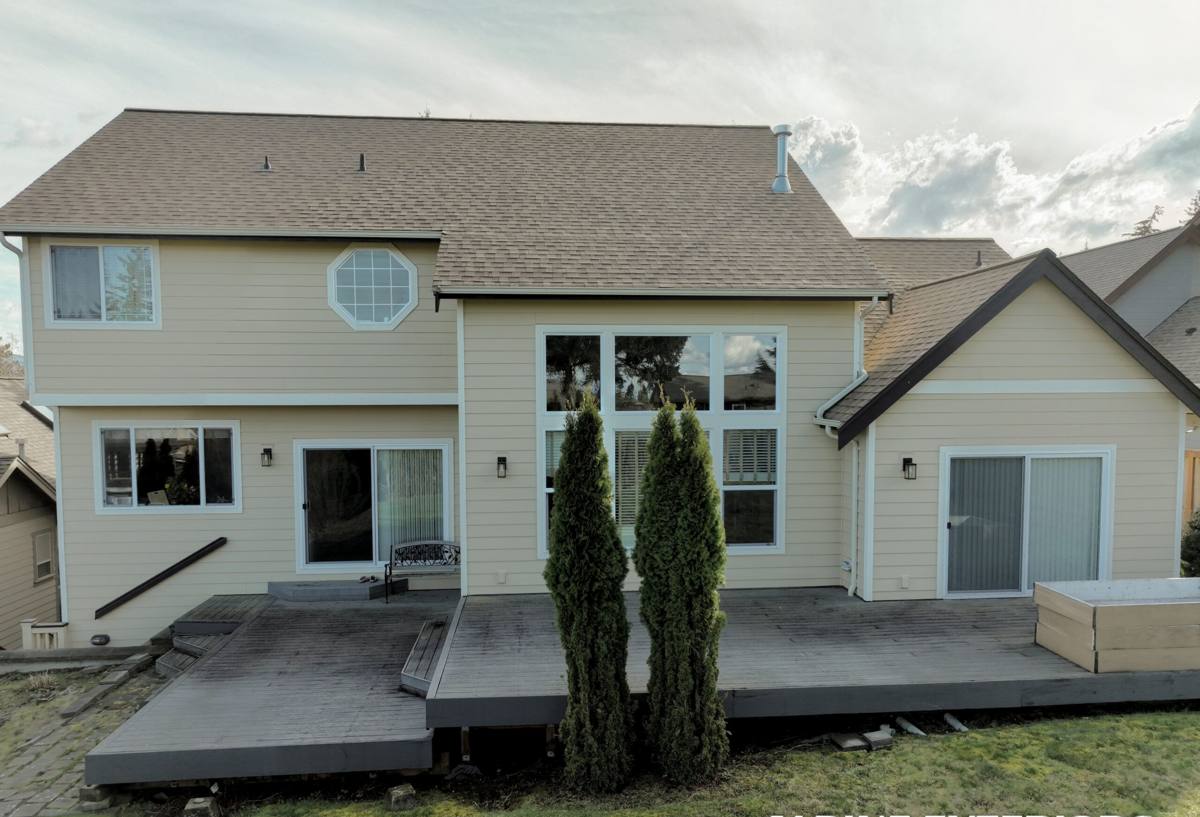
Signs Your Deck Needs Replacing, Not Just Repairing
Not every tired-looking deck needs a full teardown. But there's a point where patching individual boards or re-securing a railing is just delaying the inevitable — and spending money that won't show up in the final result. A few signs it's time for a real replacement:
- Soft or spongy spots when you walk across the deck, especially near the house or stair landing
- Visible rot or dark staining at the ledger board where the deck meets the house
- Rusted or corroded fasteners with streaking down the face of the boards
- Railings that flex or wiggle when leaned on — a structural issue, not a cosmetic one
- Persistent moss or algae that comes back within weeks of cleaning, no matter how you scrub it
- Gaps between boards that have closed up or warped unevenly, trapping water instead of shedding it
If you're seeing two or more of these, replacement is almost always the better value than continuing to chase repairs on a structure that's past its working life.
What a Correct Deck Replacement Actually Involves
Starting Below the Surface
A deck replacement isn't just swapping old boards for new ones. The framing underneath — the ledger board, joists, beams, and footings — is what determines whether the new deck lasts. On many older Ferndale homes, the original ledger board was never properly flashed against the house, which is one of the most common causes of hidden rot. A correct replacement means pulling the old decking, inspecting every structural member, and replacing anything showing decay, undersized framing, or fastener corrosion — not just what's visible from the top.
Footings and Frost Depth
Whatcom County's frost depth requirements affect how deep footings need to be set. Undersized or shallow footings are a common shortcut on older decks, and they show up as seasonal shifting, uneven boards, or a deck that pulls away slightly from the house over time. Replacement is the right time to correct this permanently.
Decking Material Options for This Climate
There's no single "best" decking material — the right choice depends on budget, how much sun and shade the deck gets, and how much maintenance you're willing to keep up with. Here's how the common options actually perform in a wet, moss-prone, salt-air environment like Ferndale's:
| Material | Moisture & Moss Resistance | Maintenance | Typical Lifespan |
|---|---|---|---|
| Pressure-treated wood | Good if sealed regularly; absorbs water if neglected | Annual cleaning and re-sealing recommended | 15–20 years with upkeep |
| Cedar | Naturally rot-resistant, but surface grays and softens without sealing | Sealing every 1–2 years | 15–25 years with upkeep |
| Capped composite | Excellent — sheds water, resists moss staining better than wood | Occasional wash, no sealing | 25–30+ years |
| PVC decking | Excellent — fully synthetic, doesn't absorb moisture | Occasional wash | 25–30+ years |
We don't push one product over another as a default — we talk through what you actually want to maintain. A wood deck can look excellent for decades if someone keeps up with sealing, but if that's not realistic for your household, a capped composite or PVC board will hold up in Ferndale's damp shade with far less effort. The trade-off is upfront cost versus long-term maintenance labor, and that's a decision that should be yours, made with honest numbers in front of you.
Fasteners, Flashing, and Hardware: Where Salt Air Does the Most Damage
This is the part of a deck replacement that homeowners rarely see but that determines whether the deck is still solid in fifteen years. Standard electro-galvanized fasteners corrode quickly in coastal air, especially where they're in direct contact with pressure-treated lumber, which is chemically more corrosive to metal than untreated wood. For Ferndale's proximity to the water, we specify hot-dip galvanized or stainless-steel fasteners and hardware rated for treated lumber contact. It costs a bit more upfront. It's not optional if you want the connections to still be sound in a decade.
Flashing at the ledger board is just as important. This is the strip of metal that keeps water from tracking behind the deck and into the rim joist or house sheathing. A poorly flashed ledger is one of the most common failure points we find on older decks in this area, and it's directly tied to the driving rain that Whatcom County winters bring. Correct flashing, installed with proper overlap and sealed transitions, is a small detail with an outsized effect on how long the structure lasts.
What Correct Hardware Looks Like
- Hot-dip galvanized or stainless joist hangers, screws, and structural connectors
- Ledger flashing installed under the house's weather barrier, not just caulked over the top
- Joist tape on top of framing to keep standing water off the wood beneath the decking
- Corrosion-resistant railing brackets and post bases, especially on decks facing prevailing wind and rain
Designing a Deck That Actually Sheds Water and Resists Moss
Moss and algae need two things to thrive: moisture and shade. You can't always change how much tree cover a lot has, but you can design a deck that doesn't hold water against itself. Proper board spacing lets water drain through rather than pool on the surface. Board orientation and airflow underneath the deck matter too — a deck built low to the ground with poor ventilation stays damp far longer after a storm than one with adequate clearance. On heavily shaded lots, we'll sometimes recommend composite or PVC decking specifically because it doesn't provide the same organic surface for moss spores to take hold on the way bare wood does.
None of this eliminates the need for occasional cleaning — every deck in this climate needs it — but the right build reduces how often and how aggressively you have to do it.
Our Deck Replacement Process
Every job starts with an honest look at what's actually underneath the old decking, because that's what determines the real scope of work — not just the square footage on top.
- On-site inspection of the existing deck, framing, ledger board, and footings
- Written estimate covering material options and what each one means for maintenance and lifespan
- Permit pulled through Whatcom County where required, before any demolition begins
- Removal of old decking and inspection of framing as it's exposed
- Repair or replacement of joists, beams, and footings as needed to meet current code
- Correct ledger flashing and corrosion-resistant fastener installation throughout
- Decking, railing, and stair installation to your chosen material and layout
- Final walkthrough so you know how to care for the specific material you chose
Permits, Codes, and Railings in Whatcom County
Most deck replacements that involve structural work — new footings, a rebuilt ledger connection, or a deck attached at a new height — require a permit in Whatcom County. We handle that process as part of the job rather than leaving it to the homeowner. Railings are a code item too: guards are generally required once a deck surface is a certain height above grade, with minimum height and baluster spacing requirements meant to prevent falls. If your existing deck was built without meeting current guard requirements, replacement is the natural point to bring it up to code.
Why a Crew That Already Works Ferndale Matters
A contractor who's replaced decks throughout Whatcom County knows which fastener grade actually holds up this close to the water, knows how Ferndale's soil and frost line affect footing depth, and has already seen what happens to a deck that skipped proper ledger flashing five years in. That's not something you learn from a spec sheet — it's from doing the work locally, on homes with the same rain, the same moss, and the same salt air yours deals with. We're not guessing at what "coastal-grade" means for this area. We've built to it.
If your deck is showing its age — soft spots, rusted hardware, moss that won't quit — we'll come take an honest look and walk you through what a real replacement involves for your specific home. The estimate is free, there's no pressure, and you'll get a clear breakdown of material options before you decide anything. Use the form below to get started.