 Bellingham Exterior
 Windows Installed at Framing Are a Different Job Than Windows Installed Later
If you're building new in Ferndale, the windows you choose and how they get installed during framing will determine whether your walls stay dry for the next thirty years or start showing water stains behind the drywall in five. New-construction windows are not the same product or the same install as a replacement window dropped into an existing opening. They have a nailing flange that gets integrated directly into the wall's weather-resistant barrier, the flashing tape, and the sheathing before siding ever goes on. Get that sequence right and the wall behind the window stays protected for decades. Get it wrong and you won't know until the damage is already inside the framing.
We install new-construction windows on homes going up all over Whatcom County, and Ferndale jobs get their own attention because of what this stretch of coastline and lowland does to a building envelope. Salt air off the bay, long stretches of driving rain, and a moss season that seems to start earlier every year all put steady pressure on window openings. A correct install accounts for that from the first piece of flashing tape, not after the first winter reveals a problem.
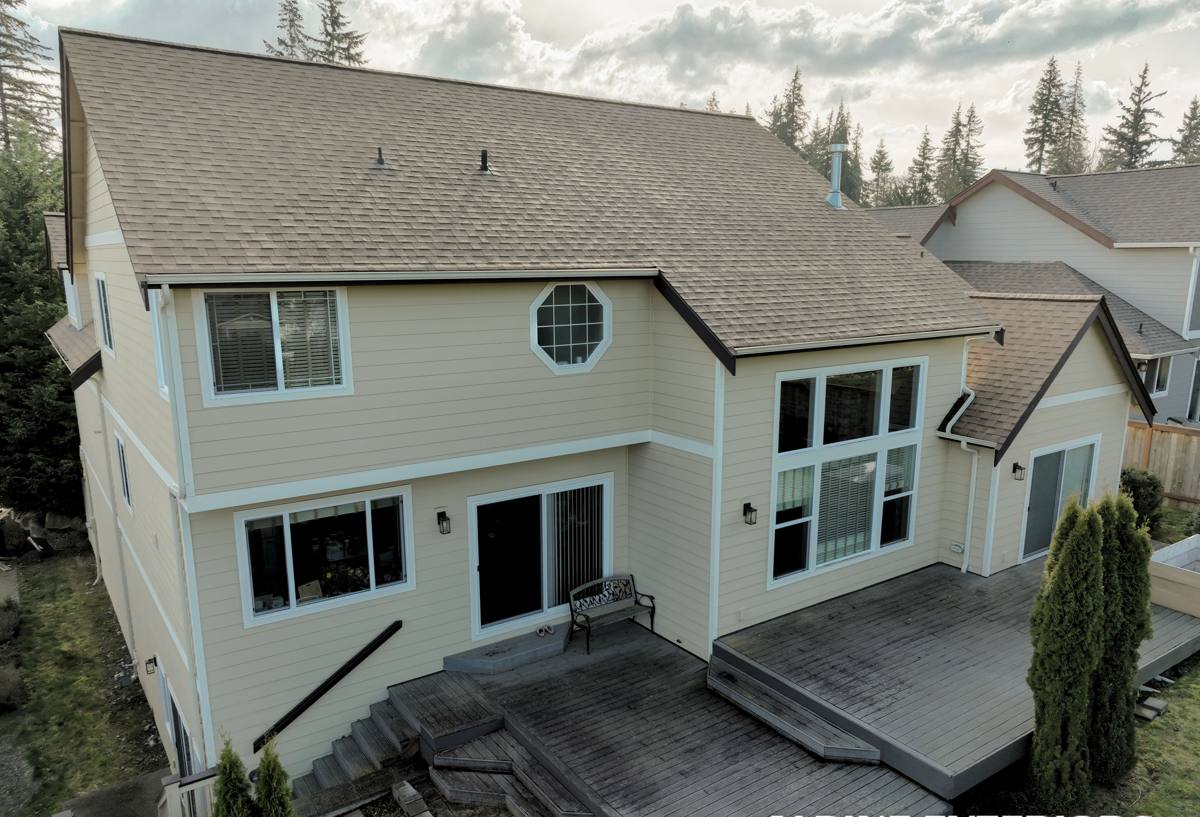
What Ferndale's Climate Actually Does to a Window Opening
Ferndale sits close enough to the water that salt-laden air is a real factor on hardware, fasteners, and exposed metal — it's not a coastal-Florida level of corrosion, but it's enough that cheap fasteners and low-grade cladding show pitting and staining years before they should. Add in the region's pattern of wind-driven rain, where water doesn't just fall straight down but gets pushed sideways into every seam and joint, and the margin for error at a window opening shrinks considerably. A flashing detail that would hold up fine in a drier inland climate can fail here within a few wet seasons.
Then there's moss. Whatcom County's damp, mild winters and shaded lots grow moss on roofs, siding, and window sills without much encouragement. Moss holds moisture against building materials far longer than open air would, and around a window that means prolonged dampness sitting right where the flashing and trim meet the wall assembly. None of this is exotic or unusual for the area — it's just the baseline a new-construction window install has to be built for, and it's why generic install methods from drier climates don't always hold up out here.
What This Means in Practice
- Flashing and sealant products need to handle sustained wet exposure, not occasional rain.
- Fastener and hardware quality matters more near the water than it does further inland.
- Sill details need a real drainage path, not just a bead of caulk, since standing moisture plus moss growth is a slow, steady threat rather than a one-time storm event.
- Overhangs, trim, and flashing geometry all need to actively shed water away from the opening, not just resist it.
What a Correct New-Construction Window Install Involves
New-construction windows are set into the rough opening before the siding goes on, which means the install has to work in sequence with the rest of the wall assembly. Skipping steps or doing them out of order is the single biggest cause of window-related water problems in new builds, and it's usually invisible until the siding is already up.
The Sequence We Follow
- Rough opening check. Confirm the opening is square, level, and sized correctly before anything else happens — a slightly out-of-square opening now becomes a window that won't operate smoothly for the life of the house.
- Sill pan flashing. A sloped, self-draining sill pan goes in first so that any water that does get past the window has somewhere to go besides into the wall framing.
- Jamb and head flashing. Flashing tape is applied in the correct shingle-lap order — sill, then jambs, then head — so every layer sheds water down and out, never into a seam.
- Window-to-WRB integration. The nailing flange gets sealed and taped into the weather-resistant barrier so the window becomes part of a continuous drainage plane, not an isolated hole in the wall.
- Fastening. Corrosion-resistant fasteners set per the manufacturer's schedule — important everywhere, more important this close to salt air.
- Interior and exterior sealant. Backer rod and sealant at the right joints, leaving the designed weep and drainage paths open rather than sealing the window shut.
- Pre-siding inspection. Every opening gets checked before the siding crew closes the wall, because that's the last point where a flashing mistake is cheap to fix.
Each step depends on the one before it. A crew that rushes the flashing order or tries to caulk around a mistake instead of correcting it is setting up a leak that won't show itself until it's already caused rot.
Choosing Frame Material for a Ferndale Build
Frame material affects how a window handles this region's damp, salt-tinged air over time — and how much upkeep it asks of you. There's no single right answer for every home; it depends on your budget, your home's style, and how much maintenance you want to sign up for.
| Frame Material | Moisture & Salt-Air Behavior | Maintenance | Typical Fit |
|---|---|---|---|
| Vinyl | Good resistance to moisture and corrosion; won't rot or rust | Low — occasional cleaning | Budget-conscious builds, rental properties, straightforward openings |
| Fiberglass | Excellent dimensional stability and corrosion resistance in wet, coastal-influenced air | Low | Homes wanting long service life with minimal upkeep |
| Wood-clad | Strong performance when detailing is precise; exposed wood interior needs protection from interior moisture too | Moderate — exterior cladding protects the wood, but seals and joints need periodic checks | Homeowners prioritizing a traditional wood interior look |
We'll walk through these trade-offs with you against your actual plans and budget rather than pushing one product line. The honest answer is that the frame material matters less than the quality of the install — a premium frame installed with a shortcut flashing sequence will still leak, and a solid mid-range frame installed correctly will outlast it.
Glass Packages Worth Considering Here
Whatcom County's mild but persistently overcast, wet climate makes double-pane, low-E glass with argon fill a sensible standard rather than an upgrade — it cuts heat loss during our long stretches of gray, damp weather and helps control condensation on interior glass during cold snaps. Triple-pane is worth discussing for north-facing rooms or homes where owners want to push efficiency further, but it adds cost and weight that not every opening needs.
Our Process for New-Construction Window Jobs
Because new-construction install work happens on a schedule set by the framing and siding crews, timing and coordination matter as much as the install itself.
How We Work With Your Build Schedule
- Plan review. We look at your window schedule and rough opening sizes early, before framing locks them in, so nothing has to be re-cut later.
- Product selection. We go over frame material, glass package, and hardware options against your budget and the home's exposure — south and west-facing walls catching more driving rain get extra attention.
- Install during the correct framing stage. We set windows once the sheathing and WRB are ready, following the flashing sequence above.
- Pre-siding sign-off. We inspect every opening before siding closes the wall — this is the point where a problem is a five-minute fix instead of a tear-out.
- Final walkthrough. Once the home is closed in, we check operation, seals, and hardware on every window before we call the job done.
Mistakes We See on New-Construction Openings
Most of the water problems we get called to diagnose in newer Ferndale-area homes trace back to a handful of repeatable errors, not bad luck:
- Flashing tape applied in the wrong order, so water gets directed into a seam instead of away from it.
- No sill pan, relying on caulk alone to keep water out of the framing.
- Fasteners that aren't rated for the exposure, leading to early corrosion and a loosened, less weathertight window over time.
- Sealant used to cover a flashing mistake instead of fixing the underlying detail — caulk is maintenance, not a substitute for correct flashing.
- Weep holes and drainage paths sealed shut by an over-eager caulk job, trapping moisture instead of letting it drain.
Every one of these is avoidable with a careful, in-order install and an inspection before the wall gets closed up. None of them are visible from outside the finished house, which is exactly why they go unnoticed until there's a real problem.
Keeping New Windows Performing Once You've Moved In
A correct install gives you a strong foundation, but a little seasonal attention keeps it that way — especially with this region's moss season and wet winters.
- Clear moss and debris off sills and nearby trim before it holds moisture against the frame for weeks at a time.
- Check exterior caulk joints once a year for cracking or separation, particularly on south and west exposures that take the most weather.
- Make sure weep holes at the base of the frame stay open and unblocked.
- Operate every window through its full range a few times a year so hardware doesn't seize or corrode unnoticed.
- Watch for any soft spots, staining, or paint bubbling on interior trim near windows — an early sign worth investigating before it spreads.
Why It Matters That We Already Work in Ferndale
A crew that mostly installs windows in drier climates or in retrofit-only work doesn't always carry the habits this coastline demands — the flashing order, the drainage details, the fastener choices that hold up against salt air and driving rain. We install new-construction windows across Whatcom County, and Ferndale's exposure to the bay and its long wet season are things we plan for on every job here, not an afterthought. That familiarity shows up in the small decisions — how a sill pan is sloped, which fastener goes where, how much overhang detail a given elevation needs — that a generic install sequence tends to skip.
If you're framing a new home or addition in Ferndale and want windows installed the way this climate actually requires, we're glad to walk the plans with you and give you a straightforward, no-pressure estimate. Fill out the form below and we'll get in touch to talk through your build.