 Bellingham Exterior
 Why Ferndale Roofs Wear Differently Than Roofs Inland
Ferndale sits close enough to the water and open farmland that its roofs take a different kind of beating than a roof twenty miles inland. You get salt-laden air moving off the Strait and the bay, wind-driven rain that doesn't just fall but gets pushed sideways under poorly lapped shingles and loose flashing, and long stretches of damp, shaded winter weather that keep moss and moisture active on the roof deck for months at a time. None of that is dramatic on its own. It's cumulative. A roof that would hold up fine in a dry inland climate for 25 years can start showing granule loss, soft decking, or moss colonies on a Ferndale roof five to ten years sooner if it wasn't built with this specific exposure in mind.
A correct new roof installation here isn't about buying a more expensive shingle. It's about getting the underlayment, flashing details, fastening pattern, and ventilation right for a marine, high-moisture environment. That's the difference between a roof that needs attention every couple of years and one you don't think about for two decades.
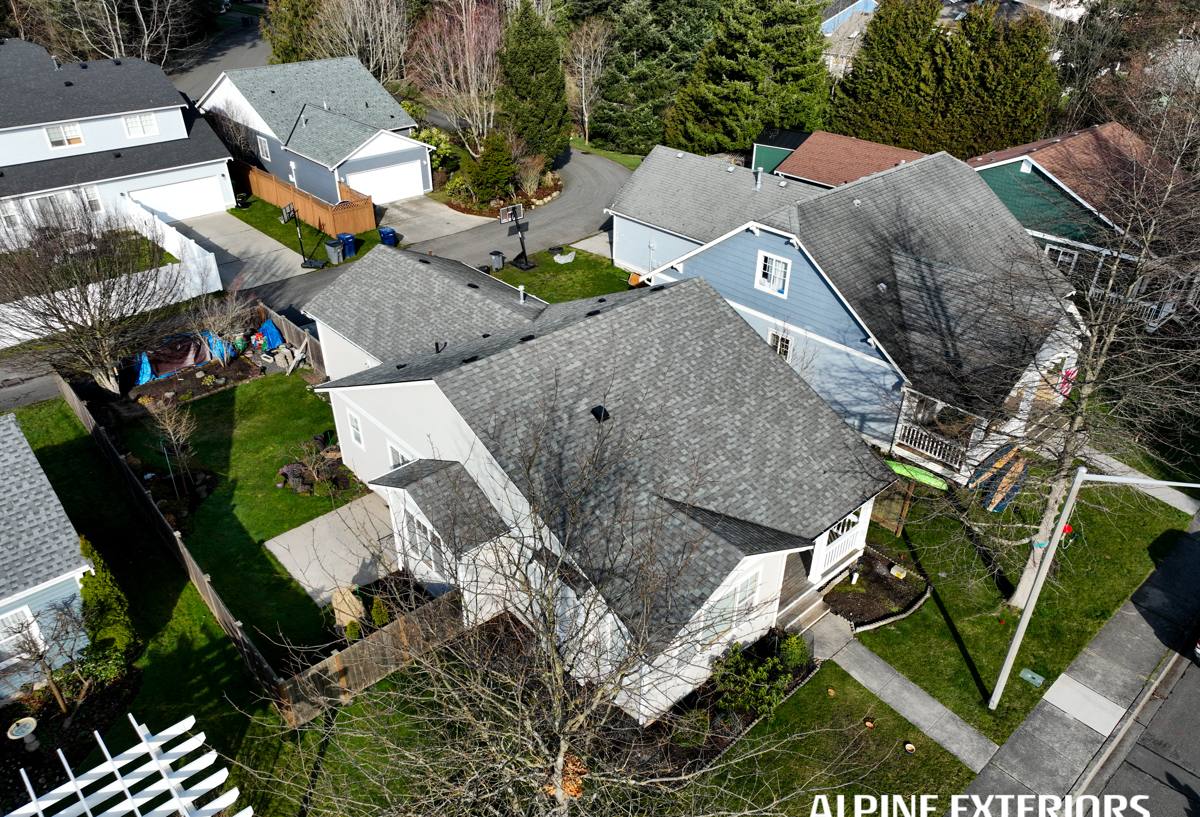
When Replacement Makes More Sense Than Another Repair
We get called out to a lot of Ferndale roofs that have had patch work done over the years, and often the honest answer is that another patch isn't worth it. Here's how we think about that call:
- Granule loss visible in the gutters or downspouts, especially on the south and west-facing slopes that take the most weather
- Shingles that are curling, cupping, or cracking across multiple areas of the roof, not just one isolated spot
- Moss growth that keeps coming back within a year of cleaning, which usually means moisture is being held under the mat, not just sitting on top of it
- Soft spots or sagging in the decking when walked, which signals water has already gotten past the roofing material
- Repeated leaks around the same penetration or valley even after prior repairs
- A roof that's 18-25+ years old on standard architectural shingles, which is realistically the useful life range in this climate
If a roof shows one or two of these in an isolated area, a repair can still be the right call. When several of these show up together, or the roof is already past its expected service life for this climate, replacement is usually the more honest recommendation — repeated repairs on an aging roof end up costing more over a few years than one correct installation.
What a Correct New Roof Installation Actually Involves
A new roof is more than laying shingles over the old ones or a bare deck. In a climate like Whatcom County's, several layers underneath the visible surface matter as much as the shingle itself.
Tear-Off and Deck Inspection
We remove the existing roofing down to the deck rather than layering over it. That lets us actually see the plywood or OSB sheathing underneath and replace any sections that have gone soft or delaminated from long-term moisture exposure — something that's common on older Ferndale roofs where moss or debris held water against the deck for years without anyone noticing.
Underlayment Built for Wind-Driven Rain
Standard felt underlayment is not enough on a roof that regularly takes rain pushed sideways by wind off the water. We use synthetic underlayment with self-adhering ice-and-water membrane at the eaves, valleys, and around every roof penetration — the areas where wind-driven rain most often finds a way in under standard shingle laps.
Flashing Details
Most roof leaks in this region don't start in the open field of the roof — they start at a poorly flashed chimney, skylight, wall intersection, or valley. New step flashing, counter-flashing, and valley metal, properly integrated with the underlayment (not just caulked over old flashing), is one of the most important parts of a correct installation and one of the easiest things for a rushed crew to shortcut.
Ventilation
A roof deck that can't breathe traps moisture from inside the home against the underside of the sheathing, which accelerates rot and can void shingle warranties. We check and correct intake (soffit) and exhaust (ridge or box vent) balance as part of every installation, not as an upsell afterward.
Material Choices for a Ferndale Roof
Most Ferndale homes are well served by a quality architectural asphalt shingle, but the right product and underlayment package depends on the roof's exposure, slope, and how long you plan to own the home. Here's how the common options compare for this climate:
| Material | Typical Lifespan Here | Moss/Moisture Behavior | Best Fit |
|---|---|---|---|
| 3-tab asphalt shingle | 15-20 years | Lower moss resistance, more prone to wind lift in gusty exposure | Budget-conscious, lower-exposure roofs |
| Architectural (laminate) shingle | 25-30 years | Better wind rating and moss resistance, especially with algae-resistant granules | Most Ferndale homes — the standard we recommend |
| Metal (standing seam or panel) | 40-50+ years | Sheds moisture fast, very moss-resistant, low maintenance | Homeowners planning long-term ownership or wanting minimal upkeep |
| Cedar shake | 20-25 years with upkeep | Higher moss and moisture risk without regular maintenance | Homeowners committed to ongoing maintenance for the look |
We don't push cedar shake as a default recommendation in this climate, not because it can't look good, but because it demands consistent maintenance to resist moss and moisture that most homeowners underestimate going in. If you want that look and are prepared for the upkeep, we'll install it correctly. For most Ferndale homes, we point people toward a algae-resistant architectural shingle or metal, because both hold up with far less babysitting.
What Drives the Cost of a New Roof
Every roof is different, so we don't quote a number until we've actually measured and inspected yours. But a few factors consistently move the price up or down:
| Factor | Why It Matters |
|---|---|
| Roof size and number of squares | The biggest single driver of material and labor cost |
| Roof pitch and accessibility | Steep or hard-to-access roofs take longer and require more safety setup |
| Number of penetrations, valleys, and roof planes | More flashing detail work means more labor |
| Existing deck condition | Rotten sheathing found during tear-off adds material and labor |
| Material selected | Standard architectural shingle vs. metal vs. premium shingle lines |
| Layers being removed | Tearing off multiple existing layers costs more than one |
Broadly speaking, a standard architectural shingle replacement on an average-size home runs in the mid-to-upper five figures range depending on these factors, with metal roofing typically running higher upfront in exchange for a much longer service life. We'll walk through exactly what applies to your roof during the estimate.
How Our Installation Process Works
- On-site inspection and measurement — we walk the roof, check the attic for ventilation and existing moisture issues, and measure accurately rather than estimating from the ground.
- Written estimate — a clear scope of work and material specification, so you know exactly what's being installed and why.
- Scheduling — we plan around Whatcom County's weather patterns and avoid starting tear-off when a multi-day rain system is moving in.
- Tear-off and deck inspection — full removal down to the sheathing, with any compromised decking replaced before anything new goes down.
- Underlayment and flashing installation — ice-and-water membrane at vulnerable areas, synthetic underlayment across the field, new flashing at every penetration and valley.
- Roofing material installation — installed to manufacturer spec and local code, with attention to nailing pattern and exposure for wind resistance.
- Ventilation check — intake and exhaust venting confirmed and corrected if needed.
- Cleanup and final walkthrough — magnetic sweep for stray fasteners, debris hauled off, and a walkthrough so you can see the finished work before we consider the job done.
Moss and Moisture: What We Do Differently
Moss isn't just cosmetic on a roof in this climate — it holds moisture against the shingle surface long after rain stops, which shortens the roof's life and, left long enough, works its way under the shingle mat. A correct installation reduces future moss growth in a few ways: algae-resistant shingle granules that resist the organic growth that feeds moss, proper ventilation that keeps the deck drier overall, and correct valley and flashing work that eliminates the low spots and standing water that moss colonizes first. We'll also talk through simple maintenance — periodic gentle cleaning and keeping gutters and valleys clear of needles and debris — so the roof you just paid for stays that way.
Permits, Timeline, and What to Expect During the Project
Roof replacements in Whatcom County typically require a permit, which we handle as part of the project so you're not navigating that process yourself. Most standard residential roof replacements are completed in one to three days depending on size, pitch, and weather, though tear-off day can be noisy and the property will have a dumpster or trailer staged during the work. We keep the site as contained as reasonably possible and communicate before we start if timing needs to shift for weather — better to wait a day than to install underlayment or shingles in an active rain system.
Why It Matters to Hire a Crew That Already Works in Ferndale
Roofing crews that mostly work drier, inland climates sometimes bring standard practices that don't hold up here — lighter underlayment packages, less attention to flashing at valleys and walls, or ventilation specs that assume less moisture load than Whatcom County actually delivers. A crew that regularly works Ferndale and the surrounding Bellingham area already knows which details matter for this exposure: where wind-driven rain tends to find weak points, how much moss pressure a north-facing slope will see, and what ventilation balance actually keeps a deck dry through a wet Pacific Northwest winter. That local pattern recognition shows up in fewer callbacks and a roof that performs the way it's supposed to for its full expected life.
Questions to Ask Any Roofing Contractor Before You Hire
- Are you licensed and insured to work in Washington, and can you provide proof?
- Will you tear off down to the deck, or install over the existing roof?
- What underlayment and ice-and-water membrane package is included, and where specifically will it be installed?
- How will you address ventilation as part of the project, not as an add-on?
- What does the written estimate include — is it itemized, or a single lump number?
- Who pulls the permit, and is that included in the price?
- What's the manufacturer's warranty, and is there a separate workmanship warranty from the installer?
- How do you handle deck repairs found during tear-off — is that a change order or is it addressed upfront?
A contractor who answers these clearly and specifically, without hedging, is usually one who does this correctly and consistently — not just on the roofs that are easy to see from the street.
Get a Straight Answer About Your Roof
If your Ferndale home's roof is showing its age, holding onto moss it shouldn't, or you've had a repair or two that didn't quite solve the problem, we're glad to take a look and give you an honest read on where things stand. The estimate is free, there's no pressure attached to it, and if the right answer is a repair instead of a full replacement, we'll tell you that too. Use the form below to get started.