 Bellingham Exterior
 Siding Installation in Puget: Built for This Stretch of Bellingham
Puget sits close enough to the water that homes here take a different kind of beating than houses further inland in Whatcom County. Salt-laden air moves in off Bellingham Bay and Puget Sound, driving rain comes in sideways during winter storms, and the shade and dampness that make this area beautiful also mean moss and algae get a long growing season on anything that stays wet. Siding installation in this neighborhood isn't just about picking a color and nailing up panels — it's about choosing a material and a installation method that can actually hold up to salt exposure, sustained moisture, and organic growth year after year.
We install exclusively James Hardie fiber cement siding, and Puget is exactly the kind of neighborhood where that decision pays off. This page walks through what the local climate does to siding, what correct installation looks like, and how our process works for homeowners in this part of Bellingham.
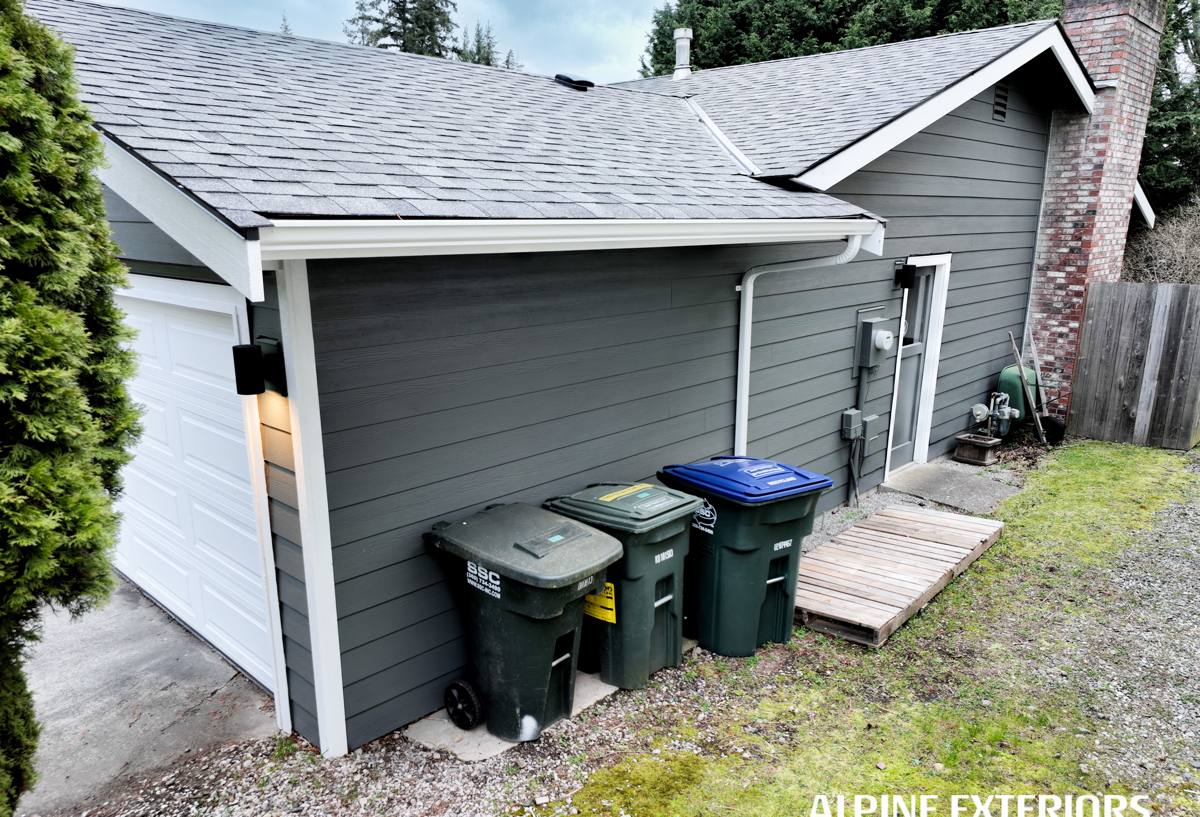
What Salt Air, Rain, and Moss Actually Do to Siding
Three separate stresses are working on your siding at the same time in Puget, and each one attacks a different weak point.
Salt Air and Moisture-Carried Corrosion
Proximity to salt water means airborne salt settles on exterior surfaces and, more importantly, works its way into fasteners, trim joints, and any exposed metal flashing. Salt accelerates corrosion in lower-quality fasteners and can degrade certain caulks and sealants faster than they'd fail further inland. It also holds moisture against the wall longer, which matters more than the salt itself in most cases.
Driving Rain and Wind-Driven Moisture
Winter storms off the Sound don't just drop rain — they push it horizontally into wall assemblies, seams, and any gap in the water-resistive barrier. Siding that isn't installed with the right overlaps, flashing, and clearances will let that water find its way behind the cladding, where it can sit against sheathing and framing for months before anyone notices a problem.
Moss, Algae, and the Long Wet Season
Whatcom County's wet season runs long, and shaded, north-facing, or tree-covered walls in Puget can stay damp for weeks at a stretch. That's ideal growing conditions for moss and algae. On absorbent or poorly finished siding, that growth holds moisture against the surface and accelerates whatever degradation is already happening underneath.
Why We Install Only James Hardie Fiber Cement Here
We made a standard choice years ago to install James Hardie fiber cement exclusively, and we don't deviate from it — not vinyl, not LP SmartSide, not primed wood, not other fiber cement brands. In a neighborhood like Puget, that standard matters more than in a drier, more sheltered part of town.
- Non-combustible material — fiber cement doesn't burn, which matters regardless of coastal exposure but is a genuine advantage over wood-based products.
- Factory-applied ColorPlus finish — baked-on color resists fading and chipping better than field-applied paint, and it's not relying on a homeowner's future repainting schedule to keep water out.
- Engineered for moisture-heavy climates — Hardie's HZ5 product line is formulated and tested for regions with sustained damp weather, which describes Puget as well as anywhere in western Washington.
- Dimensionally stable — fiber cement doesn't swell, warp, or rot the way wood-based siding can when it stays damp for extended periods, which is a real risk on shaded Puget lots.
- Resists moss and algae better when properly maintained — the factory finish and dense material give organic growth less to hold onto than porous or textured wood-fiber products.
We're not going to tell you competing products are junk — LP SmartSide, vinyl, and other fiber cement brands all have legitimate uses. But we've settled on Hardie as the one product we're willing to stand behind long-term in this climate, and we won't install something else just to win a bid.
What a Correct Siding Installation Actually Involves
The siding itself is only part of the system. Most siding failures we get called out to inspect in coastal Whatcom County neighborhoods trace back to installation details, not the material.
Drainage Plane and Water-Resistive Barrier
Every wall needs a continuous water-resistive barrier behind the siding, installed with proper overlaps and sealed penetrations, plus a drainage gap that lets any moisture that does get past the cladding drain out and dry rather than sitting against the sheathing. This is the single most important defense against driving rain, and it's invisible once the job is done — which is exactly why it needs to be inspected during installation, not after.
Fastening and Clearances
Hardie specifies fastener type, spacing, and placement for a reason — under-fastened or improperly placed nails are a common cause of panel movement and cracking. Ground clearance and roof-line clearances also matter more here than in drier climates, since splashback and prolonged dampness at the base of a wall are where rot and staining show up first.
Trim, Flashing, and Joint Details
Every window, door, corner, and butt joint is a potential entry point for wind-driven rain. Correct flashing at window and door heads, proper caulking at joints (and knowing where caulk should not be used, since some joints need to drain rather than seal), and correctly lapped trim are what actually keep Puget's storms out of the wall assembly.
| Installation Element | Why It Matters in Puget |
|---|---|
| Water-resistive barrier & drainage gap | Manages wind-driven rain that gets past the outer cladding |
| Fastener type & spacing | Salt air accelerates corrosion on undersized or incorrect fasteners |
| Ground and roofline clearances | Reduces prolonged dampness at vulnerable wall edges |
| Window and door flashing | Primary defense against horizontal rain intrusion at openings |
| Factory-finished panel selection | Reduces the surface for moss and algae to establish on shaded walls |
How Our Process Works
Every Puget project starts with a walk-around inspection of the existing siding, sheathing where accessible, and the trouble spots specific to the lot — shade patterns, drainage, prevailing wind exposure, and any visible moisture damage. From there:
- We assess what's underneath the existing siding wherever we can, since hidden sheathing damage changes the scope of the job.
- We provide a written estimate that separates material, labor, and any sheathing repair or moisture-barrier work.
- We install a full water-resistive barrier and drainage system before a single piece of Hardie siding goes up.
- We install to Hardie's fastening and clearance specifications — not the minimum needed to pass a quick look.
- We finish all trim, flashing, and caulking details, then walk the finished job with the homeowner.
Cost Factors for Puget Siding Projects
Every home is different, so we don't publish flat pricing, but these are the factors that most often move the number for homes in this neighborhood:
| Factor | Why It Affects Cost |
|---|---|
| Condition of existing sheathing | Moisture-damaged sheathing found during tear-off requires repair before new siding goes on |
| Home size and wall complexity | More corners, dormers, and trim details mean more labor and material |
| Siding profile and finish | Lap width, texture, and color line selection affect material cost |
| Access and site conditions | Sloped lots, mature landscaping, or tight setbacks common in Puget can add labor time |
| Trim and detail scope | Window, door, and corner trim replacement adds to material and labor |
Signs a Puget Home May Need New Siding
- Persistent moss or algae staining that returns shortly after cleaning
- Soft spots, bubbling, or visible warping, especially near ground level or roof lines
- Cracked, peeling, or chalky paint that keeps failing faster than expected
- Visible gaps or separation at trim, corners, or window and door edges
- A musty smell or interior moisture signs on exterior walls
- Siding that's simply reached the end of its expected service life
Why Hiring a Crew That Already Works in Puget Matters
A contractor who mainly works drier, more sheltered parts of Whatcom County can still do competent general siding work — but the details that matter most in Puget are the ones that don't show up until the first hard winter storm. Knowing where wind-driven rain tends to find gaps on water-facing walls, how much clearance a shaded wall needs to actually dry out, and which flashing details get skipped on jobs that don't account for salt air isn't something you learn from a manual. It comes from doing this specific work in this specific neighborhood.
We also stand behind the installation itself, not just the material warranty. James Hardie's product warranty covers the siding; correct installation is what determines whether that warranty — and the wall behind it — actually holds up over the decades the product is built to last.
Get a Free Estimate for Your Puget Home
If your siding is showing wear, or you're planning ahead for a replacement, we're happy to take a look and give you a straightforward, no-pressure estimate for James Hardie siding installation built for Puget's climate. Use the form below to get started.