 Bellingham Exterior
 Why Birch Bay Roofs Take More Punishment Than Roofs Inland
Birch Bay sits right on the water, and that changes what a roof has to deal with year after year. Salt-laden air moves inland off the Strait of Georgia and settles on everything, including your roof's metal components. Nails, flashing, gutters, and vent caps that would last decades in a dry inland climate corrode faster here. Add in wind-driven rain that comes in sideways during winter storms, and you've got a roof that's being tested from angles a standard installation doesn't always account for.
Then there's moss. Whatcom County's long wet season, combined with the shade from mature trees common on Birch Bay lots, gives moss and algae months of ideal growing conditions every year. A roof that would stay relatively clean in a drier part of Washington can end up carpeted in green within a couple of seasons if it's not built and maintained with that in mind.
None of this means a roof at Birch Bay needs to be exotic or overbuilt. It means the details — fastener material, flashing choices, ventilation, underlayment at vulnerable spots — need to match the actual conditions the roof will live in, not a generic spec sheet.
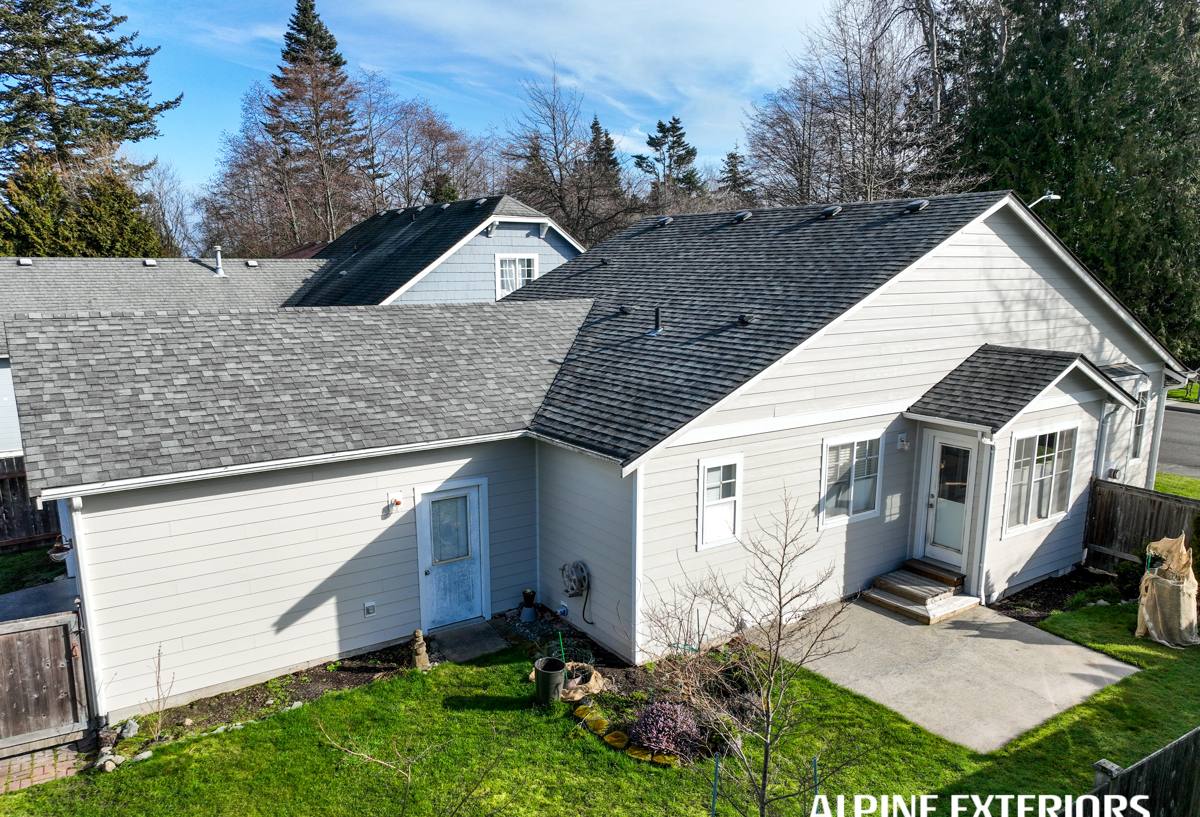
Is It Time to Replace, or Can the Roof Be Repaired?
Not every roof problem means a full replacement. But coastal exposure tends to accelerate the kind of wear that turns a repair job into a replacement job faster than homeowners expect. A few signs point toward replacement rather than another round of patching:
- Granules collecting in gutters or at downspout outlets, or shingles that look bald and blotchy from the ground
- Shingles that are curling, cupping, or cracking, especially on south- and west-facing slopes that take the most sun and wind
- Moss or algae that keeps coming back within months of cleaning, even after treatment
- Soft or spongy spots when walking the roof, or visible sagging along the ridge or eaves
- Daylight, water stains, or damp insulation visible from inside the attic
- Multiple past repairs in different areas, suggesting the roof as a whole is past its useful life rather than dealing with one isolated issue
- A roof nearing or past the typical service life for its material, especially if it's been through repeated storm seasons on a waterfront lot
If you're only seeing one or two of these and the roof is otherwise sound, a repair may genuinely be the right call. We'll tell you that if it's true — a targeted repair is cheaper than a replacement, and there's no reason to sell someone a new roof they don't need yet.
What a Correct Roof Replacement Actually Involves
Tear-Off and Deck Inspection
A proper replacement starts with removing the old roofing down to the deck, not layering over it. That's the only way to actually see what's underneath — soft plywood, rot around old flashing, or hidden leak damage that's been building for years. Any damaged decking gets replaced before anything new goes on. Roofing over a bad deck just hides the problem and shortens the life of the new roof.
Underlayment and Water Barriers
Given how much wind-driven rain Birch Bay roofs see, underlayment quality and placement matter more here than in drier inland areas. Eaves, valleys, and areas around penetrations get extra water barrier protection so wind-blown rain that gets under the shingle surface still has nowhere to go but back out.
Flashing That's Built for Salt Air
Flashing around chimneys, skylights, sidewalls, and roof-to-wall transitions is where most leaks actually start, not in the open field of shingles. In a salt-air environment, the metal used for flashing and fasteners needs to be corrosion-resistant — standard galvanized steel breaks down faster near the water than it would a few miles inland. We treat this as a standard, not an upgrade.
Ventilation
A roof that can't breathe traps moisture in the attic, which shortens shingle life and feeds the exact conditions moss needs to take hold. Balanced intake and exhaust ventilation is part of a correct installation, not an optional add-on.
Choosing Materials for Coastal Wind and Salt Air
There's no single "best" roofing material for every Birch Bay home — it depends on your roof's exposure, your budget, and how much long-term maintenance you want to take on. Here's how the common options actually compare in this environment:
| Material | Wind Performance | Salt Air / Corrosion Resistance | Moss Resistance | Typical Maintenance |
|---|---|---|---|---|
| Architectural asphalt shingle | Good, with proper fastening | Good if flashing/fasteners are upgraded | Moderate; algae-resistant granules help | Periodic moss/algae cleaning |
| Standing seam metal | Excellent | Very good with coastal-rated coatings | Very good; sheds moss more easily | Low; occasional fastener/seam check |
| Synthetic/composite shake | Good to very good | Good | Moderate to good, varies by product | Periodic cleaning, similar to shingle |
| Wood shake | Fair, wind-vulnerable over time | Poor without heavy maintenance | Poor; moss-prone in shaded, wet spots | High; regular treatment needed |
Our professional standard for waterfront and near-waterfront homes is to avoid wood shake unless a homeowner specifically wants that look and understands the maintenance commitment. In this climate, wood holds moisture, grows moss faster than it can reasonably be kept clean, and the upkeep cost over the life of the roof tends to outweigh the upfront savings. That's not a knock on the product in general — it's just a poor match for constant damp, salt-air, shaded conditions like a lot of Birch Bay lots have.
Whatever material you choose, we spec corrosion-resistant fasteners and flashing as standard on Birch Bay jobs. Using standard-grade hardware to save a small amount up front doesn't make sense when salt air will find the weak point within a few years.
Moss, Algae, and the Long Wet Season
Moss doesn't just sit on top of a roof looking bad — it actively holds moisture against the shingle surface, works its way under tabs and edges, and accelerates granule loss. On shaded, north-facing slopes common around tree-lined Birch Bay properties, it can return within a year or two of cleaning if nothing changes structurally.
A few things reduce how fast moss comes back after a replacement: algae-resistant shingles with copper- or zinc-infused granules, keeping tree canopy trimmed back from the roofline so more sun and air reach the surface, and making sure gutters and valleys are clear so water isn't sitting anywhere longer than it needs to. None of these eliminate moss entirely in this climate, but together they buy years between treatments instead of months.
How We Approach a Birch Bay Roof Replacement
- On-site inspection and honest assessment — repair versus replace, and why
- Material and detail selection based on your roof's specific sun, wind, and shade exposure
- Permitting handled through Whatcom County before work begins
- Scheduling that works around weather windows and, for vacation rentals, guest turnover
- Full tear-off, deck inspection, and repair of any compromised sheathing
- Installation of underlayment, water barriers, corrosion-resistant flashing, and ventilation
- New roofing installed to manufacturer and code specification
- Full cleanup, including a magnetic sweep for stray nails and debris hauled off site
- Final walkthrough with you and warranty paperwork provided in writing
What Drives the Cost of a Roof Replacement
We don't publish blanket pricing because two roofs of the same size can cost very differently depending on their condition and complexity. What we can tell you is what actually moves the number, so an estimate makes sense when you get one:
| Factor | Why It Matters |
|---|---|
| Roof size and pitch | More surface area and steeper pitches mean more material and labor time |
| Number of existing layers | Tearing off multiple old layers takes longer and adds disposal cost |
| Deck condition | Rot or soft sheathing found during tear-off requires repair before installation |
| Material choice | Asphalt, metal, and composite options carry different material and labor costs |
| Roof complexity | Chimneys, skylights, valleys, and multiple roof planes add flashing and labor time |
| Site access | Waterfront lots with limited staging area or steep driveways can affect logistics |
Every estimate we give reflects an actual inspection of your roof, not a phone quote based on square footage alone.
Why a Crew That Already Works Birch Bay Matters
A roofing crew that regularly works Birch Bay and the surrounding Bellingham area already understands things a crew driving in from outside the region has to learn on the fly: how exposed a given lot is to wind off the water, which details actually need the salt-air upgrade versus which don't, and how Whatcom County permitting works in practice. That familiarity shows up in fewer surprises during the job and fewer callbacks after.
It also matters for scheduling. Being based near Bellingham means we can respond quickly if a storm causes damage that needs attention before a full replacement can be scheduled, and we're not adding hours of drive time to every visit, inspection, or follow-up.
Protecting Your Investment After Installation
A correctly installed roof still needs some basic upkeep to hit its full lifespan in this climate. A few habits go a long way:
- Clean gutters and downspouts at least twice a year, more often if you're under fir or cedar cover
- Have moss and algae growth addressed before it spreads, rather than waiting until it's heavy
- Keep overhanging branches trimmed back to let sun and air reach the roof surface
- Avoid pressure washing shingles directly — it can strip granules and shorten shingle life
- Check the attic occasionally for moisture, odor, or daylight, especially after a hard storm
- Have the roof visually inspected after major windstorms, even if nothing looks obviously wrong from the ground
If you're weighing a repair against a full replacement, or just want an honest read on where your roof actually stands, we're happy to take a look. The estimate is free, there's no pressure attached to it, and you'll get a straight answer either way — use the form below to get started.