 Bellingham Exterior
 Decking Built for Silver Beach's Marine Climate
Silver Beach sits close enough to Bellingham Bay that homes here deal with a different set of conditions than decks built a few miles inland. Salt-laden air, driving rain off the water, and long stretches of shade from mature trees combine to create an environment that's tough on outdoor structures. Wood decks in this part of Bellingham tend to show weathering faster than the manufacturer's brochure promises, and the moss that thrives in Whatcom County's damp, mild winters doesn't care whether your deck is five years old or twenty.
Composite decking has become a popular answer for homeowners in this neighborhood because it doesn't feed the same problems that wood does. It won't absorb moisture and swell, it doesn't need annual staining, and it resists the surface mold and algae that show up on shaded, damp boards. That said, composite isn't maintenance-free, and not every composite product or installation detail holds up the same way near saltwater. This page covers what actually matters for a Silver Beach install.
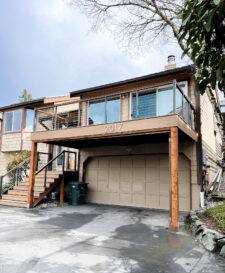
What the Local Climate Does to a Deck
Salt Air and Metal Fasteners
Homes near Bellingham Bay get periodic salt exposure carried in on wind off the water. Over years, that salt accelerates corrosion on unprotected or lower-grade fasteners, hidden clips, and structural hardware. It's a slow process, but it's a real one, and it's one of the most common causes of premature failure we see in decks built without marine-rated or coated hardware in this area.
Driving Rain and Standing Water
Bellingham's rain doesn't just fall straight down — wind-driven rain off the Sound gets pushed sideways into ledger boards, stair stringers, and the undersides of decks attached to homes. If flashing and drainage details aren't done right at the point where the deck meets the house, water finds its way behind siding and into framing, and that's where rot starts, regardless of what decking material sits on top.
Moss, Algae, and Shade
Silver Beach has plenty of tree cover and enough persistent dampness through fall, winter, and spring that moss and algae growth on horizontal surfaces is just a fact of life here. Composite decking resists rot the way wood can't, but organic growth can still form on the surface film of moisture that sits on any decking material in shaded, low-airflow spots. The difference is that composite doesn't degrade from it the way wood does — it just needs occasional cleaning to stay looking right.
Composite vs. Wood vs. PVC: What Actually Fits This Neighborhood
| Factor | Pressure-Treated Wood | Composite | PVC/Vinyl |
|---|---|---|---|
| Moisture resistance | Absorbs water, swells, checks over time | Resists moisture; core doesn't rot | Fully moisture-resistant |
| Salt air exposure | Fasteners and surface both vulnerable | Handles salt air well with correct hardware | Handles salt air well |
| Moss/algae care | Needs regular cleaning and re-sealing | Occasional wash; surface film matters | Occasional wash; smooth surface sheds growth easily |
| Upfront cost | Lowest | Mid-range | Highest |
| Annual upkeep | Staining/sealing yearly or every 2 years | Periodic cleaning, no staining | Periodic cleaning, no staining |
| Feel underfoot | Natural, but rougher over time | Consistent, wood-like texture | Smoother, more plastic feel |
Wood is still a reasonable choice for homeowners who don't mind the upkeep and like being able to sand and refinish it. Composite is the middle ground most Silver Beach homeowners land on: it costs more upfront than wood but far less over a 20-30 year span in maintenance and replacement. PVC is worth considering for waterfront-adjacent decks with heavy exposure, but it comes at a real cost premium and some homeowners find the appearance less natural than composite.
What a Correct Composite Deck Install Involves
Framing and Substructure
Composite decking is only as good as what's underneath it. We use joist spacing appropriate to the specific composite product (many require tighter spacing than traditional lumber spans allow), and we treat or cap exposed framing so the substructure isn't the weak point once the decking itself is rot-resistant.
Ledger and Flashing Details
Where the deck attaches to the house, correct flashing is non-negotiable in a climate like ours. This is the single most common place we find problems on decks we're asked to repair or rebuild — water getting behind the ledger board because flashing was skipped, undersized, or installed in the wrong sequence relative to the siding.
Fastener and Hardware Selection
Given the salt air exposure around Silver Beach, we use stainless or coated fasteners and hidden fastening systems rated for coastal-adjacent use, not generic hardware. This is a detail that's invisible once the deck is finished but makes a real difference in how the structure holds up over a decade or more.
Drainage and Airflow Underneath
Low decks and decks over grade need attention to drainage and ventilation underneath so moisture doesn't sit trapped against framing. This matters more here than in drier climates because the ground rarely gets a chance to fully dry out between fall and spring.
Our Process for a Silver Beach Composite Deck
- On-site assessment — we look at sun/shade exposure, proximity to the water, existing structure (if replacing a deck), and drainage around the site.
- Material selection — we walk through composite product options and grades based on your budget, sun exposure, and how the deck will be used.
- Structural plan — framing layout, ledger attachment and flashing plan, and fastener spec are decided before any demo or build starts.
- Demo (if applicable) — removal of the old deck, including inspection of ledger and framing condition once it's exposed.
- Build — framing, flashing, decking installation, railing, and stairs.
- Final walkthrough — we go over care basics and answer questions before we consider the job done.
What to Ask Before Hiring Anyone for This Job
Composite decking looks straightforward from the outside, but a lot of the work that determines whether it lasts is invisible once the boards are down. A few questions worth asking any contractor bidding this job:
- What fastener and hardware grade do you use, and is it rated for coastal or salt-air exposure?
- How do you flash the ledger board where the deck meets the house?
- What joist spacing do you use for the specific composite product you're installing?
- Do you handle drainage and airflow underneath the deck, or just build on top of existing grade?
- Can you show examples of composite decks you've built in this area, not just decks in general?
- What does your workmanship warranty cover, separate from the manufacturer's product warranty?
A contractor who's worked in Silver Beach and the surrounding Bellingham waterfront area specifically will have already run into the salt air, drainage, and moss issues that are common here, rather than treating your deck like a generic build.
Why Local Experience Matters for This Job
Composite decking is sold as a low-maintenance, long-lasting upgrade, and it generally is — when it's installed with this specific climate in mind. A crew that mostly builds decks in drier, inland parts of Whatcom County may not think twice about fastener grade or ledger flashing sequence, because in a dryer environment those shortcuts take longer to show up as problems. Near Bellingham Bay, they show up faster.
We've built and repaired decks across Whatcom County, and the patterns are consistent: the failures we get called out to fix are almost always tied to flashing, fastener corrosion, or drainage — not the decking material itself. Getting those structural details right the first time is what separates a deck that looks good for two years from one that holds up for two decades.
Maintaining a Composite Deck in This Climate
- Rinse or sweep debris (leaves, needles, pollen) off the surface regularly, especially in shaded areas where it collects and holds moisture.
- Wash the deck surface once or twice a year with a mild soap and water or a manufacturer-approved cleaner to prevent surface algae buildup.
- Keep gutters and downspouts near the deck clear so water isn't dumping directly onto or under the structure.
- Check railing connections and stair hardware periodically for looseness, which can be an early sign of moisture getting into a connection point.
- Trim back overhanging vegetation where possible to improve airflow and sun exposure on shaded sections.
None of this is heavy maintenance compared to a wood deck, but it's not zero-maintenance either, and doing these few things consistently is what keeps a composite deck looking and performing well through Bellingham's wet seasons.
Get a Straightforward Estimate
If you're weighing a new composite deck or replacing an aging wood deck in Silver Beach, we're happy to come take a look, walk through material options, and give you an honest read on what your site needs. There's no pressure and no obligation — just a straight answer on scope and cost so you can make the call that's right for your home. Use the form below to request a free estimate.