 Bellingham Exterior
 South Hill Decks Face a Different Set of Problems
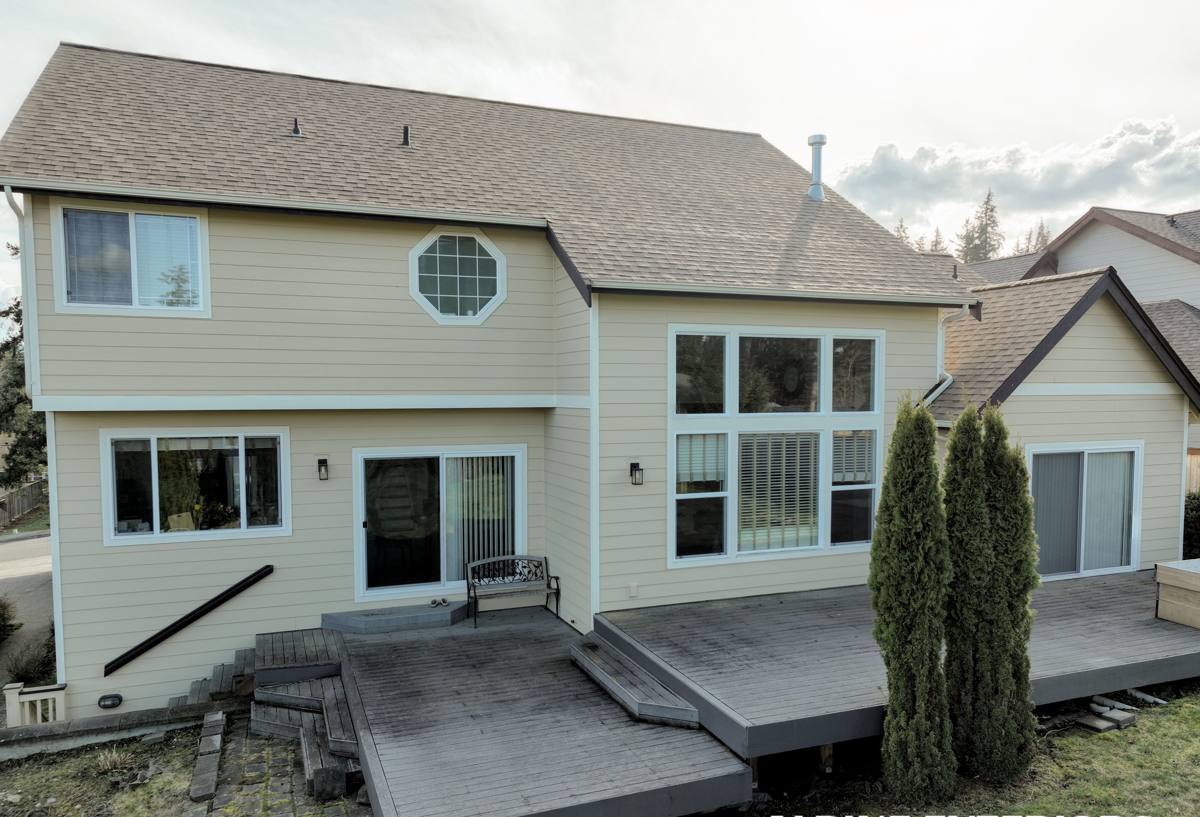
South Hill isn't a flat subdivision with young trees and full sun exposure. It's one of Bellingham's older hillside neighborhoods — mature fir, cedar, and big-leaf maple canopy, steep and terraced lots, and homes built decades apart on the same block, many of them added onto over the years. Add in the view exposure toward Bellingham Bay and the San Juans, and you get a neighborhood where a deck has to handle heavy shade, damp air off the water, and drainage down a slope, often all at once.
A deck built for a flat, sunny lot in a newer development doesn't automatically hold up here. The framing, fastener choice, and even the board profile need to account for how slowly a shaded South Hill deck actually dries out between storms.
What Whatcom County's Climate Does to a Deck Over Time
Driving Rain and Standing Moisture
Bellingham's rain doesn't fall straight down — wind off the bay drives it sideways, which means it gets up under railings, into fastener holes, and against the house where the deck ledger attaches. On a shaded South Hill lot, that moisture doesn't evaporate quickly. It sits in board grooves, in gaps between boards, and in any low spot in the substructure, which is exactly where rot and mold get started on lesser-built decks.
Salt Air Off Bellingham Bay
Homes with any bay exposure deal with a faint but constant salt content in the air. It's not the same as a beachfront property getting direct spray, but over years it accelerates corrosion on the wrong hardware — cheap coated screws, unprotected steel brackets, and low-grade fasteners rust and stain long before the decking itself wears out. This is one of the most overlooked factors in a South Hill deck build.
A Long Moss Season
Between the tree cover and Whatcom County's extended wet season, South Hill properties grow moss on nearly every horizontal surface that doesn't get direct sun — roofs, walkways, and decks included. Moss holds moisture against the board surface, and on wood decking it works into the grain. It's less destructive on composite, but it still needs to be kept off the surface and out of the gaps between boards.
Why Composite Decking Is a Good Fit for This Neighborhood
We recommend composite decking for most South Hill projects because it removes the maintenance cycle that wood demands in this climate — no annual staining or sealing, no splinters, and the board itself won't rot or delaminate from repeated wet-dry cycling. That matters more here than in a drier part of the state, because a shaded South Hill deck simply doesn't get the sun exposure to dry out and "reset" between rain events the way a wood deck in an open, sunny yard would.
To be fair about the trade-offs: composite costs more upfront than pressure-treated wood, and it isn't maintenance-free — it still needs periodic cleaning to keep organic buildup like moss, pollen, and leaf tannins from staining the surface. In deep shade, algae can develop on any decking material, composite included, if it's never cleaned. The difference is that composite doesn't structurally degrade the way wood does when that buildup sits for a season. Over the life of the deck, that's less labor and lower total cost for a South Hill homeowner, even with the higher material price at install.
Comparing Composite Decking Options
Not all composite boards are built the same, and the right choice depends on how much direct sun versus shade the deck actually gets, and how the household wants to spend its maintenance time.
| Board Type | Moisture & Moss Resistance | Maintenance | Typical Lifespan | General Cost Range |
|---|---|---|---|---|
| Uncapped composite | Good, but surface can absorb some moisture over time | Occasional cleaning; more prone to surface staining in shade | 15–20 years | Lower |
| Capped composite | Very good — plastic shell resists moisture and staining | Low; periodic rinsing and light cleaning | 20–30 years | Mid |
| PVC (cellular) | Excellent — no wood content to absorb moisture | Lowest; wipes clean easily | 25–30+ years | Higher |
Most manufacturers you've likely heard of — Trex, TimberTech, and Fiberon among them — make products across several of these tiers. We'll walk through samples on site so you can see and feel the difference before committing, rather than choosing off a brochure.
What a Correct Composite Deck Build Involves
Substructure and Framing
The composite boards on top only perform as well as what's underneath. That means properly sized and spaced joists for the specific board's span rating, a ledger board correctly flashed and sealed where it meets the house, and framing hardware rated for exterior exposure. On South Hill's older homes, we also check what the deck is attaching to — older framing or siding sometimes needs reinforcement before a new ledger goes up.
Fasteners and Flashing
Given the salt content in the air here, we use stainless steel or otherwise corrosion-resistant fasteners and hardware, not the cheapest coated screws available. We also install joist tape or flashing along the top of each joist, which keeps water from sitting directly against the framing lumber — a detail that's easy to skip and expensive to fix later.
Drainage and Airflow Underneath
On a shaded, low-lying, or ground-level deck, airflow underneath is what keeps the substructure dry between storms. We grade and vent the space below the decking so moisture has somewhere to go, rather than pooling under boards where it can't evaporate. This is especially important on South Hill lots where tree cover already limits how much sun and wind reach the deck.
Steep Lots and View Decks: What South Hill Adds to the Job
A lot of South Hill properties sit on a grade, with the house set above or below street level and a deck built to capture the bay or mountain view. That changes the engineering: taller support posts, footings that have to be set correctly on sloped or uneven ground, and railing heights and spacing that meet code for an elevated structure, not just a low deck a few steps off the ground.
Tree roots are another factor we plan around when digging footings on a treed lot — both to protect mature trees the homeowner wants to keep, and because roots can affect how a footing needs to be placed. And on a view-facing deck exposed to wind off the bay, railing and post connections need to be built to handle that load, not just look good.
Our Process From First Call to Finished Deck
- Site visit — we walk the lot, assess slope, shade, tree cover, and existing structure before recommending anything.
- Design and material selection — we go over board tiers, color options, and railing systems based on your budget and how the deck will be used.
- Permitting — we handle the permit application with the City of Bellingham for the scope of work involved.
- Structural build — framing, flashing, and fastening go in first, built to pass inspection and to hold up in this climate.
- Decking and trim — boards, fascia, and railing are installed with attention to expansion gaps and drainage.
- Final walkthrough — we go over the finished deck with you and provide straightforward care guidance specific to the boards you chose.
Maintenance Checklist for a South Hill Composite Deck
Composite cuts down on maintenance, but "low-maintenance" isn't "no-maintenance," especially under tree cover. A few habits go a long way:
- Sweep off maple leaves, fir needles, and other debris regularly — wet organic matter left on boards is what feeds moss and staining.
- Rinse the deck a few times a year, more often if it sits under heavy canopy, to keep pollen and grime from building up.
- Keep gutters and downspouts near the deck clear so runoff isn't draining directly onto or under it.
- Check that the space underneath stays clear of leaf litter, which can block the airflow the deck was built to rely on.
- Inspect railing posts and fastener points once a year for movement or corrosion, particularly on decks with bay exposure.
- Avoid high-pressure washing directly on composite boards; use a moderate setting and a soft brush for any moss or algae spots.
Why Hiring a Crew That Already Works South Hill Matters
A deck built without accounting for this neighborhood's slope, shade, and moisture will show problems within a few years — sagging framing, corroded hardware, or a substructure that never fully dries out. A crew that regularly works South Hill already knows to check footing placement on sloped lots, plan around mature trees, and detail the framing for a deck that's going to sit under canopy for most of the year. That's the difference between a deck that looks right at handoff and one that's actually built for where it sits.
We're familiar with Whatcom County's permitting process and the practical realities of working on South Hill's tighter lots and grades, so there are fewer surprises once the project is underway.
If you're considering a new composite deck or replacing an aging wood one, we're happy to walk the site with you and put together a straightforward, no-pressure estimate. There's a form below to get that conversation started.