 Bellingham Exterior
 Why Sudden Valley Roofs Wear Out Differently
Sudden Valley sits in a heavily wooded pocket of Whatcom County around Lake Whatcom, and that setting shapes almost everything about how a roof ages there. Tall conifers shade large sections of most roofs for much of the day, which means shingles and underlayment stay damp long after a storm has passed elsewhere in the Bellingham area. Add in the marine-influenced rain that rolls through this part of Washington most of the year, and you get roofs that hold moisture instead of shedding it quickly.
That combination — shade, standing moisture, and a moss season that can run from fall through spring — is harder on a roof than straight-line wind or heat ever is. Moss and algae aren't just cosmetic. They lift shingle edges, trap water against the roof deck, and work their way into fastener lines over a few seasons. Homes closer to open water also deal with a faint salt component in the marine air, which can accelerate corrosion on exposed metal flashing, fasteners, and gutter hardware over the life of a roof.
None of this means Sudden Valley homes need constant repairs. It means the roofing choices that work fine in a drier, sunnier part of the county — material selection, ventilation, flashing detail — need to be made with shade and moisture in mind from the start.
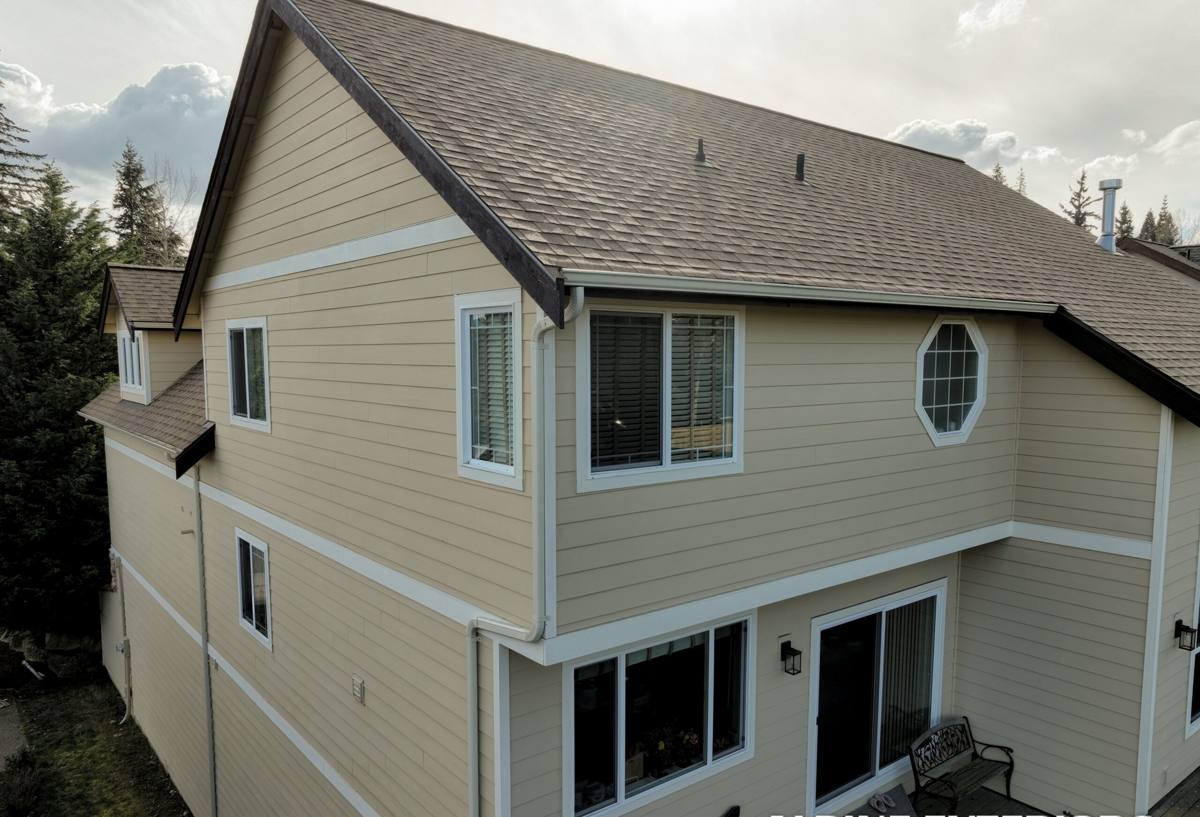
Signs a Repair Won't Cut It Anymore
A lot of roofs in this neighborhood get patched for years past the point where patching still makes sense. Here's what usually tells us a full replacement is the honest recommendation instead of another repair:
- Moss or algae staining that returns within a season or two of cleaning, even in shaded sections
- Shingles that are cupping, curling, or losing granules faster in the shaded north- or east-facing slopes
- Soft or spongy spots underfoot when we walk the roof, which usually means the decking underneath has absorbed water
- Daylight visible at the ridge or through the attic, or consistent musty smell in the attic space
- Repeated leaks around the same valley, chimney, or skylight despite prior flashing repairs
- A roof that's already 18-25+ years old, depending on material, with visible wear across multiple slopes rather than one isolated area
If only one or two of these apply and the roof deck is still sound, a targeted repair is usually the right call and we'll say so. Replacement makes sense once the damage is spread across the roof or the deck itself is compromised.
What a Correct Roof Replacement Actually Involves
It starts with what's underneath the shingles
A roof replacement done right isn't just swapping old shingles for new ones. The tear-off is where we find out what shade and moisture have actually done to the structure — soft decking, rusted fasteners, or underlayment that's been failing quietly for years. Any damaged decking gets replaced before anything new goes down, because installing new shingles over a weak deck just resets the clock on the same problem.
Underlayment and ice/water protection
Given how long moisture sits on Sudden Valley roofs, we pay close attention to underlayment quality and placement, especially at eaves, valleys, and any low-slope transitions where water moves slowly and moss tends to establish first.
Flashing and penetrations
Chimneys, skylights, and roof-to-wall transitions are where the majority of leaks start, not the open field of the roof. Correct flashing work — new metal, proper laps, sealed correctly rather than just caulked over old flashing — matters more here than in drier, more open parts of the county.
Ventilation before the finish material goes on
We check and correct intake and exhaust ventilation as part of the replacement, not as an afterthought. This step gets skipped more often than any other, and it's one of the biggest factors in how long a new roof actually lasts under heavy tree cover.
Material Comparison for Shaded, Wet Roof Conditions
| Material | Moss/Moisture Behavior | Typical Lifespan Here | Trade-Offs |
|---|---|---|---|
| Standard asphalt composition shingle | Prone to moss and granule loss in shaded areas without algae-resistant granules | 15-20 years in heavy shade | Lowest upfront cost; shorter life under tree cover |
| Algae-resistant (copper/zinc-granule) shingle | Copper or zinc granules actively resist algae and moss growth | 20-25 years in heavy shade | Modest cost increase over standard shingle; best value for shaded lots |
| Standing-seam metal roofing | Sheds water fast, minimal surface for moss to root into | 40-50+ years | Higher upfront cost; requires correct fastener and underlayment detailing |
| Synthetic/composite shake | Good moisture resistance; won't rot like wood shake | 30-40 years | Mid-to-upper cost; fewer installers do it correctly |
Choosing the Right Material for a Shaded Lot
Most homes in this community sit under partial to heavy tree canopy, and that's the single biggest factor we weigh when discussing materials with a homeowner. A standard asphalt shingle isn't a bad product, but on a north-facing slope shaded most of the day, it's fighting an uphill battle against moss from day one. Algae-resistant shingle lines, which use copper or zinc granules blended into the surface, are built specifically to slow that growth and hold up meaningfully longer in exactly this kind of setting.
For homes with more open exposure — say a south-facing slope or a lot that's been thinned — a standard shingle performs fine and there's no need to pay for algae resistance you won't benefit from. This is why we walk the whole roof and look at sun exposure slope by slope rather than quoting one blanket recommendation.
Metal roofing comes up often in this neighborhood because it sheds water and needle debris well and gives moss very little to grab onto. It's a legitimate long-term option, but it has to be installed with the right fastener spacing, underlayment, and expansion allowance, or it underperforms compared to a well-installed shingle roof. We're honest that metal isn't automatically the "better" choice for every home — it's a different maintenance profile and a different price point, and the right fit depends on the roof's shape, slope, and how long the homeowner plans to stay in the house.
Our Roof Replacement Process
- On-site inspection — we walk the roof and the attic, checking shade patterns, moss history, decking condition, ventilation, and flashing points before recommending anything.
- Written estimate — material options, scope, and a clear price, with the trade-offs of each material spelled out in plain terms.
- Scheduling around weather — given how much rain this area sees, we plan tear-off and dry-in around forecast windows so your home isn't left exposed longer than necessary.
- Tear-off and deck inspection — old material removed, decking inspected and repaired or replaced where needed.
- Underlayment, flashing, and ventilation correction — the parts of the job that don't show but determine how long the roof actually lasts.
- Final material installation — shingles, metal, or synthetic material installed to manufacturer spec.
- Cleanup and walkthrough — site cleared of debris and fasteners, and we walk the finished roof with you.
Ventilation and Moisture Control — The Step Homeowners Miss
Attic ventilation doesn't get much attention until a roof is already failing, but it's one of the biggest factors in how long a replacement actually lasts under tree cover. A roof deck that can't breathe traps moisture from below, which shortens the life of even a good shingle or metal roof from the underside. On heavily shaded lots, where the roof surface itself is drying slowly, correct intake and exhaust ventilation is what keeps the deck dry enough to hold up over the long term. We check this on every replacement and correct it as part of the job rather than treating it as a separate add-on.
Cost Factors for a Sudden Valley Roof Replacement
Pricing depends on roof size, pitch, material, and how much decking repair is needed, so we don't quote a number without seeing the roof. What we can share is what tends to move the price up or down on homes in this area specifically:
| Factor | Effect on Cost |
|---|---|
| Steep pitch or multiple stories | Increases labor and safety equipment needs |
| Heavy moss/algae buildup requiring deck repair | Adds decking replacement cost once tear-off reveals damage |
| Standard shingle vs. algae-resistant shingle | Modest cost increase for algae-resistant, often worthwhile on shaded slopes |
| Shingle vs. metal roofing | Metal carries a higher material and installation cost, longer expected lifespan |
| Number of valleys, skylights, or chimneys | More flashing detail work, adds labor time |
| Tree/limb clearance needed for equipment access | May require coordination before work starts on heavily wooded lots |
We'd rather walk you through these factors on your actual roof than throw out a broad estimate that doesn't hold up once we're up there.
Why Hire a Crew That Already Works in Sudden Valley
Roofing in a lake community with mature tree cover isn't the same job as roofing an open subdivision closer to town. Access can be tighter on wooded lots, equipment staging takes more planning around trees and slope, and the moss and moisture patterns here reward specific material and ventilation choices that a crew unfamiliar with the area might not think to flag. A contractor who's worked this neighborhood before knows to check shade exposure slope by slope, knows what decking damage under moss usually looks like before tear-off even starts, and doesn't need to relearn the local climate on your roof.
That experience also shows up in smaller ways — knowing how to stage material delivery on a narrower private road, or planning tear-off around the rain patterns typical to this part of Whatcom County so your home isn't sitting open longer than it needs to be.
Get a Straight Answer on Your Roof
If your roof is showing moss that keeps coming back, wear concentrated on the shaded slopes, or it's simply reaching the age where replacement makes more sense than another repair, we're happy to take a look. We'll walk the roof, explain what we find, and give you a straightforward recommendation — no pressure, no inflated urgency. Reach out for a free estimate using the form below.