 Bellingham Exterior
 Why Blaine Homes Take a Different Kind of Beating
Blaine sits right on Semiahmoo Bay, at the top of Whatcom County where the Salish Sea meets the Canadian border. That location is part of what makes it a great place to live, and it's also exactly what makes siding fail faster here than it does twenty miles inland. Salt-laden air off the water accelerates corrosion on fasteners and trim, driving rain off the water pushes moisture into seams and laps that would stay dry on a more sheltered lot, and the long gray stretch of fall through spring keeps north- and west-facing walls damp enough for moss and algae to take hold and stay there.
None of that is a reason to panic about your siding. It's a reason to be specific about what you install and how it's installed. A product and a crew that handle a dry, wind-sheltered lot fine can still struggle on a place exposed to open water. This page is about what siding replacement should actually look like for a Blaine home, not a generic rundown of siding in general.
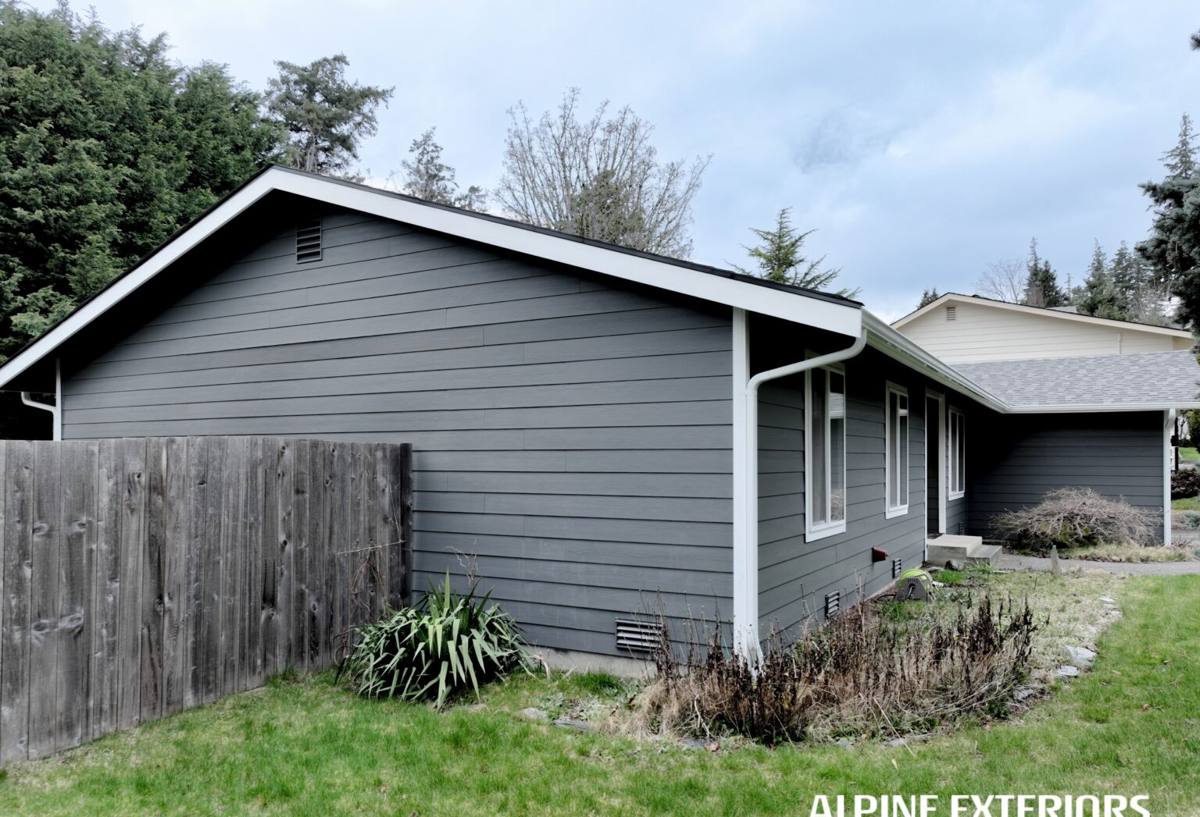
Signs a Blaine Home Needs Siding Replaced, Not Patched
Most siding problems don't show up as one dramatic failure — they show up as a handful of small signs that add up. Homeowners near the water in Blaine tend to see these earlier than homeowners further inland:
- Soft or spongy spots when you press on the siding, especially near the bottom courses and around windows
- Paint that's bubbling, peeling, or needing repainting far sooner than the manufacturer's cycle
- Persistent moss or dark streaking on north- and west-facing walls that comes right back after cleaning
- Visible cupping, warping, or gaps opening up between boards or panels
- Rust staining running down from nail heads or metal trim
- Rot or soft wood discovered at corner boards, window trim, or where siding meets the foundation
Any one of these on its own might be a repair. Several of them together, especially on an older wood or engineered-wood-clad home, usually means the siding system itself has reached the end of what it can handle and a patch will just be chasing the next failure a season later.
What a Correct Siding Replacement Actually Involves
Siding replacement is not just pulling off old boards and nailing up new ones. On a coastal Whatcom County property, the parts of the job that don't show once it's finished are the parts that determine whether it lasts. A correct job includes:
Tear-off and a real look at what's underneath
Once the old siding comes off, the sheathing and framing get inspected for rot, soft spots, or prior water damage — common at window and door openings and lower wall sections on homes that have taken years of wind-driven rain. Any damaged sheathing gets replaced before anything new goes up. Covering over a compromised wall just locks the problem in.
Weather-resistive barrier and flashing done right
A proper weather-resistive barrier, correctly lapped and taped, is what actually keeps wind-driven rain from reaching the wall assembly — the siding itself is the first line of defense, not the last. Flashing at windows, doors, and roof-to-wall intersections has to be installed in the right sequence with the barrier, not just caulked as an afterthought. This is the step that's easiest to rush and most responsible for callbacks when it's done wrong.
Fastening and clearances matched to the product and the exposure
Fastener type, spacing, and depth matter, particularly in a salt-air environment where the wrong fastener corrodes and stains years before the siding itself would fail. Proper clearance from grade, decks, and roof lines keeps splashback and standing moisture away from the bottom edge of the siding, which is where most rot starts.
Trim, caulking, and paint or factory finish
Corner boards, window and door trim, and any transitions need to be sealed and finished to a standard that holds up to repeated wetting and drying, not just to look good on install day.
Why We Install Only James Hardie Fiber Cement
We made a decision as a company to install James Hardie fiber cement siding exclusively, and we don't install vinyl, LP SmartSide, Cemplank, Allura, or primed spruce or cedar. That's not a marketing line — it's a standard we hold to because of what we've seen these products do over time in exactly the kind of climate Blaine has: salt air, sustained damp, and heavy driving rain off open water.
Fiber cement is non-combustible and dimensionally stable, meaning it doesn't expand, contract, cup, or warp with moisture cycling the way wood-based products can. James Hardie's ColorPlus factory finish is baked on under controlled conditions rather than field-painted, which matters directly for repaint cycles in a climate that's damp more months than not. Hardie also engineers specific product lines (their HZ5 line, for example) for regions with more moisture exposure, and backs installations with a strong transferable limited warranty when the work is done to their specification.
We're not going to tell you every other product is worthless — plenty of them have real strengths. What we will say is that after years of doing this work in Whatcom County, fiber cement installed correctly is what we're comfortable standing behind on a home exposed to Blaine's weather, and it's the only thing we put our name on.
How the Common Siding Options Compare for a Blaine Property
| Factor | James Hardie Fiber Cement | Vinyl | Wood / LP SmartSide |
|---|---|---|---|
| Moisture behavior near open water | Dimensionally stable, resists warping | Can warp or buckle with heat/cold cycling | Prone to swelling, cupping if moisture gets in |
| Salt-air / fastener corrosion resistance | Stable material, corrosion managed via correct fasteners | Plastic itself is inert but trim and fasteners still corrode | Wood-based substrate more vulnerable once finish is compromised |
| Finish durability | Factory-baked ColorPlus finish, long repaint interval | Color molded in, but can fade and become brittle | Field-applied paint/primer, shorter repaint cycle |
| Fire resistance | Non-combustible | Combustible | Combustible |
| Typical lifespan when installed correctly | Multiple decades | 15–25 years depending on exposure | Variable, shorter if moisture management fails |
These are general comparisons meant to explain our standard — not a claim that every non-Hardie product will fail. The point is that in a marine, high-rain environment like Blaine, the margin for error is smaller, and we'd rather install the product with the least sensitivity to that exposure.
Our Process for a Blaine Siding Replacement
- On-site assessment of your current siding, trim, and any visible moisture or rot damage
- A clear, written scope covering tear-off, sheathing repair (if needed), weather barrier, flashing, and the specific Hardie product and profile
- Careful removal of existing siding with protection for landscaping, walkways, and windows
- Sheathing inspection and repair before anything new is installed
- Weather-resistive barrier and flashing installed to manufacturer sequence
- James Hardie siding installed to spec, with fasteners and clearances set for your home's exposure
- Trim, caulking, and finish work completed and inspected
- Full site cleanup, including nail and debris sweep of the yard
Why It Matters That We Already Work Blaine
A crew that mostly works sheltered inland lots doesn't automatically think about wind-driven rain off Semiahmoo Bay when they're planning flashing details, or about how much faster moss re-establishes on a shaded north wall a few blocks from the water. Working regularly in Blaine and across Whatcom County means we're already familiar with the City of Blaine's permitting process, with the wind and moisture exposure typical of properties near the water, and with how local siding failures actually present — which lets us diagnose problems accurately instead of guessing.
It also means we're not learning on your home. The details that matter most on a coastal property — barrier lapping, flashing sequence, fastener choice, clearance from grade — are exactly the details that separate a siding job that lasts from one that needs attention again in five years.
What to Ask Any Contractor Before You Hire Them
- Are they a factory-certified installer for the product they're proposing, and can they explain why they use that product specifically?
- Will they inspect and, if needed, repair sheathing before installing new siding — not just cover over what's there?
- Do they carry current licensing and insurance, and can they provide proof without you having to ask twice?
- Will they put the full scope of work in writing, including weather barrier and flashing details, not just "install siding"?
- Do they have experience working on homes with similar water exposure, not just siding jobs in general?
A contractor who can answer these clearly and specifically, without hedging, is a good sign. One who wants to talk price before they've even looked at your walls usually isn't.
Get a Straight Answer About Your Siding
If your Blaine home is showing any of the signs above, or you just want an honest read on how much life your current siding has left, we're happy to take a look. The estimate is free, there's no pressure, and you'll get a straightforward answer about what your home actually needs — use the form below to get started.