 Bellingham Exterior
 Windows Built for Cordata's Weather, Not Just Its Openings
Cordata sits far enough inland to avoid the worst of the waterfront wind, but it still gets the full package of what makes Whatcom County hard on a house: salt-tinged marine air drifting up from Bellingham Bay, long stretches of driving rain in the fall and winter, and a moss season that seems to start earlier every year. Windows here don't just need to look good and keep out drafts — they need to shed water fast, resist the slow creep of moisture into wood trim and framing, and hold their seals through repeated wet-dry cycles for a decade or more.
"Custom" windows means more than a size cut to fit your rough opening. It means the frame material, glazing package, and flashing detail are chosen for how your specific house sits — its orientation, its exposure to wind-driven rain, and the age and condition of the wall assembly around each opening. A stock big-box window installed without attention to any of that will often perform fine for a year or two and then start showing problems right where Cordata's climate is toughest: at the sill, the corners, and anywhere caulk was asked to do a flashing's job.
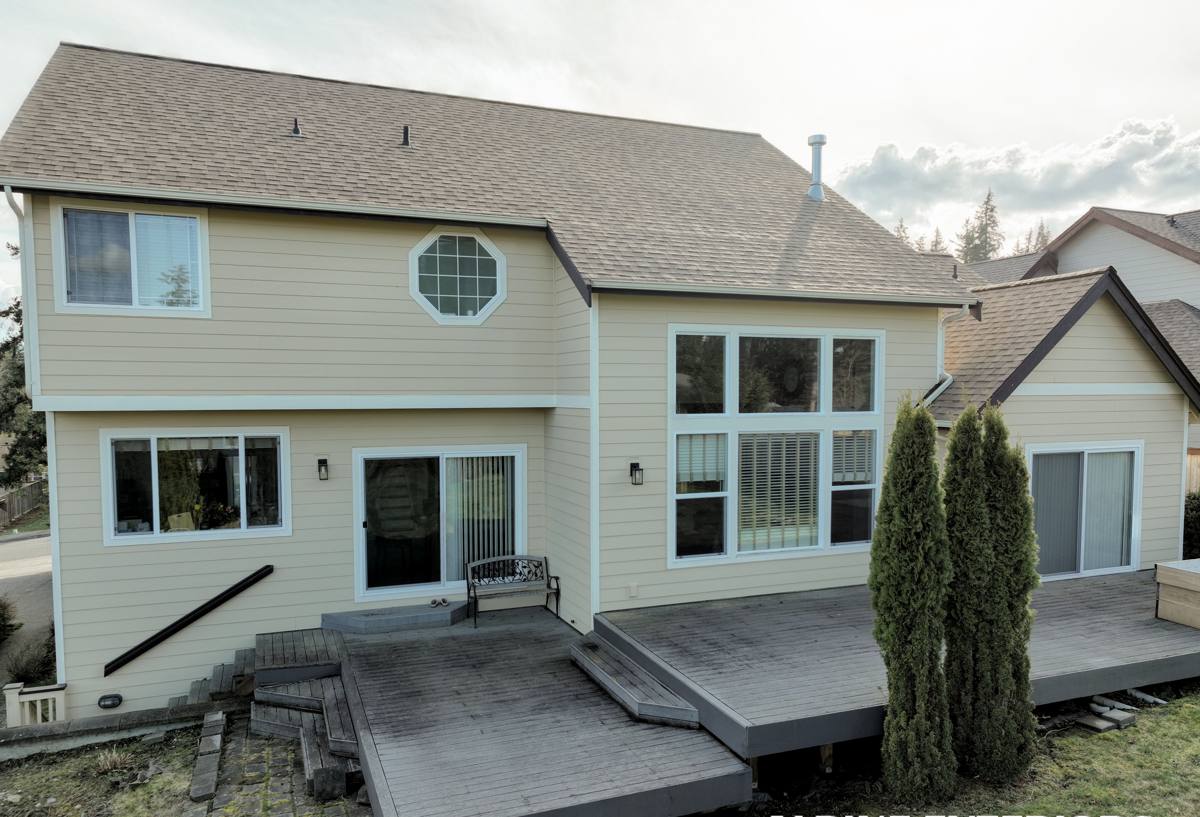
How the Local Climate Actually Attacks a Window
Driving rain and wind-loaded water
Bellingham's rain rarely just falls straight down. Wind off the Sound and the Strait pushes it sideways against west- and south-facing walls, forcing water up and under trim, sills, and poorly lapped flashing. A window that would be watertight in a calmer climate can leak here simply because the water is arriving at an angle the original install never accounted for.
Moss, algae, and trapped moisture
Whatcom County's moss season isn't limited to roofs. Moss and algae take hold anywhere shaded, damp, and undisturbed — north-facing sills, behind overgrown landscaping, in the corners of window wells. Left alone, that growth holds moisture against wood trim and painted surfaces far longer than the surrounding air would otherwise allow, which accelerates rot and paint failure around the frame.
Salt air and hardware fatigue
Even a few miles inland from the bay, airborne salt reaches window hardware, screens, and exposed fasteners. Over years, it corrodes cheaper latches, hinges, and balance mechanisms faster than an equivalent window would wear in a dry inland climate. It's a slow effect, which is exactly why it gets overlooked until a window won't latch or a screen frame crumbles at the corner.
Signs Your Current Windows Are Losing the Fight
- Fogging or a permanent haze between panes — the seal on the insulated glass unit has failed
- Soft, spongy, or discolored wood trim at the sill or jamb
- Visible daylight or a noticeable draft at the frame edge when it's windy
- Paint that bubbles or peels specifically around the window, even when the rest of the wall holds up fine
- Moss or dark streaking building up on the sill or exterior casing
- Windows that are hard to open, latch loosely, or have started to stick with seasonal humidity
- A noticeable rise in heating bills without any other obvious cause
Any one of these on its own might just mean a window needs cleaning or a hinge needs adjusting. Several together, especially on the same wall, usually point to a flashing or sealing problem that a new pane of glass won't fix.
What a Correct Installation Actually Involves
The window itself is often the easy part. The details that determine whether it lasts are the ones you don't see once the trim goes back on:
Removal and opening inspection
Every install starts with pulling the old unit and actually looking at what's behind it — the sheathing, the framing, and any existing flashing tape or building paper. This is where hidden rot or past water intrusion shows up, and it needs to be dealt with before a new window ever goes in. Installing a new window over a compromised opening just buys a few quiet years before the same problem resurfaces.
Flashing and drainage
Proper flashing directs water that gets past the exterior cladding back out and away from the framing, rather than letting it pool at the sill. In a climate with as much wind-driven rain as ours, sill pan flashing and correctly lapped house wrap or building paper aren't optional extras — they're the difference between a window that sheds water and one that slowly feeds it into the wall.
Air sealing and insulation, not just caulk
The gap between the window frame and the rough opening needs to be sealed for both air and water, using appropriate low-expansion foam or backer rod and sealant — not stuffed with fiberglass insulation and caulked over, which does little for drafts and nothing for water management.
Exterior trim and finish
Whatever trim material is used around the window needs its own protection from the same conditions attacking the window: back-primed or factory-finished material, correctly caulked joints, and a drip cap or equivalent detail above the window to break the path of water running down the wall.
Choosing a Frame and Glass Package
There's no single "best" window material — the right choice depends on your home's exposure, your maintenance appetite, and your budget. Here's how the common options actually compare for a Cordata home:
| Frame Material | Moisture Resistance | Maintenance | Typical Trade-offs |
|---|---|---|---|
| Vinyl | Very good — won't rot | Low | Budget-friendly; limited color/finish options; can expand/contract with temperature swings |
| Fiberglass | Excellent — dimensionally stable, won't rot | Low | Higher upfront cost; strong long-term value in wet climates |
| Wood-clad | Good on the exterior clad face; interior wood needs care | Moderate to high | Best classic appearance; clad exterior protects wood but seams need periodic inspection |
| Aluminum | Fair — prone to condensation without thermal breaks | Low | Slim sightlines; less common for residential retrofits here due to condensation risk |
For glass, a dual-pane unit with a low-E coating and argon fill is the practical baseline for our climate — it manages heat loss well without the added cost of triple-pane, which is rarely necessary in Bellingham's moderate temperature swings. What matters more here is the quality and warranty of the seal itself, since a failed seal shows up as fogging regardless of how good the coating was on day one.
Our Process for a Cordata Window Job
- On-site assessment. We look at each opening, the exposure of each wall, and the condition of the existing framing and trim before recommending anything.
- Honest scoping. If we find rot or past water damage, we tell you before work starts, not after we've already opened the wall.
- Accurate measurement and material selection. Windows are ordered to the actual opening, not a rounded-off standard size, and matched to the wall's real exposure to wind and rain.
- Removal, inspection, and repair. Old units come out, the opening gets inspected, and any deteriorated material is replaced before the new window goes in.
- Flashing, sealing, and insulation done to hold up to driving rain — not just caulked shut.
- Trim, finish, and cleanup so the finished opening matches the rest of the house and sheds water correctly from day one.
Why a Crew That Already Works in Cordata Matters
Bellingham's older neighborhoods and its newer construction each bring different problems. A crew that regularly works Cordata and the surrounding Whatcom County area has already seen how homes of different ages and orientations here hold up — where moss tends to build up first, which exposures take the worst of the driving rain, and what a wall assembly from a given decade usually looks like once it's opened up. That familiarity means fewer surprises mid-project and a scope of work that's realistic from the first estimate, rather than one that grows once the walls are open.
It also means the work is done by people who'll still be around locally if a question comes up two or five years later — not a crew that passed through for one job and moved on.
A Practical Checklist Before You Decide
- Get a written scope that specifies flashing method and sealing approach, not just "install windows"
- Ask what happens if rot or moisture damage is found once the old window is out
- Confirm the glass package (pane count, coating, gas fill) and the manufacturer's seal warranty
- Check whether trim material is back-primed or pre-finished before installation
- Ask how the crew handles disposal of old windows and job-site cleanup
- Get the warranty terms in writing for both the product and the labor
Living With New Windows Through Moss Season
Even a correctly installed window benefits from a little seasonal attention in this climate. Keeping sills and tracks clear of debris, rinsing off moss or algae buildup before it takes hold, and checking that exterior caulk lines stay intact after a hard winter all go a long way toward getting the full lifespan out of the investment. None of this is heavy maintenance — it's the same kind of upkeep any exterior surface needs in Whatcom County, just applied to the windows as well as the siding and trim.
If your Cordata home has windows that fog, stick, draft, or show signs of moisture damage around the frame, we're happy to take a look and give you an honest read on what's going on and what it would take to fix it right. Reach out for a free, no-pressure estimate using the form below.