 Bellingham Exterior
 Why Cordata Roofs Wear Differently Than Roofs Inland
A roof in Cordata isn't fighting the same battle as a roof three hours east of the Cascades. North Bellingham sits close enough to Bellingham Bay that salt-laden air is a real factor on metal flashing, fasteners, and exposed hardware over the life of a roof. Add in driving rain that comes sideways off the Sound during winter storms, and you've got a system that needs tight seams and correctly lapped materials, not just shingles nailed down in the right pattern. Then there's moss. In this part of Whatcom County, moss season isn't a two-month nuisance — shaded, north-facing slopes and tree-covered lots can stay damp enough to support growth for the better part of eight or nine months a year.
None of that means Cordata homes need exotic materials or gold-plated systems. It means the ordinary parts of a roof installation — underlayment choice, flashing detail, ventilation, fastener spacing — matter more here than they would in a dry climate, because there's less margin for a shortcut to go unnoticed. A roof that's "close enough" in Spokane can leak, rot, or grow moss within a few seasons here.
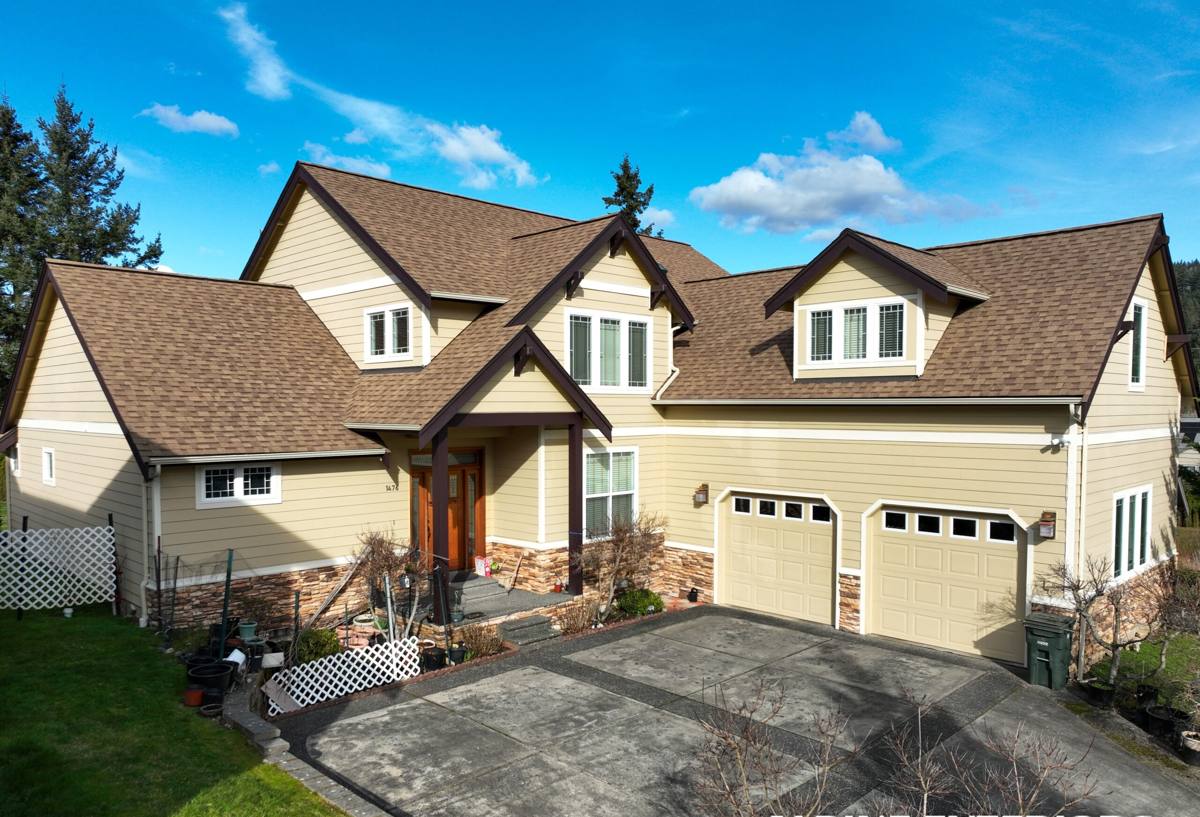
What a Correct New Roof Installation Actually Includes
Full Tear-Off, Not a Cover-Up
Overlaying new shingles on top of an old, saturated roof deck is common in drier regions and a bad idea here. It traps moisture that's already worked its way into the old layers, hides deck damage, and voids most manufacturer warranties outright. A proper new roof installation starts with removing everything down to the deck so we can actually see what we're working with.
Deck Inspection and Repair
Once the old roofing is off, the plywood or plank decking underneath gets inspected board by board. Years of slow leaks, condensation, or moss-related moisture can soften or delaminate sections that aren't visible from inside the attic. Any soft, rotted, or delaminated decking gets cut out and replaced before anything new goes down — installing new roofing over a compromised deck just resets the clock on the same problem.
Underlayment Built for Wet Winters
The underlayment is the roof's backup plan if wind ever drives water past the shingles, and in a region with this much annual rainfall it earns its keep more often than homeowners realize. We use synthetic or self-adhered underlayment products rated for high-moisture climates, with extra protection — typically an ice-and-water shield membrane — at eaves, valleys, and other vulnerable transitions where wind-driven rain concentrates.
Flashing Is Where Most Roofs Actually Fail
Chimneys, skylights, sidewalls, and roof-to-wall transitions are where the vast majority of roof leaks originate — not the open field of shingles. Correct flashing means new step flashing, counter-flashing, and valley metal installed and properly layered with the underlayment and shingles, not old flashing reused to save time. In a climate with this much sustained rain, a flashing detail that's "mostly right" will eventually show it.
Fastening to Withstand Wind-Driven Rain
Nail placement, nail count, and fastener type all affect how well a roof holds up to the wind gusts that come through with winter storm systems off the Sound. We follow manufacturer specifications for fastener pattern and exposure rating rather than treating it as a formality — under-fastened shingles are a common cause of premature blow-off and leak claims in exposed coastal-influenced areas like this one.
Choosing a Roofing Material That Holds Up in Cordata
There's no single "best" roofing material — the right choice depends on your home's exposure, roof pitch, budget, and how much shade and moss pressure the site actually gets. Here's how the common options compare for a Whatcom County home:
| Material | Moisture/Moss Resistance | Typical Lifespan | Relative Cost | Best For |
|---|---|---|---|---|
| Architectural (dimensional) asphalt shingle | Good, especially with algae-resistant granules | 25-30 years | Moderate | Most Cordata homes; balance of cost and durability |
| 3-tab asphalt shingle | Fair; more prone to granule loss in heavy rain over time | 15-20 years | Lower | Budget-driven replacements, rental properties |
| Standing seam metal | Excellent; sheds moisture and resists moss growth well | 40-50+ years | Higher | Steep-pitch or heavily shaded lots with chronic moss issues |
| Synthetic (composite) shake | Good; more consistent than natural wood in wet conditions | 30-50 years | Higher | Homeowners wanting a cedar look without wood's maintenance |
| Natural cedar shake | Fair without diligent upkeep; absorbs and holds moisture | 20-30 years with maintenance | Higher | Owners committed to regular treatment and moss control |
We don't install natural cedar shake as a standard offering. It's a legitimate product with real curb appeal, but in a climate this wet it demands a maintenance schedule — periodic cleaning, treatment, and moss removal — that most homeowners underestimate going in, and the warranty structure on wood products reflects that. If you want the look, a synthetic shake product gives you similar appearance with far more predictable long-term behavior in our rainfall.
Ventilation: The Roof System Most Homeowners Never See
A roof isn't just the shingles — it's a balanced system of intake and exhaust ventilation that keeps the attic space at roughly outdoor temperature and humidity. In a climate as damp as Whatcom County's, poor ventilation doesn't just waste energy, it lets moisture condense on the underside of the roof deck. Over a few winters, that condensation can rot decking and rafters from the inside, invisible from the ground and often invisible from inside the attic until the damage is advanced.
A correct installation includes soffit intake vents paired with ridge or upper-roof exhaust vents, sized to move air through the entire attic space rather than short-circuiting near one end. We check and correct ventilation as part of every full roof replacement — it's a small added cost during installation and a genuinely expensive problem to fix after the fact if it's ignored.
Moss and Algae: Managing a Season That Never Fully Ends
Moss doesn't just look bad — it holds moisture directly against the shingle surface, lifts shingle edges as it grows, and accelerates granule loss. On shaded or north-facing sections of a Cordata roof, moss can establish within a single wet season if nothing is done to discourage it. A few things make a real difference over the life of a new roof:
- Zinc or copper strips installed near the ridge, which release trace metal ions that inhibit moss growth as rain washes over the roof
- Algae-resistant shingle granules, standard on most quality architectural shingles now, which slow the black streaking caused by airborne algae
- Keeping valleys and gutters clear of needles and debris, since trapped organic material is what moss and algae actually feed on
- Trimming back tree canopy where practical to reduce shade and let a roof dry out between rain events
- Gentle, scheduled moss removal rather than pressure washing, which can strip granules and shorten shingle life
None of this eliminates moss risk entirely in a climate like ours — it manages it. A new roof gives you the cleanest possible starting point, but ongoing light maintenance is what keeps it that way.
Our Installation Process, Start to Finish
Homeowners deciding on a new roof usually want to know what actually happens once a crew is on-site, not just the sales pitch beforehand. Here's the sequence we follow on a standard full replacement:
- Property protection — tarps and plywood over landscaping, windows, and anything below the work area
- Complete tear-off of existing roofing down to the deck
- Deck inspection, with any damaged or rotted sections cut out and replaced
- Installation of ice-and-water membrane at eaves, valleys, and penetrations
- Full synthetic underlayment across the remaining deck
- New flashing at all chimneys, walls, skylights, and valleys
- Installation of the chosen roofing material per manufacturer fastening specifications
- Ridge and soffit ventilation installed or corrected
- Full site cleanup, including a magnetic sweep for stray nails and fasteners
- Final walk-through inspection with the homeowner
Timeline depends on roof size, pitch, and material, but most single-family homes in the Cordata area are a one-to-three-day job once we're on-site, weather permitting. Rain doesn't always stop work, but we won't install underlayment or shingles in conditions where they can't seat and seal correctly.
Signs Your Cordata Roof Needs Replacing, Not Just Patching
Not every roof problem calls for full replacement — plenty of issues are legitimate repairs. But there's a point where patching becomes a way of delaying an expense rather than solving a problem. Some signs that point toward replacement rather than another repair:
- Granules collecting heavily in gutters, indicating the shingle surface is breaking down
- Multiple past repairs to different sections rather than one recurring spot
- Visible sagging anywhere in the roofline, which can indicate deck or structural issues
- Daylight visible through the roof deck from inside the attic
- Shingles that are cupping, curling, or cracking across large sections, not just isolated spots
- A roof approaching or past 20-25 years old with asphalt shingles
- Persistent moss regrowth within weeks of cleaning, suggesting the shingles are already degraded underneath
- Interior water stains that reappear after repairs, pointing to a failure point that hasn't actually been fixed
Permits and Code Requirements
Full roof replacements in Bellingham and unincorporated Whatcom County generally require a building permit, and inspections are typically tied to key stages of the work rather than just the finished product. Wind exposure and fastening requirements are set by the adopted building code and vary somewhat by roof pitch and material, which is one more reason to follow manufacturer specs rather than generic installation habits. We handle permitting as part of the job so homeowners aren't left tracking down inspections themselves, and we build to current code rather than to whatever the old roof happened to meet when it went on years ago.
Why Hiring a Crew That Already Works in Cordata Matters
Roofing crews that mostly work drier, milder regions don't always default to the details that matter here — the extra ice-and-water coverage, the ventilation balance, the moss-conscious material choices. A crew that regularly works Whatcom County roofs treats those details as standard practice, not upsells, because we've seen what happens on roofs where they were skipped.
There's also a practical side to local familiarity: faster response if a storm causes damage, an easier time coordinating warranty service since we're not driving in from out of the area, and a working knowledge of how homes in and around Cordata are typically built — roof pitches, common deck materials, and the kinds of issues that show up in homes of a given age in this area. None of that replaces a careful inspection of your specific roof, but it means less guesswork going in.
If your roof is showing its age, or you're just trying to understand what a real replacement would involve before committing to anything, we're happy to take a look and give you a straight, no-pressure estimate. Use the form below to get started.