 Bellingham Exterior
 Roof Replacement in Lynden: What the Climate Actually Demands
Lynden sits inland from the salt water of Bellingham Bay, but it doesn't escape what the rest of Whatcom County deals with every year. Marine air moves in off the Pacific and settles into the Nooksack valley as fog and long stretches of drizzle. Add a roofing season that's short and wet on both ends, and you get roofs that work harder here than they would in a drier climate. Moss doesn't just grow on north-facing slopes in Lynden — on shaded or tree-lined lots it can take over an entire roof plane in a couple of seasons if nobody's keeping after it.
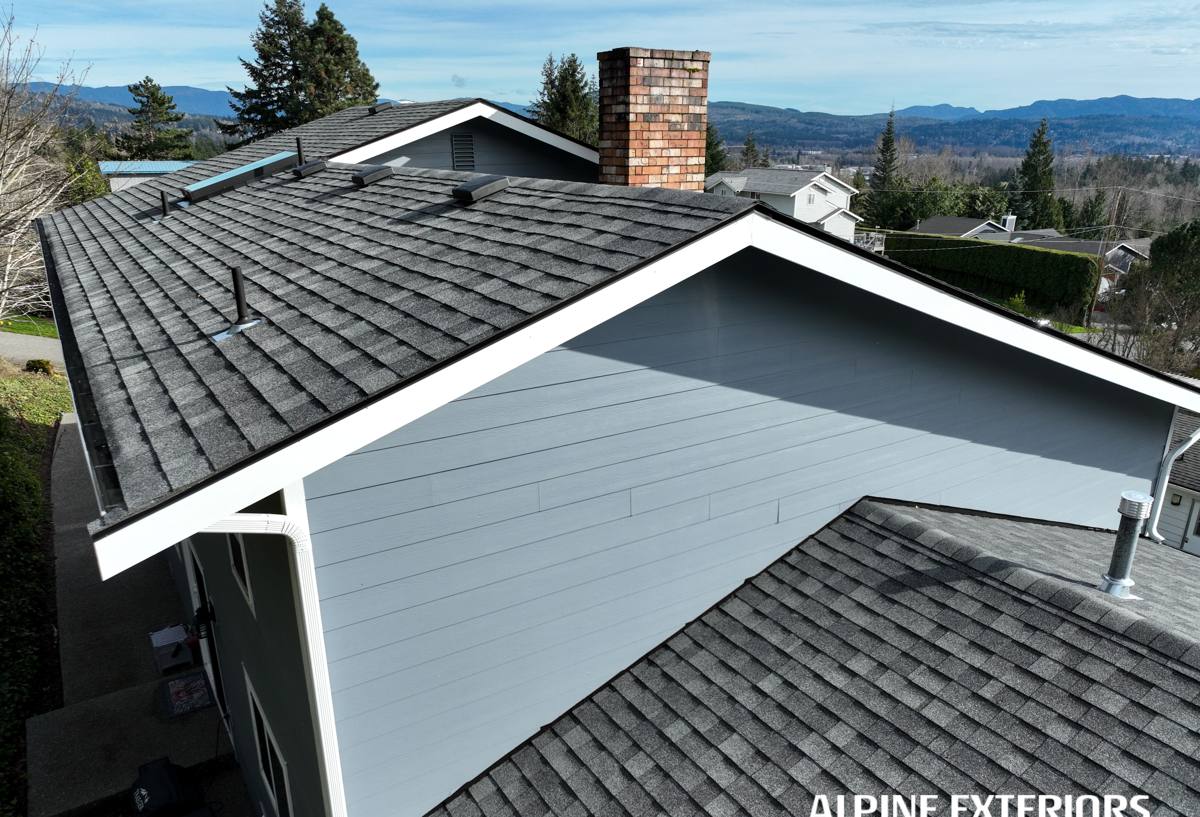
A roof replacement here isn't just about swapping old shingles for new ones. It's about building a roof system that sheds driving rain instead of absorbing it, breathes enough to keep moisture from condensing in the attic, and resists the moss and algae growth that Whatcom County's damp, mild winters practically invite. Homes we've worked on around Lynden tend to fail in predictable spots: valleys, low-slope sections, and anywhere moss has been allowed to hold water against the shingle mat for years at a time.
Signs a Lynden Roof Has Reached the End of Its Life
Most homeowners call us after noticing one obvious problem, but roofs usually give several warnings before they actually leak. Here's what we look for, and what you can check yourself from the ground or a ladder:
- Granule loss showing up in gutters or at downspout outlets — a sign the shingle mat is losing its protective coating
- Shingles that look cupped, curled at the edges, or cracked when you look closely
- Moss mats thick enough to hold visible moisture, especially on north-facing or shaded slopes
- Dark streaking across the roof field — usually algae, not just dirt
- Soft spots in the decking you can feel underfoot when walking the roof
- Daylight visible through the roof deck from inside the attic, or water staining on attic sheathing
- Flashing around chimneys, skylights, or roof-to-wall transitions that's rusted, lifted, or sealed over with old caulk instead of properly integrated
Any one of these can often be patched. Several at once, or a roof past 20-25 years old, usually means repair is just delaying an inevitable full replacement — and often at a higher total cost once you count the repair calls along the way.
What a Correct Roof Replacement Involves
Tear-Off and Deck Inspection
We don't install new roofing over old. A full tear-off is the only way to actually see the deck — plywood or plank sheathing that's been hiding under shingles for decades. In this climate, we routinely find soft or delaminated decking around old flashing points and in valleys where water has been finding its way in slowly for years. Any damaged sheathing gets replaced before anything new goes down; skipping this step is one of the most common shortcuts in the trade, and it's the one that causes soft, spongy roofs a few years later.
Underlayment and Ice-and-Water Protection
Given how much driving rain this area sees, we don't treat underlayment as an afterthought. A synthetic underlayment across the full roof, with self-adhering ice-and-water shield at eaves, valleys, and any roof-to-wall transitions, gives the roof a real second line of defense if wind-driven rain gets under a shingle tab — which it will, eventually, on any roof.
Flashing
Flashing failures cause more leaks than worn-out shingles do. Chimneys, skylights, vent pipes, and sidewall transitions all need new, properly step-flashed and counter-flashed metal — not just a bead of sealant over the old flashing. Sealant is a maintenance item, not a permanent fix, and we treat it that way.
Ventilation
An attic that can't breathe traps moisture, and trapped moisture in a marine climate leads to mold, premature deck rot, and ice damming during cold snaps. Balanced intake at the eaves and exhaust at the ridge is part of a correct install, not an upgrade you pay extra for.
Field Shingles or Panels
The visible roofing material is the last thing installed, and it's only as good as everything underneath it. We follow manufacturer nailing patterns and exposure specs exactly — installation errors are the single biggest cause of voided warranties, more often than material defects.
Choosing a Roofing System for a Lynden Home
Most Lynden homes we work on are asphalt composition shingle, and for good reason — it's a proven, cost-effective system when installed correctly. But it's worth understanding the trade-offs against the other systems homeowners ask about.
| Roofing System | Typical Lifespan | Moss/Moisture Behavior | Trade-Offs |
|---|---|---|---|
| Asphalt composition shingle | 20-30 years | Prone to moss and algae growth without upkeep; algae-resistant granules help but don't eliminate it | Lower upfront cost, wide style/color range, most common repair parts and crews available |
| Standing seam metal | 40-50+ years | Sheds water and moss more readily due to smooth, steep-shed surface | Higher upfront cost, requires installers experienced with metal-specific flashing details |
| Architectural/dimensional shingle | 25-35 years | Similar to standard composition, slightly better wind and impact resistance | Mid-range cost, heavier profile, better curb appeal than three-tab |
| Synthetic/composite shake | 30-50 years | Better moisture resistance than wood shake, low moss uptake | Higher material cost, installer familiarity varies by manufacturer |
We don't push one system on every job. What matters is matching the roof to the home's slope, tree cover, and the homeowner's timeline for owning the house — a roof for a forever-home gets evaluated differently than one for a house going on the market in a few years.
Our Process, Start to Finish
- On-site inspection — we walk the roof, check the attic, and look at flashing details before quoting anything
- Written estimate — a clear scope of what's being torn off, what's being replaced, and what materials are specified, not a vague lump sum
- Scheduling around weather — we plan tear-off days around dry windows; a roof never sits open overnight without dry-in protection
- Tear-off and deck repair — old roofing removed, decking inspected and repaired as needed
- Underlayment, flashing, and ventilation install — the parts of the job that determine whether the roof actually performs
- Field material installation — shingles or panels installed to manufacturer spec
- Cleanup and magnetic nail sweep — job site and yard cleared of debris and stray fasteners
- Final walkthrough — we go over the finished roof with the homeowner before calling the job done
Ventilation and Moisture: The Part You Don't See
A new roof can look perfect and still fail early if the attic underneath it can't manage moisture. Whatcom County's cool, damp climate means warm, moist household air rises into the attic and, without adequate ventilation, condenses on the underside of the decking. Over a few seasons that shows up as mold, rusted fasteners, or soft sheathing — often before the shingles themselves show any wear. Whenever we replace a roof, we evaluate the existing intake and exhaust ventilation and correct it if it's undersized or unbalanced, rather than just replacing what's there.
Why a Crew That Already Works in Lynden Matters
Roofing crews that mostly work drier climates tend to under-build for this region — lighter underlayment packages, minimal ice-and-water coverage, ventilation treated as optional. A crew that regularly works Lynden and the rest of Whatcom County knows which details actually matter here: where moss tends to accumulate on local roof pitches, how much ice-and-water coverage makes sense given the freeze-thaw swings we get, and how to schedule tear-offs around a weather window that can close fast. That local pattern recognition is the difference between a roof that's technically installed to code and one that's built for how this area actually behaves over 20-plus years.
Cost Factors Worth Understanding
Every roof replacement quote should account for these variables. Costs vary enough by scope that we won't quote a number without seeing the roof, but here's what actually moves the price:
| Factor | Why It Matters |
|---|---|
| Roof size and number of planes | More cuts, valleys, and hips mean more labor and material waste |
| Layers of existing roofing | Tearing off multiple old layers adds disposal cost and labor time |
| Deck condition | Rotted or soft sheathing found during tear-off adds material and labor not visible in a pre-tear-off estimate |
| Roof pitch and access | Steep or hard-to-access roofs require more safety equipment and slower, more careful work |
| Material choice | Asphalt, metal, and composite systems carry different material and labor costs |
| Ventilation and flashing upgrades | Correcting undersized ventilation or old flashing details adds scope but reduces future failure risk |
A Checklist Before You Sign a Roofing Contract
- Does the quote specify a full tear-off, not an overlay?
- Is deck repair addressed as an allowance or a change-order process, not ignored entirely?
- Does the scope name the underlayment and ice-and-water shield products, not just "standard underlayment"?
- Is flashing replacement called out specifically, especially at chimneys and valleys?
- Does the contractor address attic ventilation as part of the job?
- Is the contractor licensed and insured in Washington, with proof available on request?
- Does the manufacturer warranty require a certified installer, and does this contractor hold that certification?
If a quote is missing several of these, it's worth asking why before signing anything.
If your Lynden roof is showing its age or you just want an honest read on how much life it has left, we're happy to take a look. Fill out the form below for a free, no-pressure estimate — no obligation, just a straight answer on where your roof actually stands.