 Bellingham Exterior
 Building Decks for Sudden Valley's Particular Conditions
Sudden Valley sits inland from Bellingham Bay, tucked against Lake Whatcom and wrapped in mature timber. That setting is a big part of why people live there, but it also means decks in this community deal with a different mix of stresses than a deck on open, sunny ground closer to town. Heavy tree cover keeps large sections of many yards shaded most of the day, lake-side humidity lingers longer into the morning, and the driving rain that moves through Whatcom County most of the fall and winter has fewer places to run off before it soaks into wood, fasteners, and footings.
Waterfront neighborhoods right on Bellingham Bay deal with salt-laden air eating at metal hardware faster than almost anything else. Sudden Valley is buffered from that by distance and elevation, so salt exposure is less of a daily factor here than it is downtown or along the water. What replaces it is a long moss season and near-constant shade in spots — conditions that are just as hard on a deck if the build doesn't account for them, just in a different way. A deck built the same way you'd build one in Arizona or even a sunnier part of Bellingham will show problems here years before it should.
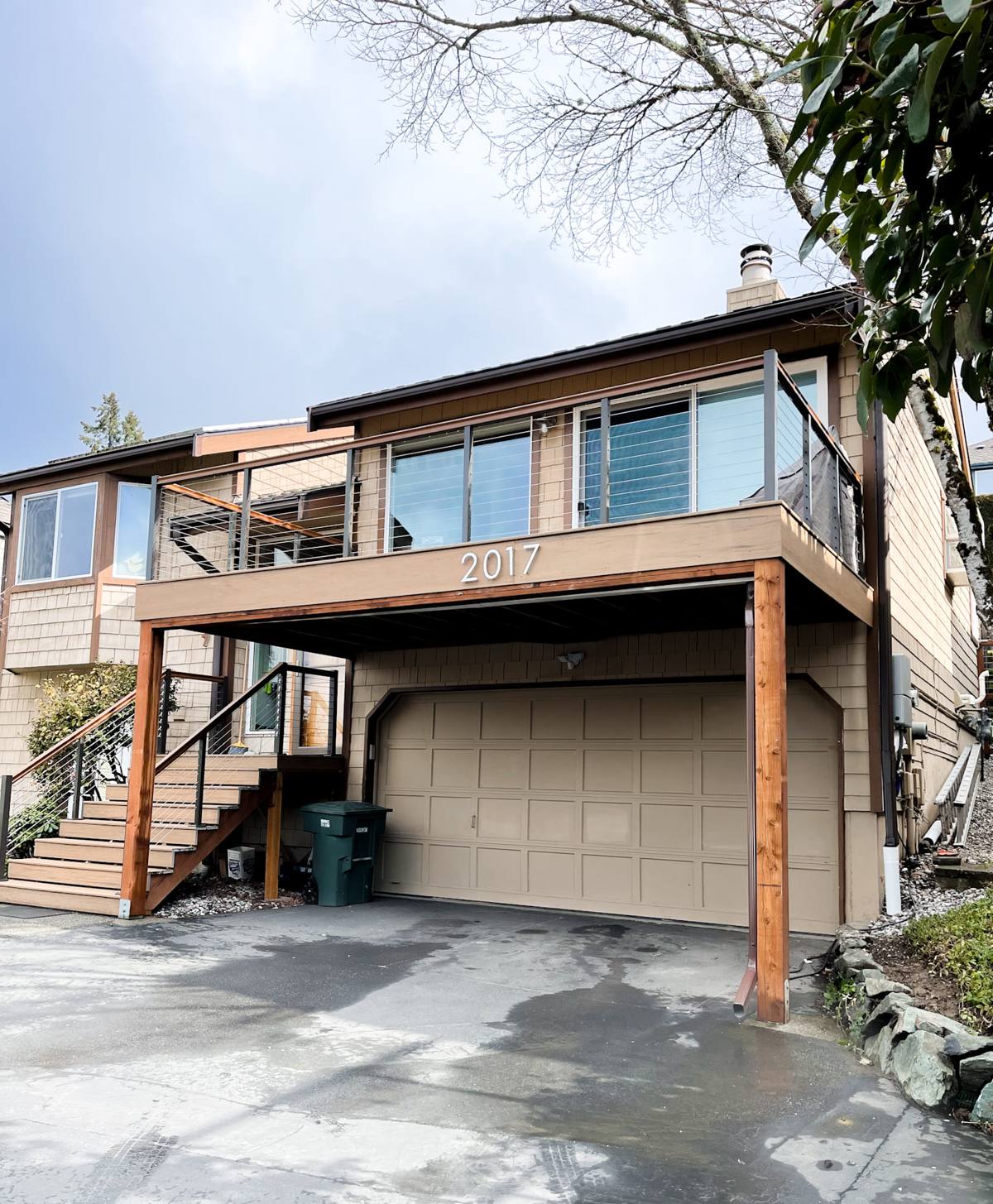
What a Correctly Built Deck Needs in This Climate
Framing and Structure
The framing is the part nobody sees once the decking boards go down, and it's the part that determines whether the deck is still solid in fifteen years or spongy in five. In a shaded, moisture-heavy setting like Sudden Valley, we pay close attention to a few things that get skipped on cheaper jobs: proper flashing where the ledger board meets the house, gapping and blocking that lets air move under the deck instead of trapping standing moisture, and joist protection (tape or coating on the cut ends and top edges, not just the factory-treated faces) so water can't wick into the wood at every screw hole.
Fasteners and Hardware
Standard galvanized fasteners are fine in a dry climate. Here, with rain and damp shade for a large part of the year, we use stainless or high-grade coated fasteners and structural hardware rated for ground-contact, wet-service conditions — especially on ledger bolts, joist hangers, and post bases, since those are the connections holding the whole structure to the house and footings. It costs more up front than the fasteners a big-box deck kit ships with, and it's the difference between hardware that's still tight in twenty years and hardware that's rusting and loosening in eight.
Decking Material
Material choice matters more in a shaded, moss-prone yard than almost anywhere else. Every material below can work in Sudden Valley — the right choice depends on how much sun the deck gets, how much upkeep you want to do, and your budget.
| Material | Upfront Cost | Moss/Moisture Behavior | Maintenance |
|---|---|---|---|
| Pressure-treated wood | Lowest | Needs regular cleaning and sealing in shade or it grows moss and grays fast | Annual cleaning, re-sealing every 2-3 years |
| Cedar | Mid | Naturally rot-resistant but still needs care in constant shade | Periodic cleaning and oil/sealer |
| Composite | Higher | Won't rot, but can still grow surface moss/mildew in deep shade — needs occasional washing | Low — no sealing, occasional wash |
| PVC | Highest | Best moisture and moss resistance of the group; sheds surface growth easiest | Lowest — wash as needed |
We'll walk you through this table in person, looking at your actual site — a deck under a full tree canopy on the north side of the house is a different decision than one that gets afternoon sun.
Moss, Mildew, and Drainage: The Design Details That Actually Matter
Most of the deck failures we get called out for in this area aren't dramatic structural collapses — they're slow moisture problems that nobody noticed until the boards were soft or the railing posts were wobbly. A few design choices head that off:
- Consistent board spacing so water drains through instead of pooling on the surface
- Grading and gap sizing under the deck so airflow can dry out the framing between rain events
- Keeping the deck surface a few inches below door thresholds so wind-driven rain doesn't back up against the house
- Choosing railing and post materials that won't trap moisture against wood framing at the connection points
- Positioning stairs and low spots away from where roof runoff or yard drainage naturally collects
None of this is complicated, but it has to be planned before the first board goes down. Retrofitting drainage into a deck that was built without it usually means tearing up sections of decking — far more expensive than getting it right the first time.
Permits and Sudden Valley's Community Requirements
New decks and significant deck rebuilds typically require a permit through Whatcom County, and depending on the size, height, and whether it's attached to the house, that can mean an inspection at the footing stage and again at final. Sudden Valley is also a covenant community with its own architectural review process for exterior changes, which commonly applies to new decks and major rebuilds. We're not going to guess at your specific covenant requirements here — every property and plan is a little different — but we handle the county permit paperwork as part of the job and can talk through what documentation your project is likely to need before we start, so you're not caught off guard partway through.
Our Process for a Sudden Valley Deck Project
- Site visit. We look at sun exposure, tree cover, drainage patterns, and the condition of anything we're tying into or replacing.
- Design and material walkthrough. We talk through layout, decking material, railing options, and rough budget ranges based on what your site actually needs — not a one-size-fits-all package.
- Written estimate. Clear scope, materials, and price before anything is signed.
- Permitting. We handle the county paperwork and can advise on what your covenant review will likely ask for.
- Build. Proper flashing, wet-service hardware, and drainage-conscious framing as standard practice, not an upgrade.
- Final walkthrough. We go over the finished deck together and cover basic care specific to your site's sun and shade conditions.
Repair, Resurface, or Rebuild? Signs to Watch For
Not every deck problem in Sudden Valley means starting over. A lot of older decks just need the surface addressed while the frame underneath is still sound — but only an honest look at the framing tells you which situation you're in. Watch for:
- Boards that feel soft, spongy, or spring back slowly when you step on them
- Persistent moss or dark staining that comes back within weeks of cleaning
- Gaps opening up around the ledger board where the deck meets the house
- Railing posts that wiggle at the base, not just at the top rail
- Rust streaks running down from screws, bolts, or joist hangers
- Visible daylight or soft wood where support posts meet footings
If it's mostly surface wear on solid framing, resurfacing with new decking (and upgrading fasteners while it's open) is often the more affordable path. If the framing itself is compromised, patch repairs just delay a rebuild and can hide the real problem in the meantime. We'll tell you straight which situation you're looking at.
Why It Matters That We Already Work in Sudden Valley
A crew that's done work in Sudden Valley already knows what the shade and lake proximity do to a deck over time, has a sense of the community's architectural review process, and isn't guessing at drainage and material choices based on generic advice that assumes a sunnier, drier yard. That familiarity shows up in fewer surprises during permitting and a build that's designed for the actual conditions on your property from day one, instead of a standard package that happens to get installed there.
Keeping a New Deck in Good Shape Once It's Built
Whatever material you choose, a yearly rinse to clear moss and debris out from between boards, keeping gutters clear so runoff isn't dumping onto the deck, and a quick look at fastener heads and railing posts each spring will catch small issues while they're still small. We're happy to walk you through a simple care routine matched to your specific deck and site when the job wraps up.
If you're planning a new deck, or you've got one showing its age, we'd be glad to take a look and put together a straightforward, no-pressure estimate — just fill out the form below.