 Bellingham Exterior
 Building New in Sudden Valley? The Windows Only Get One Shot
Sudden Valley is one of the more active pockets of new construction around Lake Whatcom, and most of the lots going up there share the same profile: heavily treed, sloped, and shaded for a good part of the day. That combination changes how a window opening needs to be built, not just what window goes in it. On a new build, the window installation happens once. Once the siding closes over the flashing and the drywall covers the interior trim, there's no going back to fix a sill pan that was skipped or a nailing fin that was sealed in the wrong order. Get it right at framing, and the window will perform for decades. Get it wrong, and the first sign of trouble usually shows up as a stain on the interior sill two or three winters later, long after the crew that installed it has moved on to the next job.
We treat new-construction window installation in Sudden Valley as its own trade skill, separate from window replacement. The techniques, the sequencing with other trades, and the tolerance for error are all different, and we build our process around that.
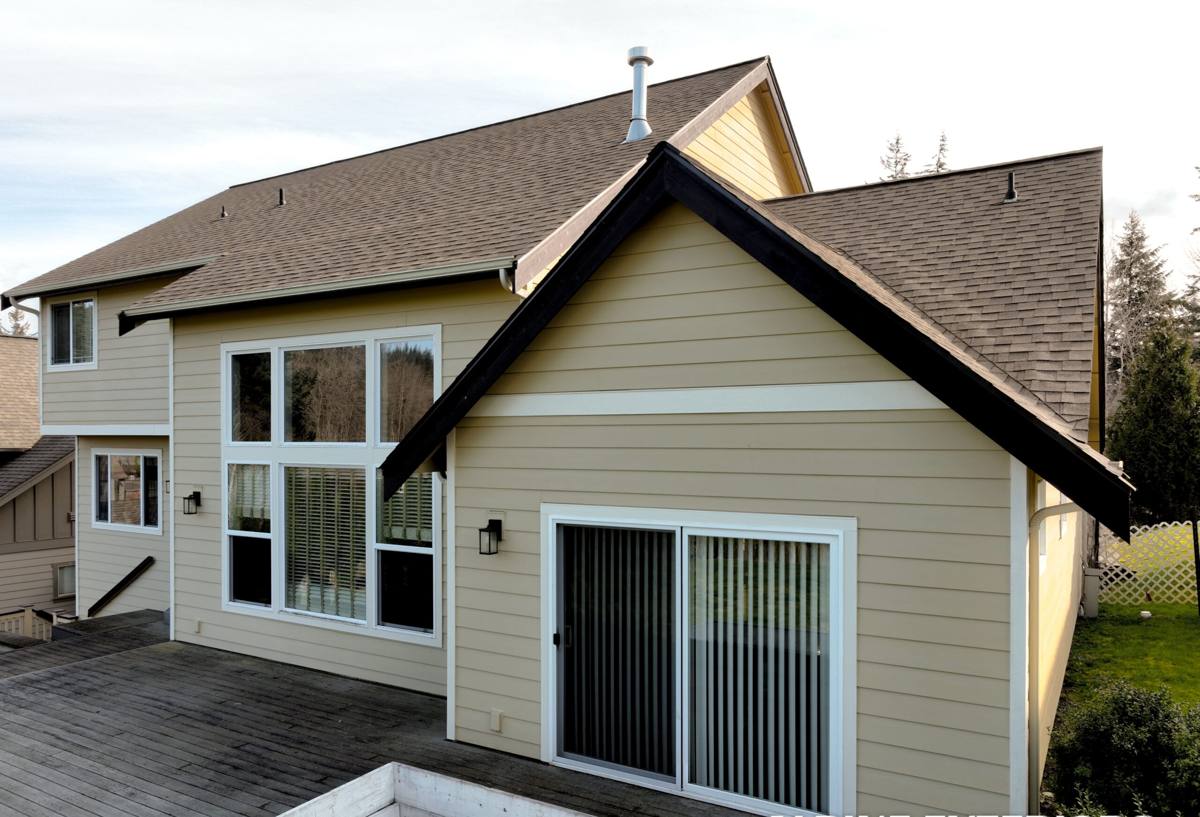
What Whatcom County's Climate Asks of a New Window Opening
Bellingham and the rest of Whatcom County deal with a genuinely wet building climate — driving rain off the Sound, salt-laden air along the coastal areas, and a moss season that can run close to half the year on shaded roofs and siding. Sudden Valley adds its own layer to that: heavy second-growth tree canopy and the humidity that sits over Lake Whatcom keep framing lumber and sheathing damp longer during a build than a more open, sun-exposed lot would. That matters for window installation in two specific ways.
First, the rough opening and the water-resistive barrier around it need to dry properly before the window goes in and gets sealed up. Trapping moisture behind a window on a shaded Sudden Valley lot is a slower, quieter problem than on an exposed lot, and it's also slower to show itself — which is exactly why it needs to be caught during the build, not after.
Second, wind-driven rain in this region doesn't fall straight down. It hits window openings at an angle, which means flashing and sill pans have to manage water that's being pushed sideways and upward under pressure, not just water running down the wall. A window that would perform fine in a drier inland climate can still leak here if the flashing sequence wasn't built for wind-driven rain from the start.
New-Construction vs. Replacement Windows: Not the Same Job
Homeowners sometimes assume "new-construction window" just describes a window that happens to be new. It actually refers to the window's frame design and how it's meant to be installed — and it's a meaningfully different process from replacing a window in an existing wall.
| Factor | New-Construction Install | Replacement Install |
|---|---|---|
| Access to the opening | Fully open stud bay, no siding or interior finish yet | Closed wall — working around existing siding, trim, drywall |
| Window frame style | Nailing-fin frame, fastened directly to sheathing | Flush-fin or insert frame, fitted into the existing opening |
| Flashing sequence | Full sill pan, jamb flashing, and WRB integration built from scratch | Flashing repaired or partially reused; less room to correct existing defects |
| Sealing to the wall assembly | Sealed into the weather-resistive barrier before siding goes on | Sealed against existing siding and trim |
| Margin for error | High — every layer is visible and inspectable before it's covered | Lower — existing water damage or rot may already be hidden |
New construction gives us the advantage of a clean, open opening — but that advantage only pays off if every layer is actually done in the right order. A rushed new-construction install can end up with the same hidden problems as a bad replacement, just built in fresh instead of inherited.
What a Correct New-Construction Install Actually Involves
Sill Pan and Flashing Sequence
Every opening gets a sloped sill pan before the window ever sits in place, so that any water that gets past the window has somewhere to go besides the framing. Jamb and head flashing are then layered in shingle-style order — each piece overlapping the one below it — so water is always directed outward and down, never trapped behind a layer.
Integrating with the Weather-Resistive Barrier
The window's nailing fin has to be woven into the house wrap or building paper correctly: paper laps over the top flashing, tucks under the side flashing, and the whole assembly is taped or sealed as one continuous water plane. A window that's simply caulked to the outside of the WRB, instead of integrated into it, is one of the more common shortcuts we see on rushed builds — and it's invisible once the siding goes on.
Shimming, Fastening, and Insulation
The window needs to sit level, plumb, and square in the opening, shimmed at the right points so the frame isn't racked or stressed once fasteners go in — a stressed frame is harder for sashes to operate smoothly and can strain the seals over time. The gap between the frame and the rough opening gets filled with a low-expansion foam or backer rod system, not packed solid, which would bow the frame inward.
Sealant — Where It Goes and Where It Doesn't
Sealant belongs at specific points in the assembly, not everywhere. The bottom of the window should generally be left able to drain, not fully sealed — a fully caulked sill traps any water that does get in rather than letting it weep back out. Knowing which joints to seal and which to leave open is a detail that separates a window installed correctly from one that just looks finished.
Choosing Windows for a Sudden Valley Lot
Frame Material
Vinyl, fiberglass, and wood-clad frames all show up on new builds around the lake, and each is a legitimate choice with real trade-offs. Vinyl is the most cost-effective and handles moisture well with no maintenance, though it has more thermal movement over large sizes. Fiberglass costs more but holds its shape better on larger openings and takes paint if you want a custom color. Wood-clad frames give the most traditional interior look but carry more upkeep responsibility on the exterior cladding over time, which matters in a climate that grows moss on anything shaded and static for long. We'll walk through which fits your design and budget rather than push one option across the board.
Glass Package for Shaded Lots
Most Sudden Valley lots get partial to heavy shade from surrounding trees, which changes the glass conversation compared to a wide-open, south-facing lot. Solar heat gain is less of a concern under a tree canopy, so the priority shifts toward a solid low-E coating for winter heat retention and condensation resistance rather than heat-blocking performance. Argon-filled double-pane units are the standard baseline; triple-pane is worth discussing on north-facing rooms or if the home is aiming for a tighter overall energy target.
How We Handle a New-Construction Window Job
- Framing walkthrough: we check rough opening sizes against window schedules before anything is installed, catching sizing conflicts while they're still cheap to fix.
- Sill pan and flashing install: built to each opening before the window goes in, inspected as we go rather than covered immediately.
- Window set and shim: leveled, squared, and fastened per the manufacturer's schedule — not just "screwed until it feels tight."
- WRB integration and taping: house wrap and flashing tape are layered in the correct shingle order around the fin.
- Insulation and interior seal: low-expansion foam or backer rod at the perimeter gap, sized to the window manufacturer's spec.
- Final exterior seal and walk-through: operation checked on every unit — smooth swing or slide, tight latch, no binding — before we sign off.
On a new build we coordinate directly with the builder or general contractor's schedule, since window installation sits between framing and siding and any delay ripples through the rest of the trades. We show up on the day the opening is ready, not before the sheathing is dry and not after siding has already started closing things in.
Mistakes We See on New Builds Around the Lake
- Windows set before the WRB is fully in place, forcing flashing to be added around it instead of integrated with it
- Sill pans skipped on the assumption that "the window's own seal will handle it"
- Fully caulked sills that trap incidental water instead of letting it drain
- Foam packed solid in the perimeter gap, bowing the frame and binding the sashes
- Flashing tape applied in the wrong lap order, directing water inward instead of out
- Windows installed out of level or square to save time, leaving locks and rollers to fight it for years
None of these show up on a walk-through the day the windows go in. They show up in year two or three, as a stuck sash, a musty smell in a wall cavity, or a stain that wasn't there before. That's exactly why the sequence matters more than the finished appearance on day one.
Why It Matters to Hire a Crew That Already Works Sudden Valley
Sudden Valley is its own kind of build environment — private roads, lake-adjacent lots, mature tree cover, and terrain that's rarely flat. A crew that's worked there before already knows what to expect from access, staging materials on a sloped lot, and coordinating around a community with its own traffic and site rules. More importantly, they've seen how those shaded, humid lots behave over a full wet season and build accordingly, rather than installing the same way they would on an open lot in town. That local pattern recognition is the difference between a window installed to a generic standard and one installed for the conditions it will actually sit in.
What Affects the Cost of New-Construction Window Installation
| Cost Factor | Why It Moves the Price |
|---|---|
| Number and size of openings | More units and larger spans mean more flashing, labor, and material |
| Frame material | Vinyl is the most economical; fiberglass and wood-clad cost more up front |
| Glass package | Standard low-E double-pane vs. triple-pane or specialty coatings |
| Site access | Sloped or wooded lots can slow staging and material handling |
| Coordination timing | Installing on schedule with the builder avoids delay costs; rushed or out-of-sequence work often costs more to correct |
| Custom shapes or sizes | Non-standard openings require custom units and more flashing detail |
We give straightforward, itemized pricing based on your actual window schedule rather than a flat per-window rate that ignores site conditions — a shaded, sloped Sudden Valley lot and an open in-town lot don't cost the same to build on, and the estimate should reflect that honestly.
If you're framing a new home in Sudden Valley or planning one, we're happy to walk the site, review your window schedule, and put together a straightforward, no-pressure estimate — just fill out the form below.