 Bellingham Exterior
 Siding Repair in Sudden Valley: A Different Kind of Job
A siding repair call is not a small version of a full re-side. It's a diagnostic job first and a construction job second — the work only turns out right if whoever's doing it correctly identifies why a section failed before they touch a single board. That distinction matters more in Sudden Valley than it does on a lot of Bellingham properties, because the combination of salt air working in off the water, driving rain, and a moss season that runs most of the year gives siding more ways to fail here than it has on a drier, more open site. We do repair work throughout Sudden Valley regularly enough to recognize the patterns specific to this community, and this page is about that one service — siding repair, done right, for homes in this part of Whatcom County.
This isn't our page on full siding replacement, and it isn't our case for why we install James Hardie fiber cement and nothing else, though that standard shapes what we recommend when a repair calls for new material. It's specifically about what a correct repair looks like on a Sudden Valley home, how we decide what's actually needed, and why a crew that already knows this area does that job differently than one seeing it for the first time.
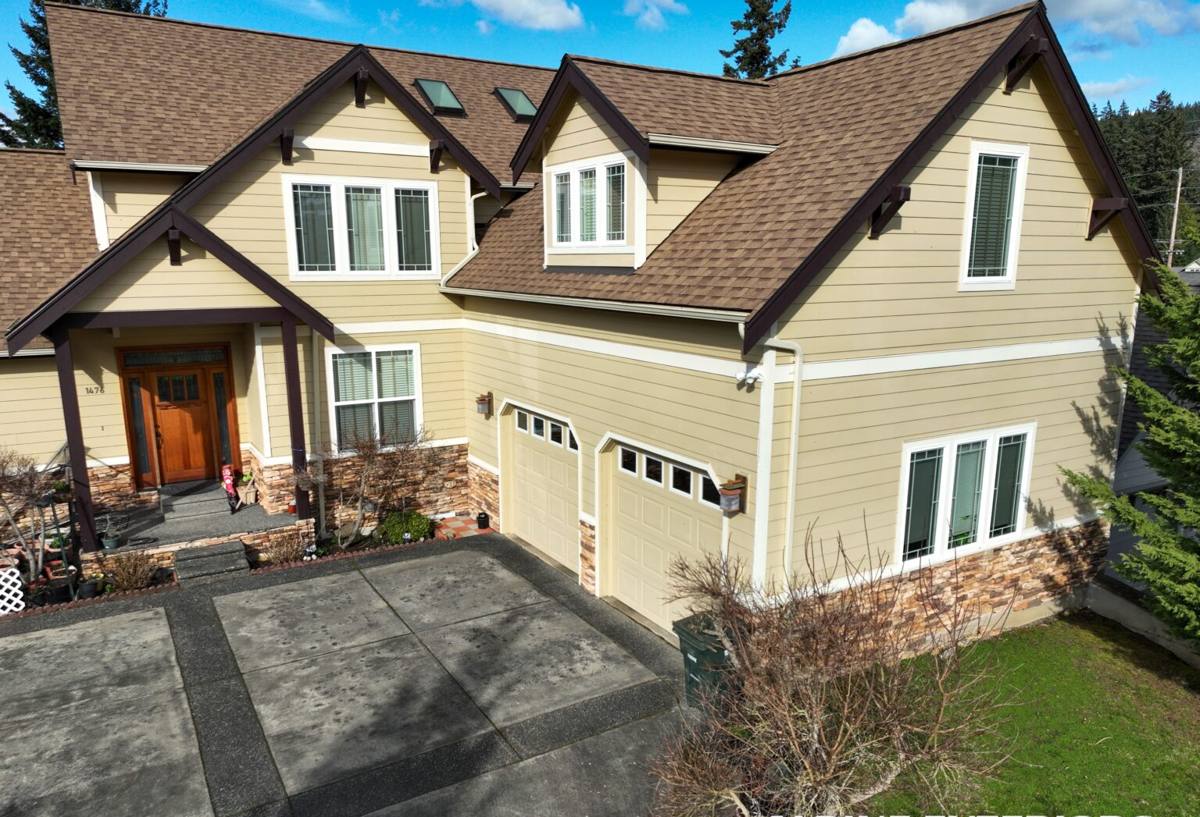
What Salt Air, Driving Rain, and a Long Moss Season Do to Siding
Salt Air Working Its Way Inland
Whatcom County sits on a marine coastline, and prevailing winds carry salt-laden air well past the shoreline, reaching inland communities like Sudden Valley on top of the humidity already coming off Lake Whatcom. That salt load doesn't rot siding by itself, but it accelerates corrosion in exposed fasteners, trim flashing, and hardware — and once a fastener starts corroding, the seal around it goes with it, which opens a small, steady path for water to get behind the siding.
Wind-Driven Rain Finding the Weak Points
Rain in this region rarely falls straight down. Wind pushes it sideways into lap joints, under trim, and into any gap in the water management system behind the siding, and a hilly, tree-lined community like Sudden Valley sees that force hit different walls of the same house unevenly depending on elevation and orientation. A repair that only addresses the visible damage without checking how water is actually reaching that spot tends to fail again in the same place within a season or two.
A Moss Season That Never Fully Ends
Shade, humidity, and mild temperatures are the exact conditions moss and mildew need, and Sudden Valley's tree cover keeps those conditions active for most of the year. Roofs usually show it first, but porous or already-compromised siding picks up moss and mildew too, especially on north-facing walls that rarely see direct sun. Once organic growth takes hold on a section of siding, it holds moisture against the surface longer than bare siding would, which speeds up whatever damage is already underway underneath.
Signs Your Siding Needs Repair, Not Just a Cleaning
Some siding problems are cosmetic and some are structural, and telling the difference from the ground isn't always obvious. These are the signs worth a closer look before assuming a pressure wash or a coat of paint will solve it:
- Soft or spongy spots when you press on a panel, especially near the bottom edge or around window and door trim
- Visible gaps, cracking, or separation at butt joints, corners, or where siding meets trim
- Bubbling, peeling, or discolored finish that keeps coming back in the same spot after cleaning or repainting
- Staining on interior walls or ceilings near an exterior wall, which usually means water is already past the siding
- Missing, loose, or visibly corroded fasteners and trim pieces
- Moss or mildew that returns quickly to the same section even after it's cleaned off
- Warping, buckling, or a panel that no longer sits flat against the wall
Repair or Replace? How We Make That Call
Not every damaged section needs to come out, and not every repair is worth doing instead of a broader replacement. The right call depends on how far the damage has spread and what's driving it.
| Situation | Usually Points To | Typical Approach |
|---|---|---|
| Isolated damage at one corner, joint, or penetration | A localized flashing or sealant failure | Targeted repair of the affected section and the water management detail behind it |
| Soft spots spreading along multiple panels on one wall | A wall-level moisture problem, often tied to grading, gutters, or a failed barrier | Broader section replacement with the underlying cause addressed first |
| Damage concentrated on one or two shaded, north-facing elevations | Chronic moisture exposure from limited sun and heavy tree cover | Repair with attention to drainage detailing, since the same exposure will keep working on the wall |
| Widespread soft spots, warping, or finish failure across most elevations | Siding nearing the end of its service life, or an original installation issue | Full re-side is usually the more cost-effective long-term option |
| Damage limited to trim, fascia, or a small area after storm impact | A discrete, one-time event rather than an ongoing condition | Straightforward repair, no broader replacement needed |
What a Correct Siding Repair Actually Involves
Finding the Real Source, Not Just the Symptom
A soft panel or a stained corner is a symptom. The actual problem is almost always upstream of it — a gap in flashing, a failed sealant joint, a downspout dumping water against a wall, or a barrier detail that was never done correctly in the first place. Pulling the damaged section and stopping there, without tracing where the water actually got in, usually means the same spot fails again within a wet season or two. We open up enough of the wall to see the real cause before we decide what the repair needs to include.
Matching Material, Profile, and Finish
A repair that stands out visually from the surrounding siding is a repair done without much care for the finished result. When we're patching into existing James Hardie siding, matching the plank width, exposure, and ColorPlus finish keeps the repair close to invisible. When the existing siding is a different material, we're upfront about what will and won't blend seamlessly, and we walk through the realistic options — including where a full-wall or full-house re-side in fiber cement makes more visual and long-term sense than trying to patch a mismatched material forever.
Restoring the Water Management System, Not Just the Panel
The siding itself is only the visible layer. Behind it is a system of building wrap or drainage plane, flashing, and fastening that's supposed to keep water moving out and away from the wall assembly. A repair that reinstalls new siding over a torn or improperly lapped barrier hasn't actually fixed anything — it's just covered it back up. Every repair we do includes putting that underlying system back together correctly, not just closing up the visible gap.
Repairing Existing Siding vs. Repairing With James Hardie
Plenty of Sudden Valley homes we get called out to aren't wearing James Hardie siding — we see cedar, primed wood, vinyl, and engineered wood products just like anywhere else in the neighborhood. We'll diagnose and repair what's actually on the wall, and we're straightforward about what each material can realistically take. Where a repair calls for a full section of new siding, though, our standard is James Hardie fiber cement, for the same reasons we install it on every full re-side: it doesn't have a wood-fiber core to protect at cut edges, the ColorPlus finish is baked on rather than field-applied, and the HZ5 formulation is built for exactly the kind of sustained wet-weather exposure this area gets. If a repair is small enough to blend into existing non-Hardie siding, we'll tell you that honestly rather than pushing an unnecessary upgrade. If the damage is extensive enough that a section-by-section patch stops making sense, we'll say that too.
Our Siding Repair Process in Sudden Valley
- On-site inspection: We look at the damaged area and the wall assembly around it, not just the spot that was reported, since related damage often extends further than what's visible from the ground.
- Diagnosis: We identify the actual source of the moisture or damage — flashing, sealant, drainage, or an installation detail — before recommending a scope of work.
- Written scope and estimate: You get a clear explanation of what we found, what we recommend, and why, before any work starts.
- Repair execution: We remove only what needs to come out, correct the underlying water management detail, and install matched or new material to spec.
- Final check: We confirm the repair ties in cleanly with the surrounding siding and that flashing and drainage details are functioning as intended before we call the job done.
Why a Crew That Already Works Sudden Valley Matters
Sudden Valley is a private community with its own internal road network and homeowners association, and a crew that already works here regularly isn't learning those logistics on your job. That familiarity extends past scheduling and access, though. It shows up in knowing that a wall facing a particular direction on a heavily wooded lot is going to stay damp longer than the same wall on a more open property a few miles away, and in recognizing which failure patterns are common on shaded, lakeside homes versus what's typical elsewhere in Bellingham. A repair crew that's seen enough Sudden Valley homes knows to check the drainage detailing on a shaded wall even if the visible damage looks minor, because that's the wall where a small problem tends to come back.
Before You Hire Someone for a Siding Repair
- Ask them to explain what caused the damage, not just what they plan to replace
- Confirm they'll open up the wall enough to check the barrier and flashing behind the damaged section, not just swap panels
- Ask how they'll match material, profile, and finish to your existing siding, and where an exact match isn't realistic
- Confirm current Washington contractor licensing and active liability insurance
- Get a written scope of work before anything is torn off the wall
- Ask about experience with HOA or private-road communities if that applies to your property
If you're seeing soft spots, staining, or siding damage anywhere on a Sudden Valley home, we're glad to come take a look and give you a straight read on what's actually going on and what it would take to fix it right. Reach out below for a free, no-pressure estimate.